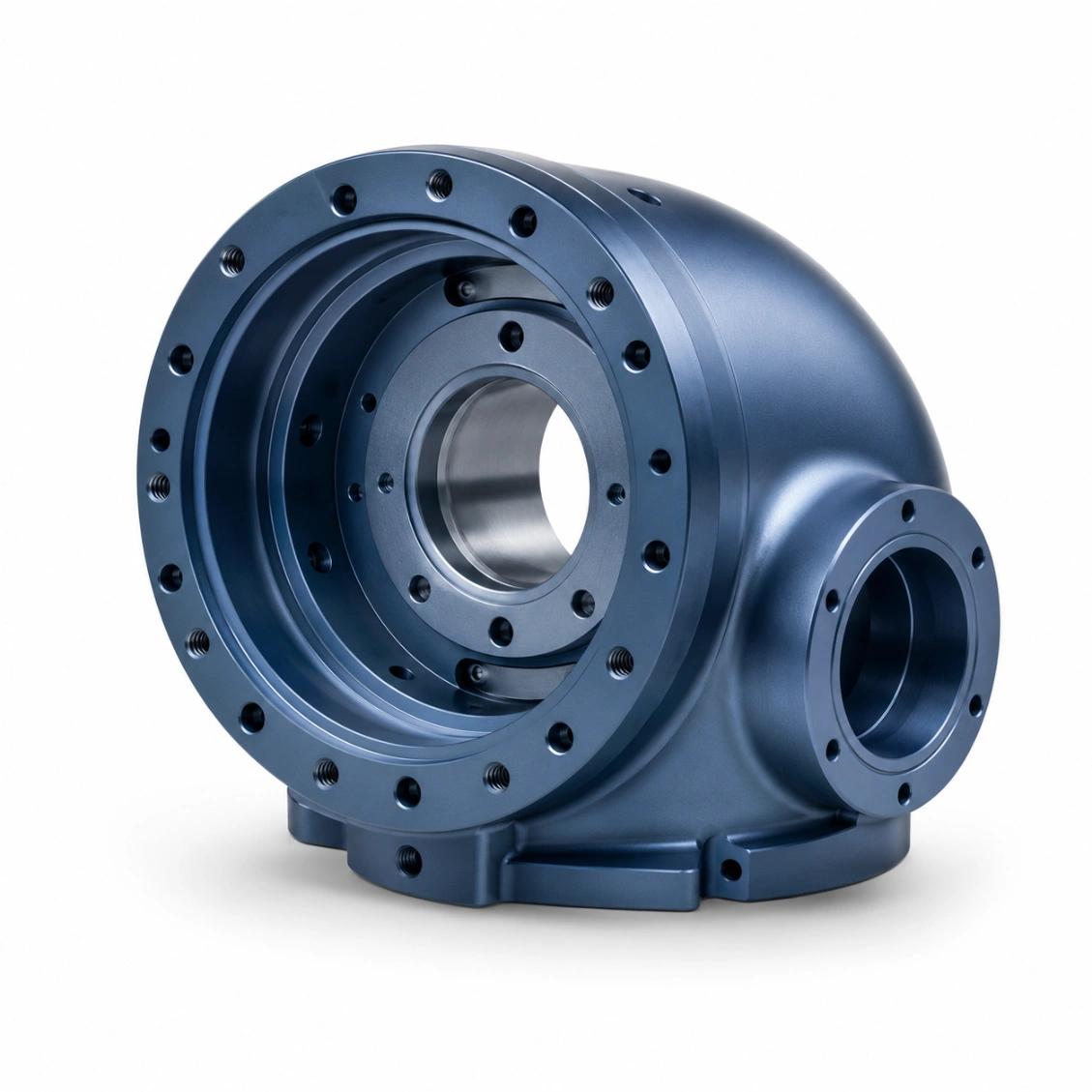
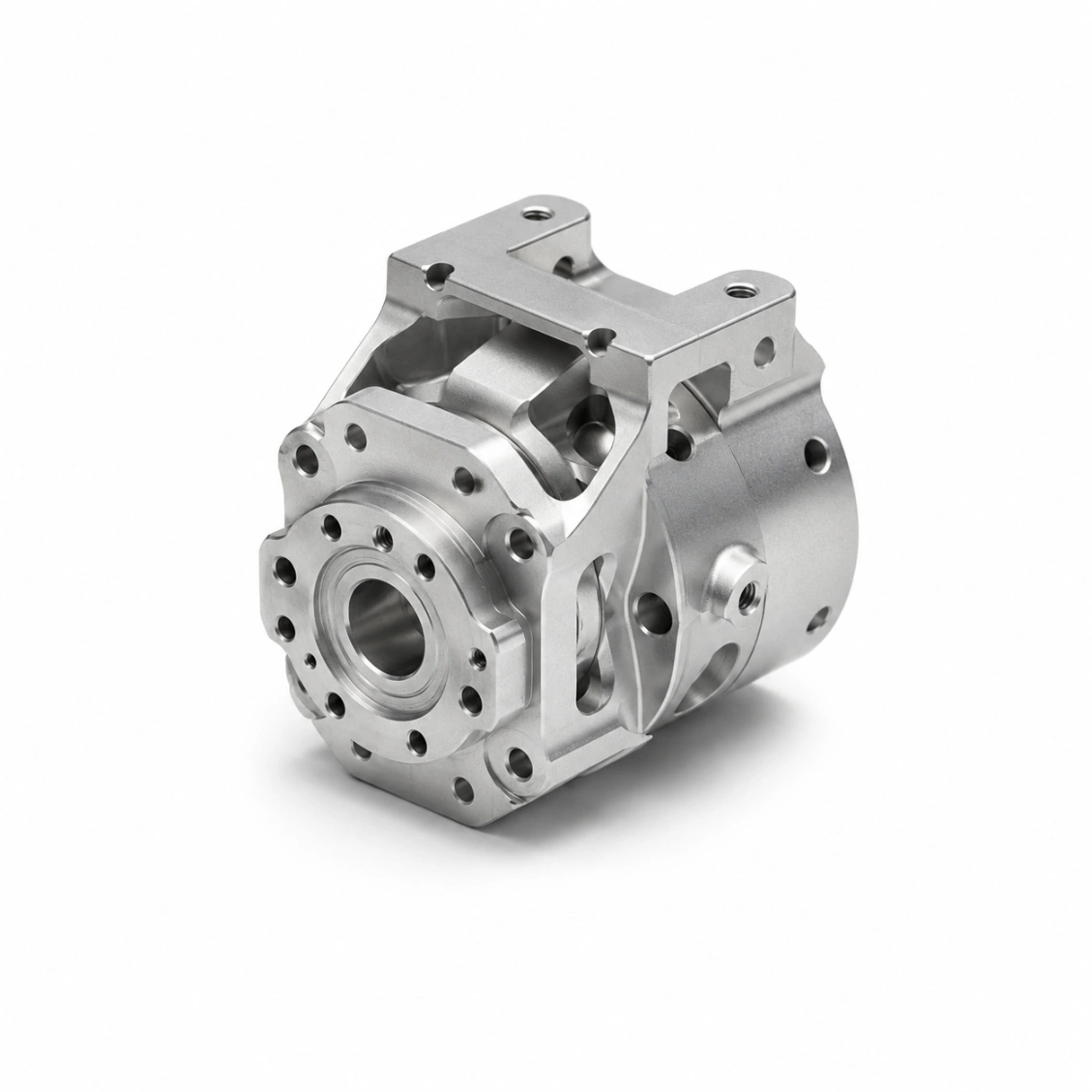
Custom robot joint housings with precision bearing bores (IT5), harmonic drive flanges, reducer seats,
and lightweight hollowed walls — all in one 5-axis setup. Concentricity ≤ 0.005 mm, Al 7075 or Ti
Grade 5.
A robot joint housing must simultaneously provide a precision bearing bore, a reducer mounting flange, a
lightweight hollow body, and a structural load path — all concentric within 0.005 mm.
⦿
Bearing Bore Accuracy
Bearing bores machined to IT5 — OD k5/m5 for rotating inner race. Concentricity between the input
bearing bore, output flange face, and reducer seat bore must be ≤ 0.005 mm TIR.
⚡
Reducer Interface
Harmonic drive, cycloidal, or planetary reducer seats require precise flange face runout (≤ 0.005 mm)
and bolt pattern position (±0.01 mm) to ensure zero-backlash assembly.
⚖️
Lightweight Design
Robot joint housings must minimise rotational inertia. Internal pocket milling removes non-structural
material while maintaining minimum wall thickness at all load-bearing zones.
Our Work
Robot Joint Housings We've Made
Shoulder, elbow, and wrist joint housings for collaborative and industrial robots.
"The CMM report matched our incoming inspection perfectly. Every critical dimension was within spec on
the first article. Lead time exactly as quoted."
AK
Alex K.
Mechanical Engineer · Germany
★★★★★
"HXC's DFM review caught a tolerance stack issue before we committed to production. The finished parts
were perfect and batch consistency was excellent."
SL
Sophie L.
Design Engineer · France
★★★★★
"We've sourced over 30 part numbers from HXC across three years. Quality is consistent, lead times are
reliable, and the engineering team is always responsive."
JT
James T.
Senior Buyer · UK
FAQ
Robot Joint Housing — FAQ
Common questions from engineers and procurement teams — answered by our manufacturing team.
A robot joint housing is the structural enclosure of a robot axis joint — it holds the
bearings, provides the interface for the reducer (harmonic drive, cycloidal, or planetary), and forms
the structural connection between adjacent robot links. Its bearing bore, reducer seat, and output
flange must all be concentric within a few micrometres for zero-backlash, smooth rotation.
Robot joint bearing bores: IT5 tolerance class — for angular contact bearings and
cross-roller bearings used in robot joints, the bore must be K5 or M5 (slight interference with the
bearing outer race) for a fixed outer race, or H5 for a rotating outer race. All bore tolerances are
verified on the CMM and reported.
All critical concentric features — input bearing bore, output flange face, and reducer seat bore — are
machined in a single 5-axis setup without rechucking. This eliminates the setup error
that would occur in multi-operation machining, achieving concentricity ≤ 0.005 mm TIR between all
features.
HXC has machined interfaces for all major robot reducer types: Harmonic Drive (HDSI, Ovalo,
SPINEA); Cycloidal (Nabtesco, Sumitomo); Planetary (Neugart, Stober,
Apex). Provide the reducer model number and we'll machine to the manufacturer's published
interface drawing — no re-design needed.
Combining Al 7075 with internal pocket milling: 40–50% weight reduction vs a solid Al
housing of the same envelope. Ti Grade 5 hollow housing: 30% lighter than Al solid with 60% higher
specific stiffness — used in aerospace and high-performance collaborative robots.
The first-article CMM program (measuring all critical dimensions — bearing bores, flange faces, reducer
seat, and inter-feature concentricity) is saved and re-run on 100% of parts in small
batches and on a statistical sample basis for large production runs. Out-of-spec parts are
quarantined before shipment.
Hard anodizing (Type III, 15–25 µm) on Al 7075 is standard — provides wear resistance
on housing faces and corrosion protection, while only adding 15–25 µm to outside surfaces (not
affecting bore tolerances, which are machined to compensate). Passivation is standard for SUS316L
housings.
Prototype (1–3 pcs): 7–10 days. Small production batch (50–200 pcs): 12–18 days. Large
production run: 18–28 days depending on complexity and CMM inspection load.
Get a Quote
Send Your Drawing. Get a Quote.
Every enquiry includes a DFM review — tolerance feasibility, material confirmation, and process approach confirmed before production starts. MOQ 1 piece.
24hr
Quote Response
MOQ 1
Prototypes OK
ISO
9001:2015
📐
DFM Review on Every Enquiry
Tolerance feasibility, fixturing strategy, and material confirmation. Specific, actionable feedback — not generic pushback.
🎯
First Article Inspection — Standard
FAI report on every new run. Material certs and surface treatment certs included with every shipment.
🔄
Same Process: Prototype to Production
Process plan from your prototype applies to production batches. No re-qualification when you scale.
⚙
3 / 4 / 5-Axis CNC + Turning
Complex structural parts, shafts, housings, and transmission components. Metals and engineering plastics.
ISO 9001:20153/4/5-Axis MillingCNC TurningCMM InspectionGlobal Delivery