
Advanced CNC Machining
5-Axis CNC
Machining Service
Precision 3+2 and simultaneous 5-axis machining for complex geometries, multi-sided parts, deep cavities, and high-accuracy components.
Simultaneous 5-Axis & 3+2
Fewer Setups, Higher Accuracy
Complex Surfaces & Multi-Angle Features
Superior Surface Finish
Prototype to Production

Capability
5-Axis Simultaneous

Setups Reduced
1 vs. 4–6
Core Value
Why 5-Axis CNC Machining for Complex Parts
Standard 3-axis machining reaches its limits on complex, multi-face parts. Here is the problem-and-solution reality of choosing 5-axis.
The Challenges with Standard Machining
✕
Multiple setups accumulate errorEvery re-clamping introduces positioning deviation — on multi-face parts this compounds across all features.
✕
Deep cavities and undercuts are inaccessibleA vertical 3-axis spindle cannot reach angled walls, undercuts, or deep pockets without custom fixtures or multiple tilts.
✕
Long tool reach causes vibrationReaching deep features requires long tool extensions — increasing deflection, chatter, and poor surface finish.
✕
Complex curved surfaces need multiple programsFree-form surfaces and smooth transitions between faces require re-setup and often manual blending — adding cost and time.
✕
Multi-process workflow inflates lead timeParts moving through multiple machines, queues, and re-fixturings multiply both cycle time and handling risk.
How 5-Axis Solves These Problems
✓
One setup, all facesMulti-face geometry completed in a single clamping — positional relationships between features are inherently more accurate.
✓
Tool can approach from any angleTwo rotary axes tilt the part or spindle to access undercuts, angled walls, and deep pockets without special fixtures.
✓
Shorter tools, less vibration5-axis positioning reduces required tool overhang — shorter, stiffer tools produce better finishes and hold tighter tolerances.
✓
Continuous surface machiningSimultaneous 5-axis interpolation produces smooth, continuous contoured surfaces in a single pass without repositioning steps.
✓
Shorter cycle time and lower costFewer setups means less machine time, less handling, less risk of damage — complex parts are often cheaper on 5-axis overall.
Mode Comparison
3+2 Positional vs Simultaneous 5-Axis
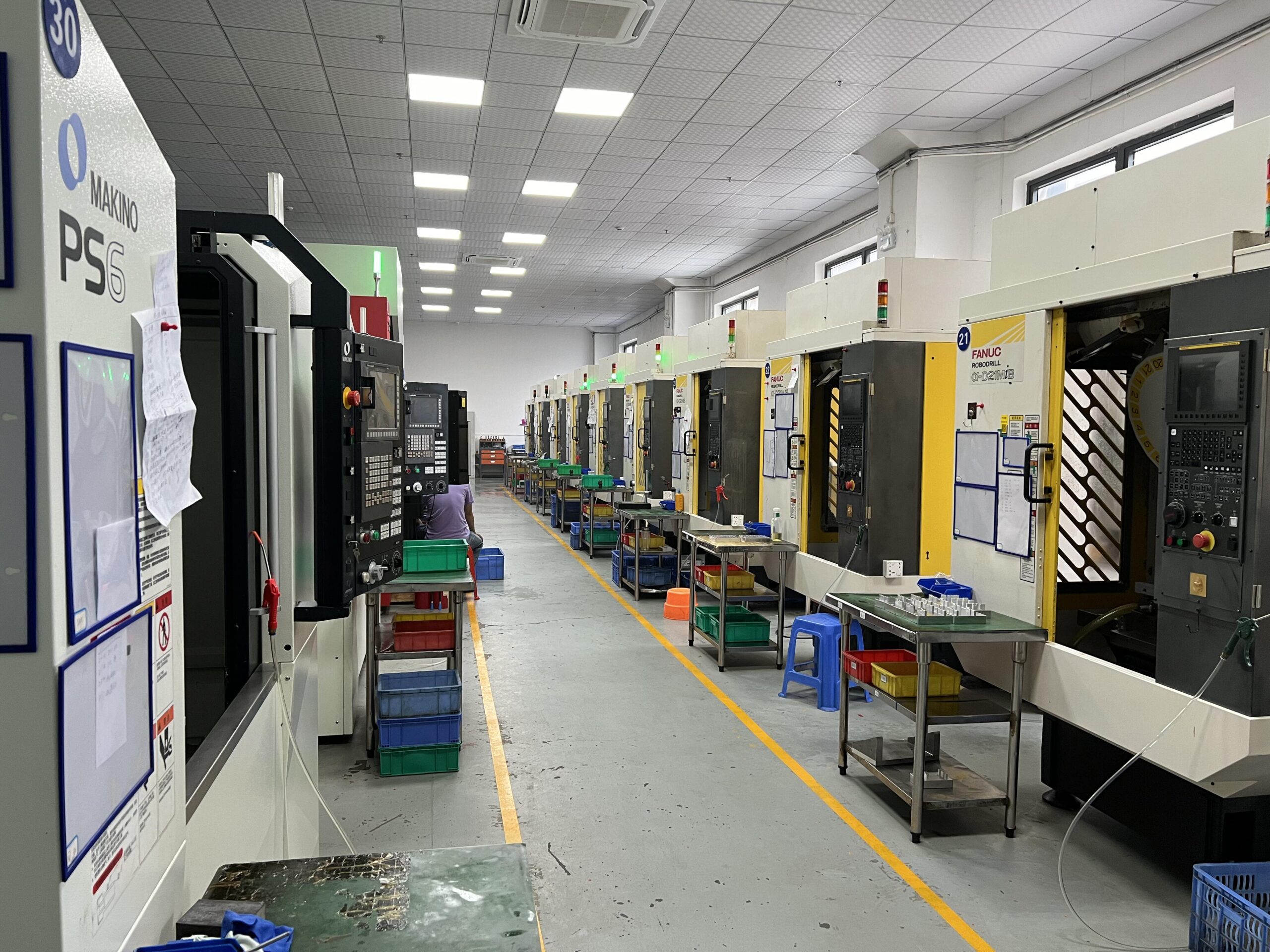
3+2 Positional Machining
Index, Lock, Mill
The two rotary axes position the workpiece at a defined angle, then lock in place. Standard 3-axis machining is then performed in that orientation. Simpler programming, lower CAM complexity, highly cost-effective for angled features.
Angled holes and tapped features on compound angles
Multi-sided parts requiring indexed face access
Side milling features unreachable with 3-axis
More economical than simultaneous for qualifying parts
More stable and predictable for non-complex geometry
Best For
Angled HolesMulti-Sided Parts
Side MillingIndex Features
Simultaneous 5-Axis
All Axes Move Together
All five axes interpolate simultaneously, allowing the tool to maintain optimal cutting contact across continuously changing surfaces. This is the highest level of CNC capability — essential for impellers, turbine blades, and complex medical components.
Free-form surfaces and organic 3D contours
Impellers, turbine blades, and aerospace structures
Medical components with complex curved geometry
Mold cavities with deep undercut surfaces
Best surface finish on continuously curved geometry
Best For
ImpellersTurbine Blades
Medical PartsComplex Molds
Part Gallery
Typical Parts for 5-Axis CNC Machining


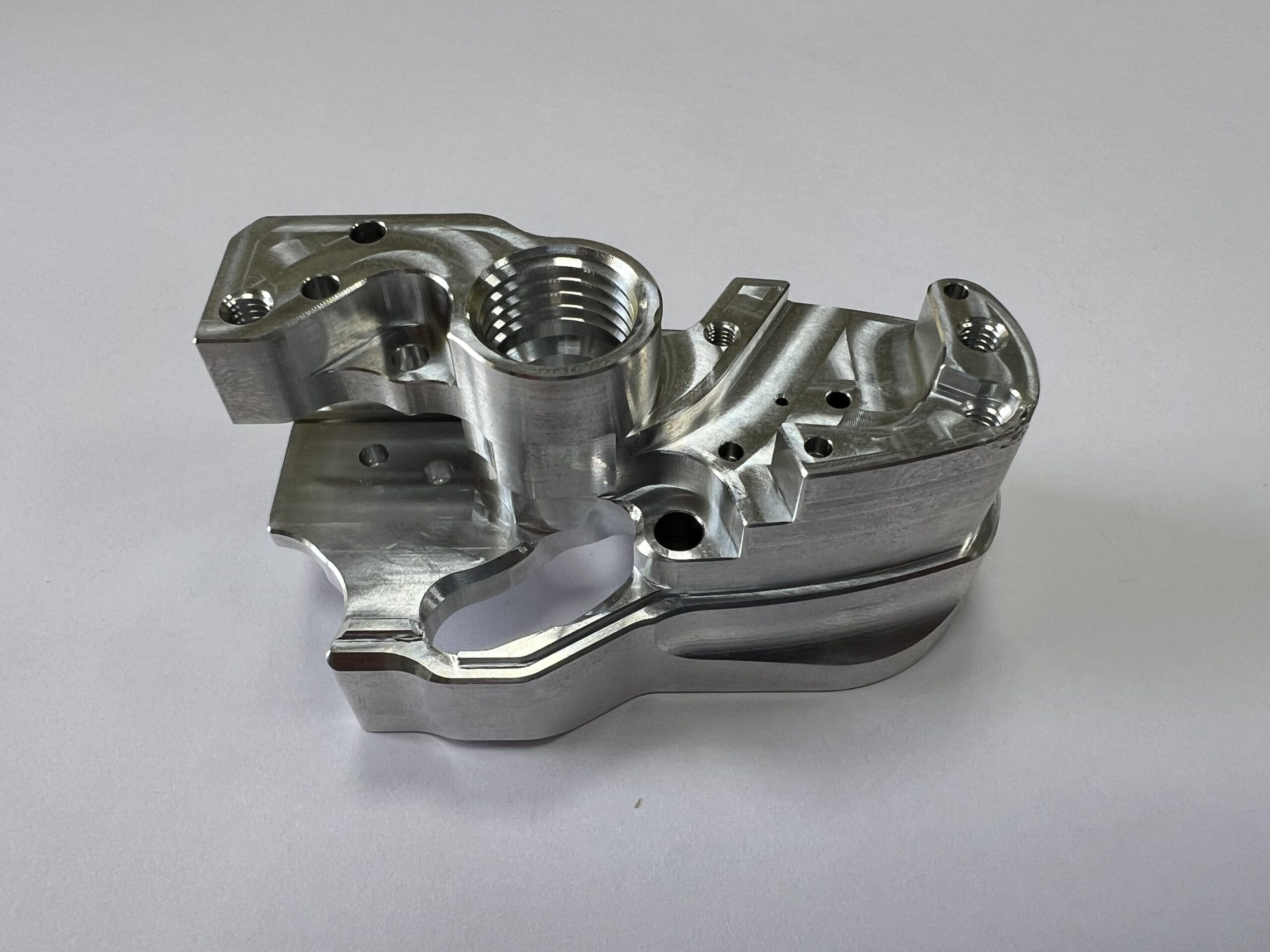


Impellers & turbine blades
Aerospace brackets
Medical device components
Precision molds & dies
Multi-face housings
Complex manifolds
Robot joint parts
UAV structural frames
Deep cavity aluminum parts
Parts with undercuts
Capability Highlights
5-Axis Machining Advantages
CAP / 01
5X
Multi-Sided Machining in One Setup
Complete all faces and angular features in a single clamping. Eliminates positional error from re-fixturing — essential for parts where face-to-face relationships are toleranced tightly.
CAP / 02
∿∿
Complex Surface Machining
Simultaneous 5-axis interpolation produces smooth, continuous contoured surfaces — impellers, turbine profiles, and freeform organic shapes that are impossible on 3-axis machines.
CAP / 03
⬛
Deep Cavities & Undercuts
Rotary axis tilt allows the tool to reach into deep cavities and access undercut features from optimal angles — removing the need for special fixtures or multi-step manual repositioning.
CAP / 04
RT
Shorter Tools, Better Rigidity
5-axis tilt minimizes required tool overhang. Shorter, stiffer cutters vibrate less, deflect less, and hold tighter tolerances — especially on deep features where long tools would fail.
CAP / 05
◎
Reduced Re-Clamping Errors
Each time a part is repositioned, a small datum shift is introduced. On multi-face parts with tight positional tolerances, eliminating setups is the single most effective way to improve accuracy.
CAP / 06
Ra
Better Finish on Complex Geometry
Optimal tool-to-surface angle maintained throughout the cut produces smoother finishes on curved geometry. Reduces or eliminates post-machining manual polishing on complex contoured parts.
Material Selection
Materials for 5-Axis Machining
6061
Al 6061-T6
General purpose · Housings & brackets
7075
Al 7075-T6
High-strength · Aerospace & UAV structures
2024
Al 2024-T3
Fatigue resistant · Aircraft structural parts
MIC
Al MIC-6
Cast tool plate · Precision base plates
304
Stainless 304/316L
Corrosion resistant · Medical & food
17-4
17-4PH Stainless
High-strength · Aerospace structural
4140
Alloy Steel 4140
Heat-treatable · High-strength parts
H13
Tool Steel H13
Hot-work molds · Die inserts
GR2
Titanium Grade 2
Pure Ti · Medical & chemical
TC4
Ti-6Al-4V / TC4
Aerospace & implant grade · High-strength
Ni
Inconel 625 / 718
Nickel superalloy · High-temp parts
Co
Cobalt Alloys
Medical implants · Turbine parts
PEEK
PEEK
250°C+ · Semiconductor & medical
POM
Delrin / POM
Low friction · Precision mechanical parts
PTFE
PTFE / Teflon
Chemically inert · Seals & valve seats
PEI
Ultem / PEI
High-temp · Medical & aerospace
Technical Specifications
5-Axis Technical Capability
Tolerance
±0.005 mm
Achievable on critical features with CMM verification
Axes
3+2 & 5-Axis
Both positional and simultaneous 5-axis modes
Setup Reduction
1 vs 4–6
Complex multi-face parts in a single clamping
Surface Finish
Ra 0.4 μm
On curved contoured surfaces, standard achievable
Part Complexity
Unlimited
Free-form surfaces, deep cavities, undercuts, compound angles
Quote Turnaround
24 hrs
DFM review and 5-axis machining strategy included

Surface Quality
Better Surface Quality on Complex Geometry
One of the most significant — and underappreciated — advantages of 5-axis machining is the improvement in surface finish on complex curved and angled geometry. This is a direct consequence of toolpath geometry and tool engagement conditions.
∿
Smoother transitions on contoured surfaces
Simultaneous axis interpolation maintains consistent cutter contact angle throughout the toolpath — eliminating the stepped transitions that occur with 3-axis point machining of curved surfaces.
RT
Reduced vibration through shorter tool projection
5-axis tilt allows shorter tool-to-surface reach. Shorter cutters are stiffer — less chatter, less surface waviness, and tighter tolerance capability at depth.
◈
Less manual polishing on complex shapes
Better as-machined surface quality on impellers, mold cavities, and multi-face housings reduces — or eliminates — post-machining manual finishing operations.
◎
Consistent finish across multiple faces
Single-setup machining ensures the same cutting conditions — speed, feed, tool — are applied consistently across all faces, producing uniform finish without manual blending at parting lines.
Applications
5-Axis Machining for Demanding Industries
Aerospace
Structural brackets, connectors, guide vanes
Medical
Surgical instruments, implant mating parts
Robotics
Joint housings, end-effector structures
Semiconductor
Vacuum chambers, high-flatness parts
Automotive
Performance housings, complex brackets
UAV / Drone
Lightweight complex structural frames
Mold & Die
Mold cavities, die inserts, complex cores
±0.005mm
Precision Tolerance
5-Axis
Simultaneous & 3+2
Ra 0.4μm
Surface Finish
24hr
Quote Turnaround
Design Guidance
When to Choose 5-Axis Instead of Standard Milling
✓
Multiple angled faces on a single part
If your part requires features on 3 or more faces at different angles, 5-axis eliminates the setups that would otherwise be required.
✓
Complex curved or free-form surfaces
Impeller blades, turbine profiles, organic housing contours, and smooth transitions between faces are 5-axis territory — 3-axis produces visible scallops.
✓
Deep cavities or undercut features
Features a vertical spindle cannot reach without tilting — undercuts, angled interior walls, and deep pockets — are addressable with 5-axis positioning.
✓
Tight positional tolerances between multiple faces
When bore-to-bore, face-to-face, or pin-to-pin dimensions must be held across different part faces, single-setup 5-axis machining is far more reliable than serial re-fixturing.
✓
Parts requiring 4+ setups on a 3-axis machine
If your 3D model requires 4 or more fixture positions on a conventional machine, the part almost certainly benefits from 5-axis consolidation — in cost, time, and accuracy.
✓
High-value materials requiring minimal manual rework
Titanium, Inconel, and medical-grade stainless are too expensive to risk on multi-setup machining. 5-axis reduces handling, error, and the risk of scrapping a costly blank.
Workflow
How Our 5-Axis Service Works
1
Upload CAD File
Send STEP or IGES. Complex geometries reviewed for 5-axis manufacturability.
2
DFM Review
Our engineers assess 5-axis approach, setup strategy, and flag any features that affect cost or feasibility.
3
5-Axis Strategy
Optimal axis mode (3+2 or simultaneous), fixturing, and toolpath strategy selected for your part geometry.
4
Production
Parts programmed and machined on our 5-axis centers by experienced operators.
5
Inspection
CMM verification of critical dimensions and surface quality assessment.
6
Delivery
Material certs and dimensional report included. Shipped worldwide with full tracking.
FAQ
Common Questions
Everything you need to know about 5-axis CNC machining — from the basics to the decision criteria.
5-axis CNC machining is a manufacturing process where a cutting tool moves simultaneously across five axes — X, Y, Z (linear) plus A and B (rotary) — allowing the workpiece to be approached from virtually any angle. This enables complex geometries, undercuts, curved surfaces, and multi-face features to be machined in fewer setups with greater accuracy compared to standard 3-axis milling.
In 3+2 (positional) machining, the two rotary axes position the workpiece at a fixed angle, then conventional 3-axis machining is performed. This is ideal for angled holes, multi-sided parts, and indexed features. Simultaneous 5-axis machining moves all five axes at the same time, enabling the machining of continuous free-form surfaces, impellers, turbine blades, and complex organic contours that cannot be achieved with 3+2.
Choose 5-axis machining when your part has: multiple angled faces, complex curved or free-form surfaces, deep cavities or undercuts that are inaccessible with a vertical 3-axis setup, critical positional relationships between features on different faces, or when repeated manual re-clamping would introduce unacceptable error accumulation. If your part requires more than 2 setups on a 3-axis machine, 5-axis is likely more cost-effective.
Parts best suited for 5-axis machining include: impellers and turbine blades, aerospace structural brackets and connectors, medical device components and surgical instrument parts, precision molds and die inserts, multi-face housings and enclosures, complex hydraulic manifolds, robot joint housings, UAV structural frames, deep cavity aluminum parts, and any part with compound angles or undercuts.
Yes. 5-axis machining improves accuracy in two ways: first, by reducing the number of setups, it eliminates re-clamping errors that accumulate each time a part is repositioned. Second, it allows shorter, more rigid tooling to reach complex features, reducing tool deflection and vibration — both of which are major contributors to dimensional error on 3-axis machines.
Yes, significantly. A part that requires 4–6 setups on a 3-axis machine can often be completed in 1–2 setups on a 5-axis center. Each eliminated setup removes a potential source of positioning error and reduces cycle time, clamping labor, and the risk of part damage during handling.
Our 5-axis machining centers process aluminum alloys (6061, 7075, 2024), stainless steel (304, 316L, 17-4PH), carbon and alloy steel (1018, 4140, 4340), titanium (Grade 2 and Grade 5/TC4), nickel superalloys (Inconel 625, 718), and engineering plastics (PEEK, Delrin/POM, PTFE). Material selection is driven by the application — we can advise on optimal material choice during the DFM review.
Yes. We support 5-axis machining from single-piece prototypes through to full production. Prototypes typically ship in 3–5 business days. There is no minimum order quantity. A DFM review is included with every prototype order to identify any features that may need adjustment for 5-axis manufacturability.