
Product Category
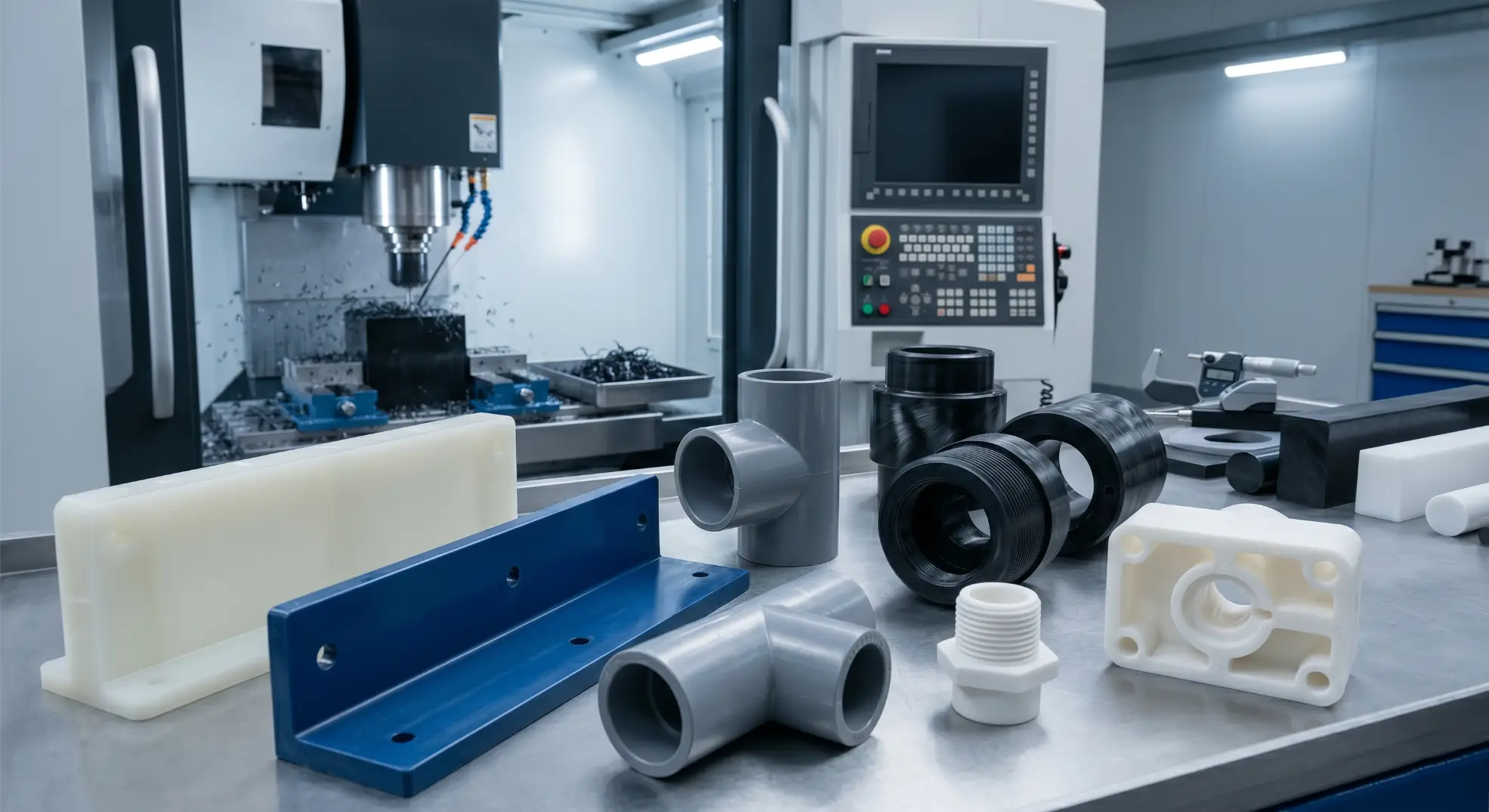
PPH — 7 Product LinesPVC / PP
/ HDPE
CNC Parts
7 product lines in PVC, PP, and HDPE — chemical equipment parts, corrosion-resistant panels, structural supports, insulating parts, water treatment components, pipe and fitting accessories, and tank accessories. Chemical resistant · NSF-61 / FDA compliant options · Lowest cost corrosion-resistant plastic.
Chemical Resistance Comparison — ✓ Resistant / ✗ Not Resistant
Chemical
PVC
PP
HDPE
Dil. Acids
✓
✓
✓
Alkalis NaOH
✓
✓
✓
Ketones
✗ PVC
✓
✓
Temp >80°C
✗ PVC
✓ PP
✓
Potable Water
Grade dep.
✓ FDA
✓ NSF-61
pH 2–12
Chem. Resist.
NSF-61
Water Safe
7
Product Lines
pH 2–12
Chem. Resistance
NSF-61
Potable Water
24hr
Quote
Chemical Equipment Part ✦Corrosion Panel ✦Structural Support ✦Insulating Part ✦Water Treatment Part ✦Pipe Fitting ✦Tank Accessory ✦
Chemical Equipment Part ✦Corrosion Panel ✦Structural Support ✦Insulating Part ✦Water Treatment Part ✦Pipe Fitting ✦Tank Accessory ✦
Full Product Range
7 Corrosion-Resistant Parts — PVC · PP · HDPE
PVC-U · PP Homopolymer · HDPE · NSF-61 / FDA · Profile ±0.1mm · MOQ 1 piece
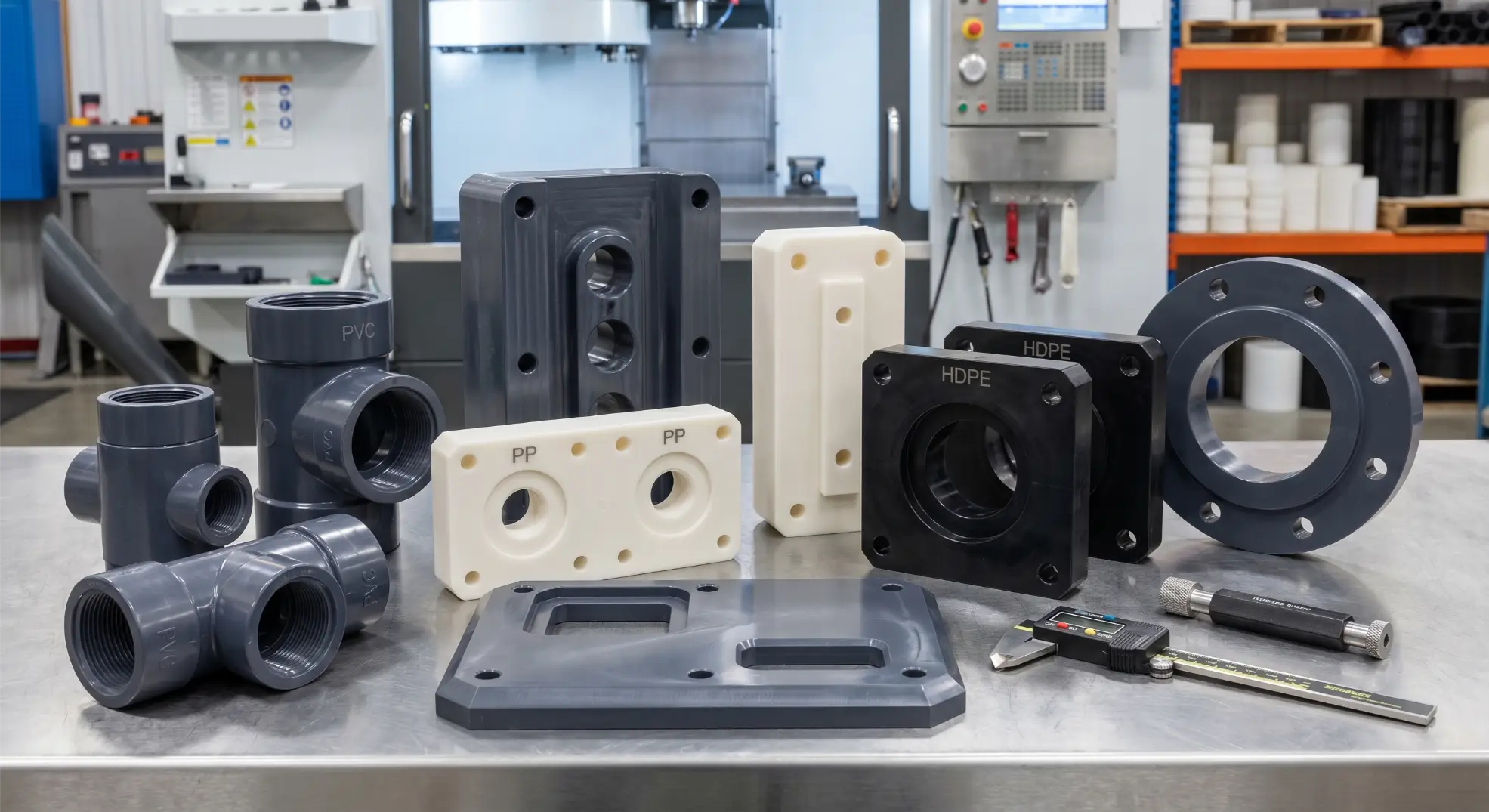
PPH-001/002/003
CHEMICAL & STRUCTURAL / 001–003 — FEATURED
Chemical Equipment Parts, Corrosion-Resistant Panels & Structural Supports
PVC, PP, and HDPE machined parts for chemical processing equipment — fittings, spacers, structural components, and panels for chemical plant environments where metal would corrode and expensive engineering plastics (PTFE, PEEK) are unnecessary. Grade selection by chemical service: PVC for aqueous acids, alkalis, and salt solutions up to 60°C (avoid PVC with ketones, esters, and aromatic hydrocarbons — PVC swells and degrades); PP for the widest organic chemical resistance including esters, ketones, and elevated temperature service to 100°C; HDPE for general chemical service, abrasive slurry handling, and potable water applications where PP's higher cost is unjustified. All three grades machine economically — typical part cost is 30–60% lower than equivalent PTFE parts while providing adequate chemical resistance for the majority of chemical plant service conditions. Corrosion-resistant panels: face flatness ±0.1mm; PVC, HDPE, or PP sheet machined to profile; edge chamfered for clean installation. Structural support blocks: profile ±0.1mm; bolt holes to drawing; lightweight (HDPE density 0.95 g/cm³ vs steel 7.85 g/cm³ — 12% of steel weight).
PVC-U · PP Homopolymer · HDPEGet Quote

PPH-004
INSULATION / 004
Insulating Parts
PVC and HDPE electrical insulating spacers and supports for chemical environments where other insulating materials would corrode. PVC CTI adequate for low-voltage applications (<600V); HDPE for applications requiring FDA/NSF compliance alongside insulation. Profile ±0.1mm; bore H9; chemical resistant to battery acid, chlorinated water, and process chemicals.
PVC-U · HDPEGet Quote

PPH-005
WATER TREATMENT / 005
Water Treatment Parts
HDPE (NSF-61 potable water certified) and PP (FDA 21 CFR 177.1520) water treatment equipment components — filter housings, valve bodies, and instrumentation mounts. HDPE NSF-61 is the standard material for potable water contact fittings in North American water systems. Profile ±0.1mm; bore H9; threaded ports to BSP or NPT standard.
HDPE (NSF-61) · PP (FDA)Get Quote
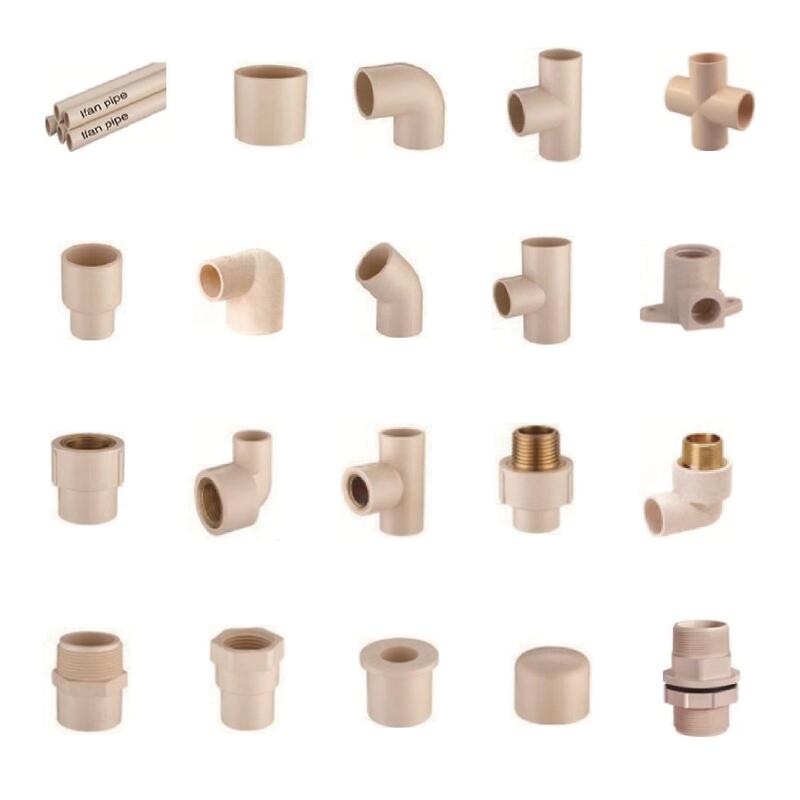
PPH-006
PIPING / 006
Pipe & Fitting Accessories
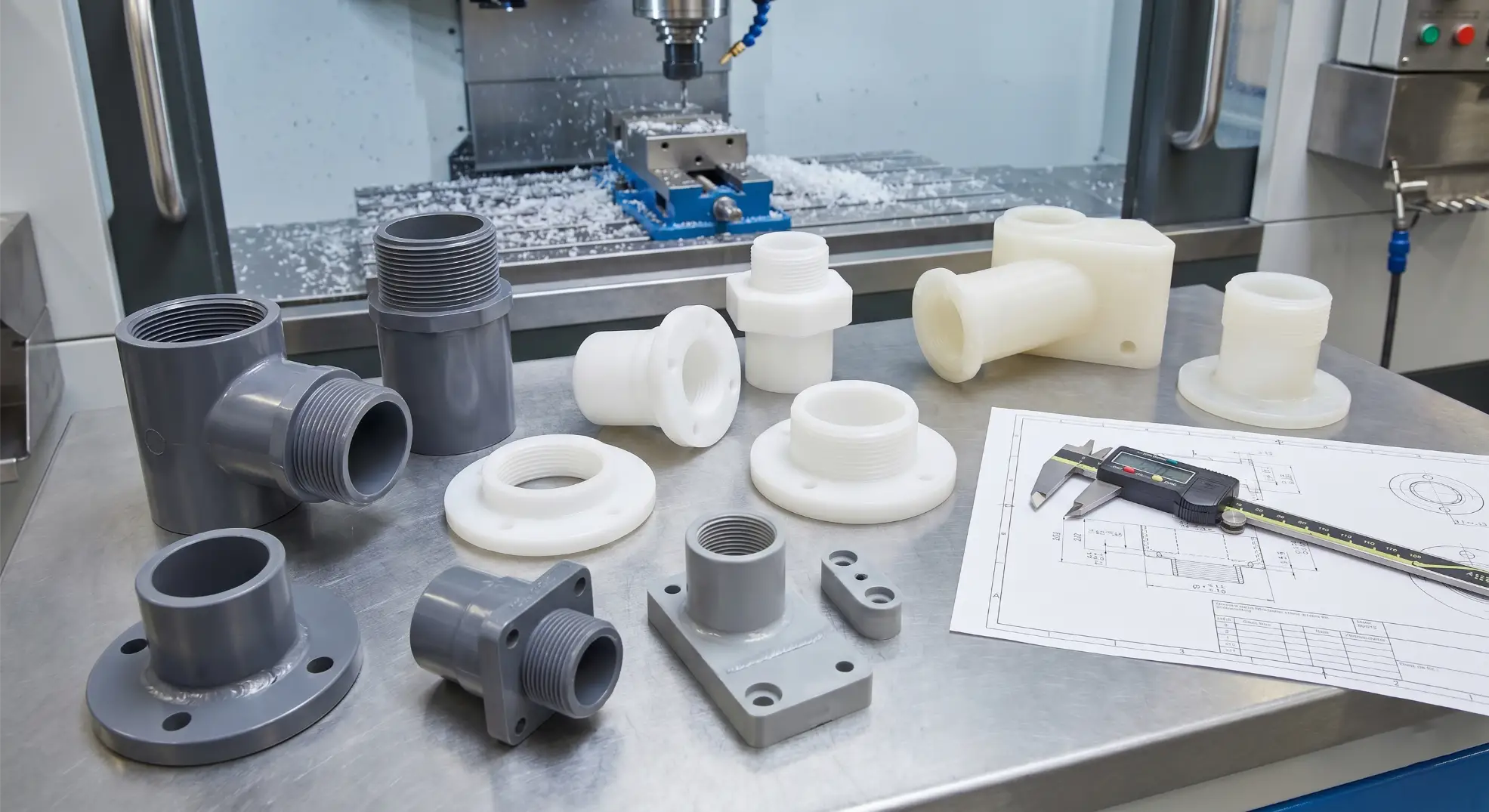
PVC and PP pipe system fittings and accessories — adapters, reducers, union nuts, and specialised fittings not available in standard pipe fitting catalogues. Thread to BSP, NPT, or metric standard; bore H9; chemical resistant to service fluid. PVC for cold water and aqueous service; PP for chemical service and elevated temperature.
PVC-U · PPGet Quote
PPH-007
TANK / 007
Tank & Vessel Accessories
PVC, HDPE, and PP tank nozzles, overflow fittings, level sensor mounts, and vessel accessories. Threaded or flanged to drawing; weldable (PP and HDPE weld easily for tank fabrication; PVC solvent-welded). Profile ±0.1mm; chemical resistant to tank contents; available in weld-grade PP and HDPE for fusion welding to tank walls.
PVC-U · HDPE · PPGet Quote
Manufacturing Capability
Grade Selection Guide — PVC vs PP vs HDPE
🔬
PVC — Stiffest, Best for Structural Fittings
Rigid PVC (PVC-U) has the highest modulus (~3 GPa) of the three — best for structural fittings and panels requiring dimensional stability. Best chemical resistance to aqueous acids, alkalis, and salt solutions. Service temperature 60°C maximum. Avoid with ketones, esters, aromatic hydrocarbons, and THF — PVC swells and degrades. Easiest to machine of the three — clean chip formation and good surface finish.
Best stiffnessAvoid ketones/esters
⚗
PP — Widest Chemical Resistance
PP (polypropylene) has the widest organic chemical resistance of the three — including esters, ketones, and many solvents that attack PVC. Service temperature 100°C continuous. FDA food-contact compliant. Weldable for tank fabrication. Slightly harder to machine than PVC (chip strings at low feed rate). Specify PP where ketone/ester chemical resistance is required or where temperatures exceed 60°C.
Ketone/ester resistant100°C service
💧
HDPE — Potable Water and Impact
HDPE has the best impact resistance of the three, NSF-61 potable water certification, and good general chemical resistance. Density 0.95 g/cm³ — 12% of steel weight. Best for water treatment applications where NSF-61 is the required certification (rather than FDA). Weldable. Machines similarly to UHMW-PE but slightly easier due to lower molecular weight.
NSF-61Best impact of 3
Precision Specifications
Tolerances & Grade Reference — PVC / PP / HDPE
📐
Tolerances by Feature
Profile
±0.1 mm
Bore (PVC)
H8
Bore (PP/HDPE)
H9
Face Flatness
±0.1 mm
Thread
BSP/NPT std
⚙
Grade Reference
PVC Max Temp
60°C
Continuous service. Avoid ketones, esters. Best stiffness and machinability of three grades.
PP Max Temp
100°C
Widest organic chemical resistance. FDA food-contact. Weldable for tank fabrication.
HDPE
NSF-61
Potable water certified. Best impact of three. Weldable. 0.95 g/cm³ — lightest of three.
Cost vs PTFE
30–60%
Lower cost than PTFE/PEEK for most chemical plant applications where extreme conditions are not required.
Our Advantage
Why Plant Engineers Choose Our PVC / PP / HDPE Parts
Sel
Grade Selection Advisory at DFM
We confirm PVC vs PP vs HDPE at DFM based on chemical service, temperature, and certification requirement. Many customers specify PVC for all chemical applications — incorrect when service temperature >60°C or ketone/ester chemicals are present. PP is the correct grade for elevated temperature and organic solvent resistance.
NSF
HDPE NSF-61 — Not Just "Food Grade"
NSF-61 is the specific certification required for potable water contact in North American water distribution systems — different from FDA food-contact certification. We clarify which certification is required for the customer's application and specify the correct grade. NSF-61 HDPE for water treatment; FDA PP or HDPE for food processing.
Weld
Weld-Grade PP and HDPE Available
PP and HDPE tank accessories and nozzles supplied in weld-grade material — compatible with hot-gas welding and butt fusion welding to PP and HDPE tank walls. We confirm welding compatibility with the customer's tank fabrication process at DFM. PVC parts also available in solvent-cement grade for PVC tank systems.
Cost
30–60% Lower Cost vs PTFE
PVC, PP, and HDPE parts cost 30–60% less than equivalent PTFE parts for the same chemical service in most applications. We advise PTFE only where PVC/PP/HDPE chemical or temperature limits are genuinely exceeded — not as a precautionary over-specification that adds unnecessary cost.
Frequently Asked Questions
PVC / PP / HDPE Parts — Common Questions
PVC: stiffest (3 GPa), best machinability, 60°C max, aqueous chemical resistant. Attacked by ketones/esters. PP: widest organic chemical resistance (esters, ketones), 100°C, FDA food-contact. Harder to machine. HDPE: NSF-61 potable water, best impact of three, good general chemical resistance, 80–100°C. All three are 30–60% lower cost than PTFE for most chemical plant applications.
HDPE (NSF-61) for potable water — NSF-61 is the specific certification for North American water distribution systems. PP (FDA 21 CFR 177.1520) for food-processing water systems. Both are weldable for fabricated tank and piping systems. PVC is not typically NSF-61 certified for potable water direct contact.
Profile: ±0.1mm. Bore: H8 (PVC) / H9 (PP/HDPE). Face flatness: ±0.1mm. Thread: BSP, NPT, or metric to standard. PVC achieves the best tolerances of the three grades due to higher stiffness. PP and HDPE are softer and require more care to achieve clean surfaces.
MOQ: 1 piece. Lead times: simple parts: 3–7 days. Complex profiles: 5–10 days. PVC, PP, HDPE rod, sheet, and pipe in stock. Weld-grade PP and HDPE available from stock. NSF-61 HDPE certified stock available. All grades in white/natural and black.
Structured data embedded · Eligible for Google FAQ rich results