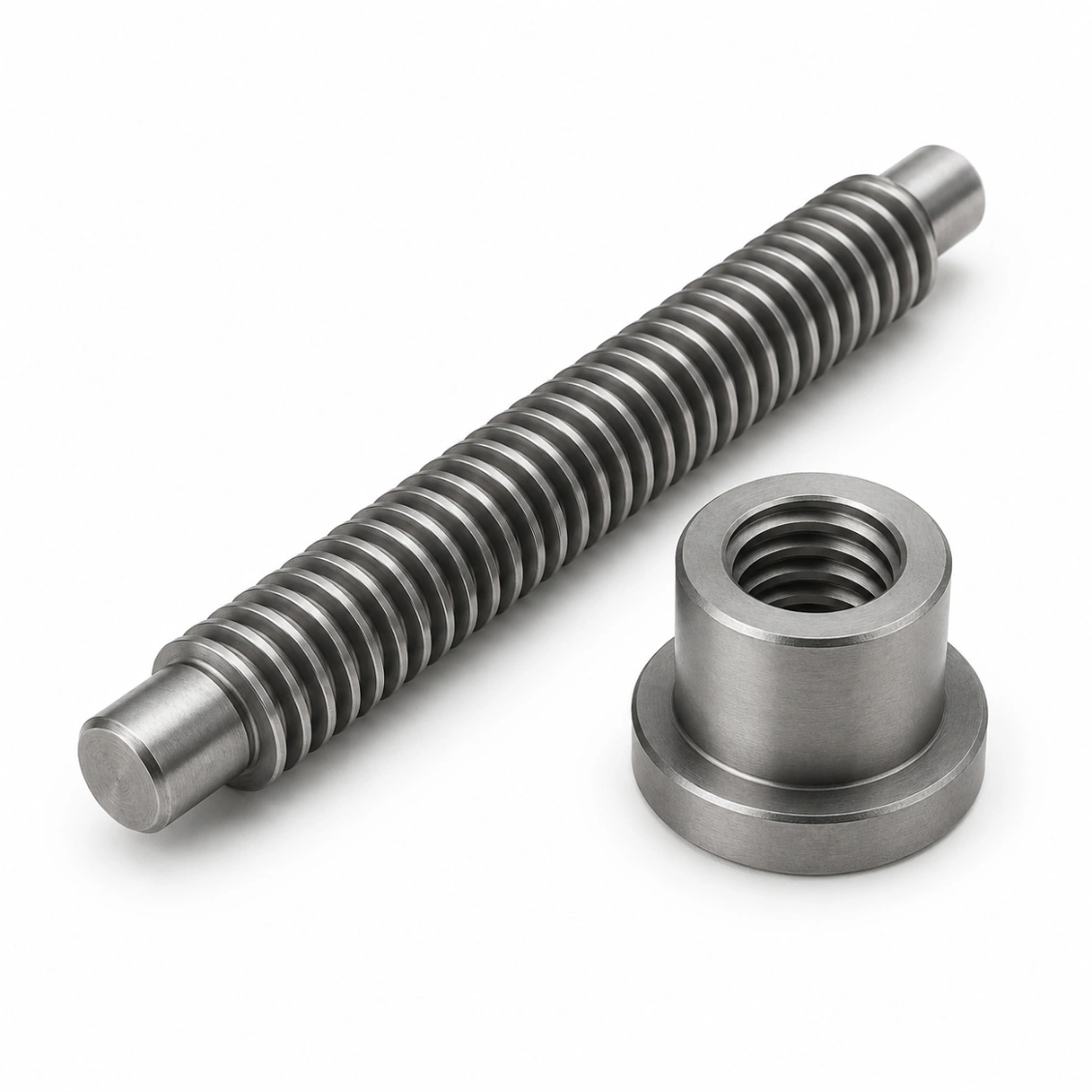
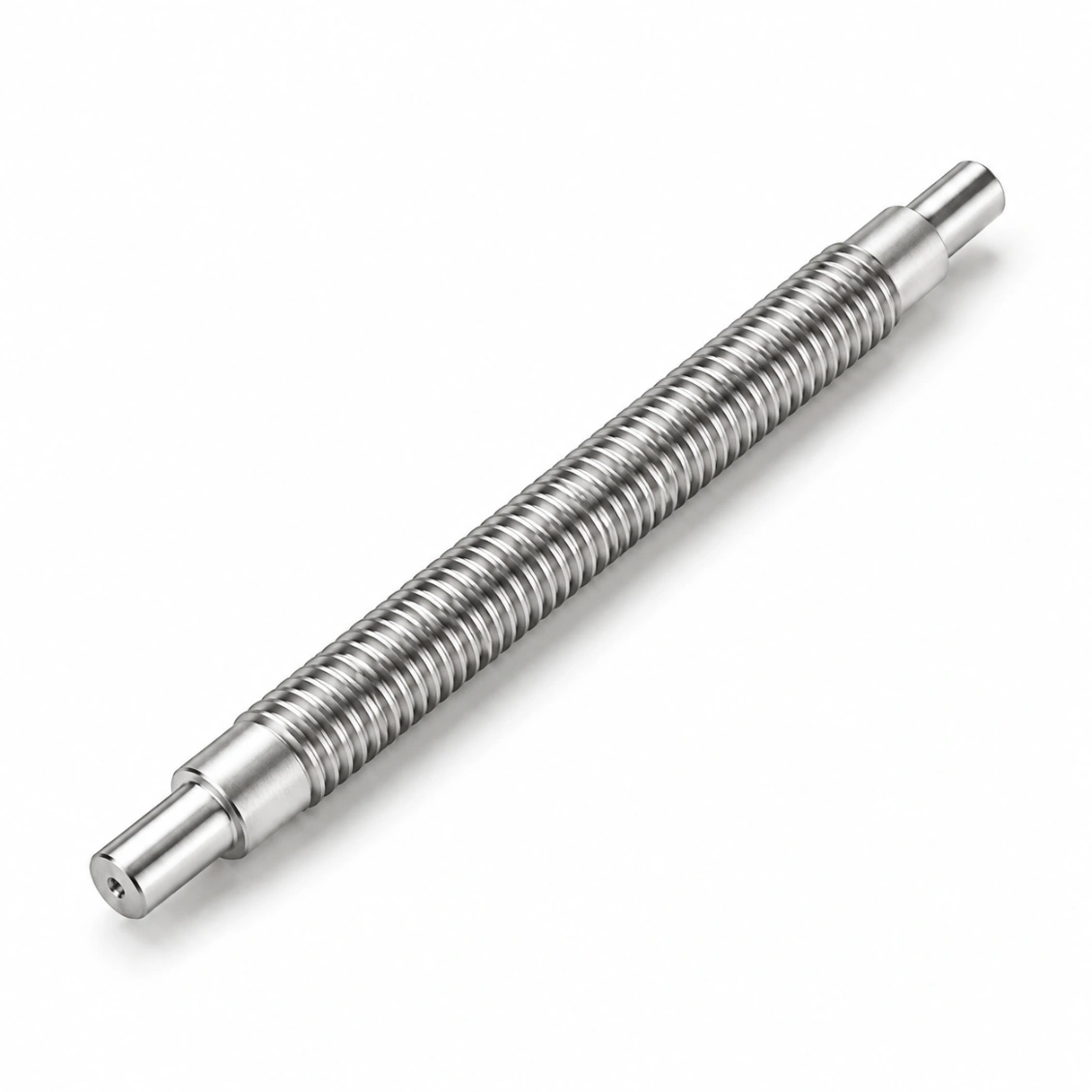
Precision CNC machined lead screw transmission parts — trapezoidal lead screws, ACME lead screws,
lead screw nuts, anti-backlash flange nut housings, and lead screw end bearing blocks. As a precision
lead screw manufacturer we grind the thread profile to DIN 103 / ASME B1.5, Ø6–100 mm, with lead
accuracy up to ±0.015 mm/300 mm for CNC machines and lead-screw-driven linear actuators.
PART DWG · LSC-000 Tr32×6 LEAD SCREWISO 9001 : 2015
Tr 32 × 6
30° Flank
Anti-Backlash Nut
Tr · ACME · Stub ACME · Multi-Start
Thread Forms
42CrMo4 · C45 · SUS · PB2 · AB2
Materials
48hr Quote · MOQ 1
Service
±0.015mm
Lead accuracy / 300mm
Tr 6–100mm
Trapezoidal & ACME diameter
P2–P7
Accuracy classes
7 Days
Fastest lead time
Our Work
Lead Screw & Nut Parts We've Made
Precision ground trapezoidal lead screws, ACME lead screws, bronze lead screw nuts, anti-backlash flange
nut housings, and lead screw end bearing blocks for CNC machines, lead-screw-driven linear actuators, and
industrial positioning.
From Drawing to Finished Lead Screw Transmission Parts
Upload your lead screw or lead screw nut drawing — trapezoidal or ACME thread, pitch, diameter, accuracy
class, end machining, material, and surface treatment.
01
Upload Drawing
STEP, DXF, PDF, or sketch with key dimensions.
02
Quote in 48h
Material, thread profile, accuracy class, end machining, lead time.
"Excellent quality trapezoidal lead screws and bronze nuts from HXC. The lead-error report matched our CMM."
AK
Alex K.
Mechanical Engineer · Germany
★★★★★
"HXC's DFM review caught issues with our anti-backlash lead screw nut before production. Perfect first time."
SL
Sophie L.
Design Engineer · France
★★★★★
"Three years sourcing precision lead screw assemblies from HXC. Consistent quality, reliable lead times."
JT
James T.
Senior Engineer · UK
FAQ
Lead Screw Transmission Parts — FAQ
Common questions about lead screw selection, accuracy classes, dimensions, materials, and sourcing.
A lead screw is a precision threaded shaft used to convert rotary motion into linear
motion (or vice versa) in positioning systems, lead screw linear actuators, and machine tool slides.
Unlike a power screw (optimised for force transmission), a lead screw is optimised for
positional accuracy — the linear travel per revolution (the lead) must be accurate and
consistent along the full length. Trapezoidal lead screw thread forms (DIN 103) and ACME lead screw
forms (ASME B1.5) are the standard thread profiles for lead screws in CNC machines and actuators.
Lead screw: sliding contact between screw thread and nut (trapezoidal or ACME). Higher
friction → lower efficiency (20–40%), self-locking (won't back-drive under load), lower speed
capability. Advantages: simple, low cost, self-locking for vertical actuators, tolerates side loads.
Ball screw: rolling contact via recirculating steel balls. Lower friction → higher
efficiency (90–95%), not self-locking, capable of high speeds and duty cycles. In the lead screw vs ball
screw decision: ball screws are preferred for CNC machine axes; lead screws for slower linear actuators,
jigs, fixtures, and vertical lifting where self-locking is needed.
DIN 103 / ISO lead screw accuracy classes: P7 — general industrial actuators,
±0.1 mm/300 mm. P5 — standard CNC machine positioning, ±0.023 mm/300 mm.
P3 — precision CNC and optical equipment, ±0.015 mm/300 mm. P2 —
high-precision measuring machines, ±0.008 mm/300 mm. For manual machine tool tables and jigs: P5–P7.
For CNC axes: P3–P5. For precision laser and optics stages: P2–P3.
Trapezoidal (Tr) — DIN 103 / ISO 2904: 30° thread angle, metric pitch. The European
standard for machine tool lead screws. Designated Tr (major diameter) × (lead), e.g., Tr32×6. Common
metric trapezoidal lead screw sizes: Tr8×1.5, Tr10×2, Tr12×3, Tr16×4, Tr20×4, Tr24×5, Tr32×6, Tr40×7,
Tr50×8. ACME — ASME B1.5: 29° thread angle, inch pitch. The American standard. Widely
used in the USA and for replacement parts on American machine tools. Stub ACME —
shallower thread depth than standard ACME, for applications with limited radial space. HXC grinds both
Tr and ACME profiles to P2–P7 accuracy in single-start and multi-start (double-lead) configurations.
Lead error is the deviation of the actual axial advance per revolution from the nominal
lead. It has two components: periodic error (repeating with each revolution
— caused by grinding wheel runout); and cumulative error (increasing over the screw
length — caused by machine thermal drift or lead inaccuracy). Measured with a laser interferometer or
precision leadscrew tester. DIN 103 P3: cumulative error ≤ 0.015 mm over any 300 mm length. HXC measures
lead error at 25 mm intervals and provides the full error plot with every precision lead screw order.
Screw materials: C45 (medium-duty), 42CrMo4 induction-hardened HRC 50 (standard
precision screws), and stainless steel (SUS304/316) for corrosive and medical environments — our
stainless steel lead screw and stainless steel trapezoidal lead screw options. Nut
materials: PB2 phosphor bronze (CuSn8) — the standard bronze lead screw nut material with good
lubricity, wear resistance, and corrosion resistance against steel screws; aluminium bronze (AB2) for
higher load capacity; PTFE-impregnated bronze for dry-running vertical actuators; acetal (POM/Delrin)
for low-cost self-lubricating plastic lead screw nuts; and cast iron for large machine tool tables where
the nut is machined integral with the slide. Material selection depends on load, speed, duty cycle, and
environment.
Anti-backlash lead screw nuts use two nut halves spring-preloaded against each other
— each nut half engages opposite flanks of the thread, eliminating the free play between nut and screw.
Backlash in a standard nut is 0.1–0.5 mm; an anti-backlash (zero-backlash) nut reduces this to
0.005–0.02 mm at the cost of slightly higher friction and faster wear. Anti-backlash is essential for
CNC axes and positioning stages where the axis changes direction. HXC supplies both standard and
anti-backlash lead screw nut assemblies, including split-nut and half-nut configurations.
A lead screw is self-locking when the lead angle is smaller than the friction angle
between nut and screw — meaning the axial load on the nut cannot back-drive the screw without an
external torque. Standard trapezoidal screws (Tr, 30° flank) are typically self-locking for leads ≤ 1/3
of the major diameter. Self-locking is important for vertical lifting actuators (the screw holds the
load without a brake) but a disadvantage for CNC axes (the motor must overcome stiction at direction
reversal). Multi-start (double-lead) ACME screws have a larger lead angle and are generally not
self-locking.
Yes — HXC standard lead screw supply includes custom end machining: ground bearing
journals (k6 for rolling bearing press fit) at both ends, ground flange faces,
tapped end holes for coupling attachment, and keyways where required.
We also supply matching lead screw end support bearing blocks (fixed/floating sets) and thrust bearing
arrangements. End machining is included in the quoted price — all features are machined and ground in
one setup for concentricity between the thread and bearing journals. Specify the required bearing type
and any coupling configuration on your drawing.
Yes — HXC is a custom lead screw and lead screw nut manufacturer and supplier based in China, producing
custom lead screws, trapezoidal lead screws, ACME lead screws, bronze and plastic lead screw nuts,
flanged nut housings, and lead screw end bearing blocks to your drawing. Our lead screw manufacturing
process covers turning, thread grinding, induction hardening, and laser lead-error inspection in-house.
Whether you need a single prototype (MOQ 1) or production batches of custom acme lead screws and
precision lead screw assemblies, we machine to DIN 103, ISO 2904, and ASME B1.5 standards with full ISO
9001:2015 quality control and dimensional reports.
Standard Tr or ACME screw, P5 or P7, C45 or 42CrMo4: 7–10 days prototype, 10–16 days for 20–100 pcs.
P3 precision ground lead screw: 10–14 days prototype, 14–20 days production. P2 ultra-precision: 14–20
days. Nut machining: 3–5 days additional. End bearing block sets: 3–4 days additional. Stainless steel
screws add 2–3 days. Rush production available — contact us with your deadline.
Get a Quote
Send Your Drawing. Get a Quote.
Every enquiry includes a DFM review — tolerance feasibility, material confirmation, and process approach confirmed before production starts. MOQ 1 piece.
24hr
Quote Response
MOQ 1
Prototypes OK
ISO
9001:2015
📐
DFM Review on Every Enquiry
Tolerance feasibility, fixturing strategy, and material confirmation. Specific, actionable feedback — not generic pushback.
🎯
First Article Inspection — Standard
FAI report on every new run. Material certs and surface treatment certs included with every shipment.
🔄
Same Process: Prototype to Production
Process plan from your prototype applies to production batches. No re-qualification when you scale.
⚙
3 / 4 / 5-Axis CNC + Turning
Complex structural parts, shafts, housings, and transmission components. Metals and engineering plastics.
ISO 9001:20153/4/5-Axis MillingCNC TurningCMM InspectionGlobal Delivery