
Choosing the wrong metal casting processes can derail your entire production timeline and blow past your budget.
Every mechanical engineer and procurement officer knows that selecting between sand casting vs. die casting, or opting for investment casting (lost wax), isn’t just about shaping metal—it’s about managing surface finish and dimensional tolerance, controlling molten metal solidification, and minimizing precision casting defects.
In this comprehensive guide, we break down the 11 essential types of casting used in modern manufacturing today. From high-volume high-pressure die casting (HPDC) to specialized centrifugal casting manufacturing and shell mold casting techniques, we cover exactly when to deploy each method.
More importantly, we look at the critical next step: how casting post-processing CNC machining bridges the gap between a raw foundry blank and a high-tolerance, assembly-ready component.
Here is what you need to know to optimize your next production run.
Understanding the Fundamentals: What is a Casting Process?
When you need to manufacture complex, hollow, or massive metal components, traditional cutting and carving methods often fall short. That is where a casting process comes in. In our facility, we look at casting as the foundational bridge between raw liquid metallurgy and near-net-shape engineering components.
At its core, a metal casting process involves pouring molten metal into a specifically designed mold cavity. Once the liquid metal cools and undergoes molten metal solidification, it takes the exact shape of the mold. We use this manufacturing method to produce everything from heavy engine blocks to intricate aerospace components that would be impossible or cost-prohibitive to machine from solid billet stock.
The Basic Mechanics of Metal Casting
While there are many specialized metal casting processes, every project we run follows a fundamental four-step thermodynamic and mechanical cycle:
- Pattern and Mold Making: We create a replica of the final part (a pattern) to form the negative cavity inside a mold, factoring in precise shrinkage allowances.
- Melting and Pouring: The target alloy is heated in a furnace past its melting point and poured into the gating system of the mold.
- Solidification: The liquid metal cools inside the mold cavity. This phase dictates the grain structure, mechanical properties, and potential precision casting defects like gas porosity or shrinkage.
- Demolding and Cleaning: The solidified part is removed from the mold, and we cut away the excess gates, risers, and flash before sending it to post-processing.
Expendable Molds vs. Permanent Molds
To choose the right approach for your production run, you must first understand the primary divide in tooling: expendable molds versus permanent molds.
| Feature | Expendable Mold Casting | Permanent Mold Casting |
|---|---|---|
| Mold Material | Sand, plaster, wax, or shell (destroyed to extract the part) | Metal dies (typically steel or iron, reused repeatedly) |
| Production Volume | Ideal for low to medium volumes and prototyping | Best for high-volume, automated production runs |
| Design Complexity | Can handle extreme geometric complexity and deep undercuts | Limited by the need to mechanically eject the part |
| Tooling Cost | Low upfront cost, higher per-piece cost | High upfront tooling cost, very low per-piece cost |
| Surface Finish | Variable; ranges from rough to medium-smooth | Excellent surface finish and dimensional tolerance |
The 11 Core Types of Casting Processes

Different projects demand different manufacturing approaches. Choosing the right metal casting processes depends entirely on your production volume, material choice, and required dimensional tolerance. Here is a breakdown of the 11 core casting methods used in modern manufacturing.
1. Sand Casting (Green Sand & Chemically Bonded)
Sand casting is the most widely used method in the industry, adaptable to almost any metal alloy.
- Green Sand: Uses a mix of sand, clay, and water to create reusable molds. It is highly cost-effective for large components.
- Chemically Bonded: Uses synthetic resins to bind the sand, delivering a stronger mold, better surface finish, and tighter tolerances.
2. Investment Casting (Lost Wax Casting)
Investment casting is the go-to process for complex geometries and exceptional surface finishes. A wax pattern is coated with a ceramic slurry to create the mold, and the wax is melted out before pouring the molten metal. This method is frequently used to manufacture intricate aerospace and industrial parts, such as high-performance turbine blades and guide vanes.
3. High-Pressure Die Casting (HPDC)
HPDC forces molten metal into a steel mold cavity under immense pressure. It is incredibly fast, making it ideal for high-volume production of non-ferrous metals like aluminum and zinc. This process yields excellent dimensional accuracy and thin-walled structures.
4. Low-Pressure Die Casting (LPDC)
LPDC fills the mold from a bottom reservoir using low-pressure gas. This controlled, rising flow reduces air entrapment, significantly minimizing precision casting defects like gas porosity. It is preferred for critical automotive components like aluminum wheels.
5. Permanent Mold Casting (Gravity Die Casting)
Unlike sand casting, permanent mold casting uses reusable steel or iron molds. Molten metal is poured directly into the mold using gravity. It offers better mechanical properties and surface finishes than sand casting, making it perfect for medium-volume production runs.
6. Centrifugal Casting
This technique pours molten metal into a rapidly spinning mold. The centrifugal force throws the heavy metal against the outer walls, while lighter impurities collect at the center and are machined away. It is the premier method for manufacturing cylindrical parts like pipes, bushings, and rugged joint shafts.
7. Shell Mold Casting
Shell mold casting is an evolution of sand casting that uses a resin-covered sand mixture heated against a metal pattern to form a thin, hardened shell. This technique offers significantly better dimensional tolerance and faster production speeds than traditional sand molds.
8. Squeeze Casting
Squeeze casting combines elements of casting and forging. Molten metal solidifies under intense pressure applied by a hydraulic press. This process completely eliminates internal porosity, resulting in outstanding squeeze casting mechanical properties and robust structural integrity.
9. Lost Foam Casting
Similar to investment casting, this process uses a polystyrene foam pattern instead of wax. The foam is buried in unbonded sand, and the incoming molten metal vaporizes the foam instantly, taking its exact shape. It allows for highly complex internal passageways without the need for cores.
10. Plaster Mold Casting
This method uses a gypsum plaster mix instead of sand to form the mold. Plaster has low thermal conductivity, which allows the molten metal to cool slowly and fill incredibly fine details. It delivers a superior surface finish but is limited to non-ferrous materials like copper and aluminum.
11. Vacuum Casting
Vacuum casting utilizes a vacuum system to draw molten metal into the mold cavity. Eliminating air resistance ensures the metal fills every micro-detail while eliminating air pockets. It is heavily utilized for rapid prototyping casting molds and thin-walled structural components.
Comparative Engineering Guide: Which 11 Different Types of Casting Process Is Best for Your Project?

Choosing the right method from the 11 different types of casting process depends heavily on your production volume, budget, and required precision. For instance, while high-pressure die casting excels at high-volume production for zinc or aluminum, it isn’t ideal for stainless steel due to extreme melting temperatures.
When your project demands the highest strength and corrosion resistance, choosing investment casting for stainless steel parts ensures excellent dimensional accuracy before any final machining takes place.
Material Compatibility Matrix
Different metal casting processes handle specific alloys based on their melting points and cooling behaviors.
| Casting Process | Aluminum & Magnesium | Zinc Alloys | Copper & Bronze | Steel & Stainless Steel | Cast Iron |
|---|---|---|---|---|---|
| Sand Casting | Excellent | Good | Excellent | Excellent | Excellent |
| Investment Casting | Good | Fair | Excellent | Excellent | Good |
| High-Pressure Die Casting | Excellent | Excellent | Fair | Not Recommended | Not Recommended |
| Permanent Mold Casting | Excellent | Good | Good | Fair | Fair |
| Centrifugal Casting | Good | Fair | Excellent | Excellent | Excellent |
Cost, Volume, and Tolerance Breakdown
Balancing upfront tooling costs against piece-part costs determines the overall profitability of your manufacturing run. Below is the structural breakdown of how these core processes stack up regarding surface finish and dimensional tolerance.
-
Sand Casting
- Production Volume: Low to Medium (1 to 10,000 parts)
- Tooling Cost: Very Low
- Unit Cost: Medium
- Dimensional Tolerance: ±0.030 in to ±0.050 in
- Surface Finish: Rough (300 to 560 μin Ra)
-
Investment Casting (Lost Wax)
- Production Volume: Low to High (10 to 100,000+ parts)
- Tooling Cost: Medium to High
- Unit Cost: High
- Dimensional Tolerance: ±0.005 in to ±0.010 in
- Surface Finish: Excellent (60 to 125 μin Ra)
-
High-Pressure Die Casting (HPDC)
- Production Volume: High (10,000 to 1,000,000+ parts)
- Tooling Cost: Very High
- Unit Cost: Very Low
- Dimensional Tolerance: ±0.002 in to ±0.005 in
- Surface Finish: Very Smooth (32 to 63 μin Ra)
-
Permanent Mold Casting
- Production Volume: Medium to High (1,000 to 100,000 parts)
- Tooling Cost: High
- Unit Cost: Low to Medium
- Dimensional Tolerance: ±0.010 in to ±0.020 in
- Surface Finish: Good (90 to 200 μin Ra)
Why Precision Casting Demands Post-Cast CNC Machining
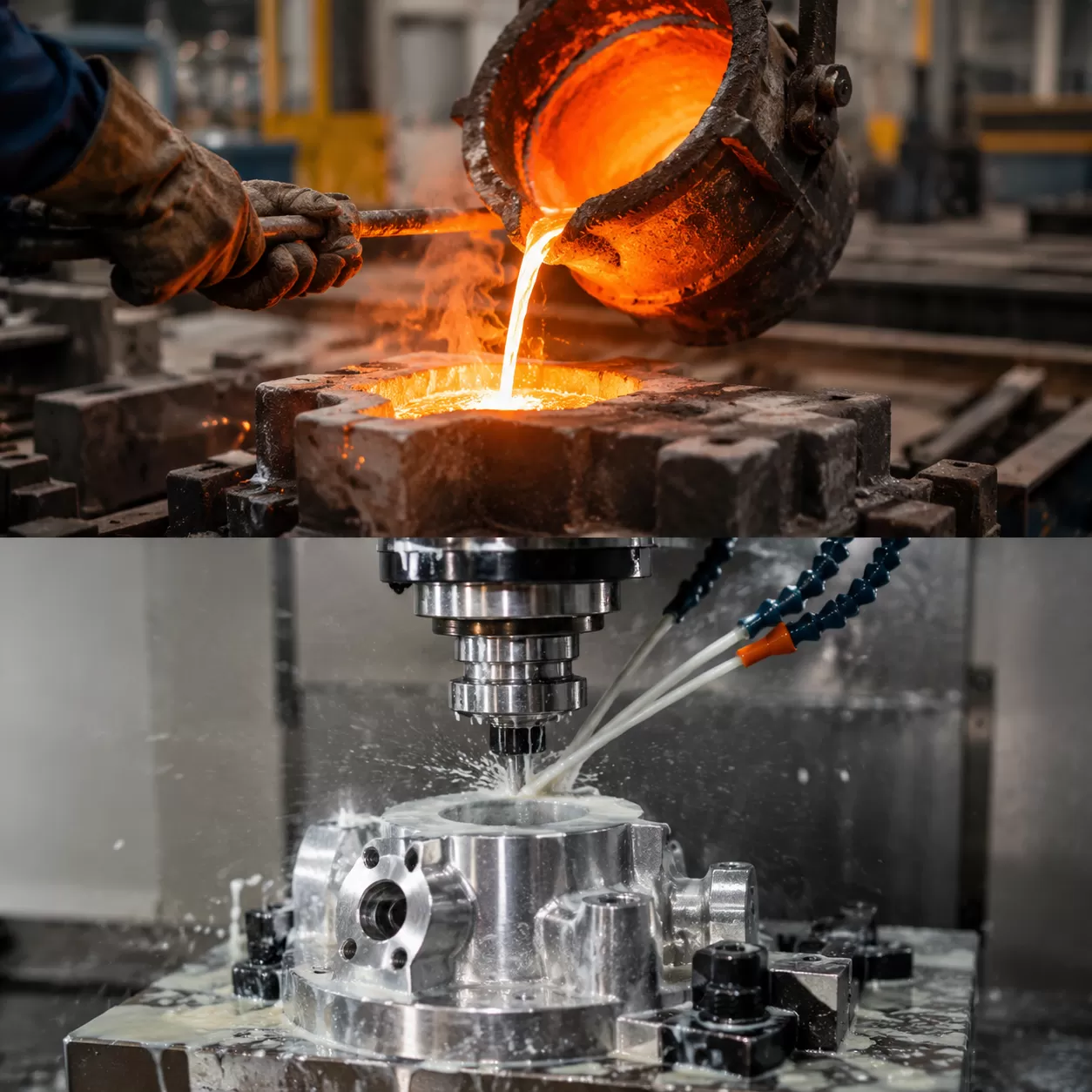
While metal casting processes are incredibly efficient for creating complex geometries, they rarely produce a finished, market-ready part right out of the mold. To achieve true engineering perfection, secondary machining is non-negotiable.
The Reality of Near-Net-Shape Castings
Most precision casting methods yield what we call near-net-shape components. They look like the final product, but they lack the exact dimensional accuracy required for critical industrial applications.
- Shrinkage and Warp: As molten metal solidifies, it naturally contracts, leading to microscopic dimensional variations.
- Surface Roughness: Even high-end investment casting leaves a surface finish that is often too rough for high-friction environments or tight seals.
- Mating Features: Critical features like threaded holes, O-ring grooves, and perfectly flat mating faces cannot be cast reliably and must be cut with precision.
Scaling Production with HXCNC’s Multi-Axis Precision Machining Solutions
At HXCNC, we bridge the gap between raw castings and high-performance components. Our state-of-the-art multi-axis CNC machining solutions are tailored specifically to refine cast parts, ensuring they meet the strictest aerospace, automotive, and medical standards.
By utilizing our advanced equipment facility, we eliminate the need for multiple setups, drastically reducing production cycle times while maintaining strict geometric tolerances. Whether your project involves aluminum die castings or complex stainless steel investment castings, our secondary machining capabilities deliver the exact tolerances and flawless surface finishes your application demands.
Frequently Asked Questions (FAQs) About the 11 Different Types of Casting Process
What is the most common metal casting process?
Sand casting is by far the most widely used metal casting process, accounting for over 70% of all metal castings produced globally. Its popularity stems from its exceptional cost-effectiveness, flexibility with various alloys, and the ability to produce components ranging from small brackets to massive industrial automation components.
Which casting method offers the highest dimensional accuracy?
Investment casting (lost wax) and high-pressure die casting (HPDC) deliver the highest dimensional accuracy and superior surface finish. Investment casting is preferred for complex, net-shape geometries in ferrous and non-ferrous metals, while HPDC is the go-to for high-volume, tight-tolerance non-ferrous parts.
How do you prevent precision casting defects like gas porosity?
Preventing precision casting defects requires strict quality control over the molten metal solidification process. Key preventative measures include:
- Proper venting: Ensuring molds allow trapped gases to escape easily.
- Degassing treatments: Removing dissolved hydrogen from the liquid metal prior to pouring.
- Temperature control: Maintaining optimal pouring temperatures to reduce turbulence.
- Mold design: Utilizing optimized runners and risers to ensure uniform cooling.
Why do cast parts require secondary CNC machining?
While advanced metal casting processes yield near-net-shape parts, they rarely meet the hyper-critical tolerances required for functional engineering. Secondary CNC machining is necessary to:
- Achieve precise dimensional tolerances (down to thousandths of an inch).
- Create perfectly smooth mating surfaces and threaded holes.
- Correct minor surface imperfections left behind by the casting mold.
- Ensure perfect concentricity for rotating parts like high-speed shafts and a precision spindle.