
The Anatomy of an HPDC System: How It Works
If you need to manufacture thousands of complex metal parts with absolute consistency, you are likely looking at the High Pressure Die Casting (HPDC) process. The biggest worries we hear from engineers center around part structural integrity, internal voids, and whether the tooling can withstand high-volume production. We engineered our HPDC systems to solve these exact pain points by combining rugged structural frameworks with precise, high-pressure injection control.
The Tooling Framework
The heart of the machine relies on a two-part mold system engineered from hardened H13 tool steel to endure extreme thermal shock and immense clamping forces.
- Fixed Die Half (Cover Die): This front half mounts securely to the stationary platen of the machine. It aligns directly with the injection mechanism to receive the molten metal.
- Moving Die Half (Ejector Die): This back half moves along the tie bars during the machine cycle. It contains the ejector box and pins that physically push your finished part out of the mold.
The Injection Mechanism
To achieve a dense, net-shape component without internal air pockets, our system utilizes a heavy-duty three-stage injection assembly.
- Shot Sleeve: The chamber where the molten metal is held right before injection.
- Hydraulic Plunger: Driven by high-powered accumulators, this piston forces the liquid metal out of the sleeve and into the die cavity.
- Intensification Phase: Once the mold cavity fills, the hydraulic system instantly kicks into high gear, ramping up to over 1000 bar of hydraulic pressure. This extreme squeeze packs extra metal into the microscopic gaps, eliminating shrinkage porosity and internal voids before the metal hardens.
Step-by-Step Process Breakdown
We run a highly automated, lightning-fast production cycle to maximize efficiency and maintain tight tolerances.
| Step | Operation | Key Action & Purpose |
|---|---|---|
| 1 | Mold Preparation & Lubrication | Automated nozzles clean the die faces and spray a specialized release agent. This protects the H13 steel, controls thermal shifts, and ensures easy part release. |
| 2 | Metal Pouring & High-Speed Injection | Molten metal is metered into the shot sleeve. The plunger fires, filling the entire die cavity in under 100 milliseconds (<100 ms) to prevent the metal from freezing prematurely. |
| 3 | Solidification under Intensification | The machine maintains massive clamping force and intensification pressure, forcing raw metal inward to counteract natural cooling shrinkage. |
| 4 | Ejection & Part Cooling | The moving die half retracts. Mechanical ejector pins push the hot casting out of the cavity into a cooling station or a robotic gripper. |
| 5 | Trimming & Flash Removal | The raw casting passes through a hydraulic trim press to instantly shear away the gating system, runners, and excess flash material. |
Hot Chamber vs. Cold Chamber Die Casting: Choosing Your Method
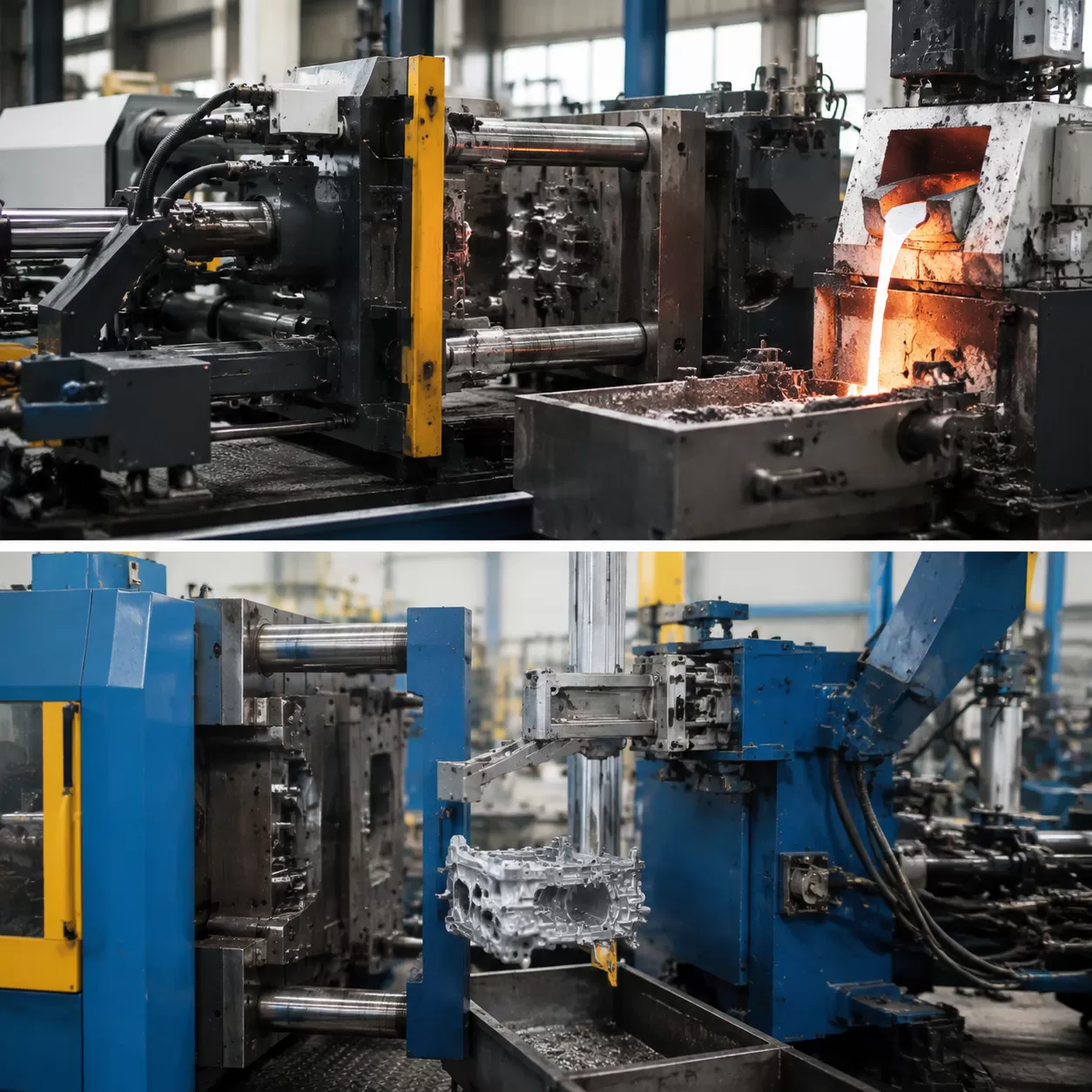
Selecting the right high pressure die casting (HPDC) setup comes down to the melting point of your target alloy and the specific performance needs of your components. The process splits into two distinct mechanical configurations: hot chamber and cold chamber systems.
Hot Chamber Die Casting
The defining feature of hot chamber die casting is its submerged injection system. The plunger mechanism and gooseneck are permanently immersed in the molten metal within the melting furnace itself.
- The Mechanism: Because the injection hardware stays hot, molten metal fills the chamber automatically after each cycle, allowing the hydraulic plunger to force the material directly into the die cavity.
- Compatible Alloys: This method is ideal for low-melting-point zinc and magnesium alloys, as well as lead.
- Core Benefit: Eliminating the metal transfer step delivers exceptionally rapid cycle times, making it a highly efficient choice for high-volume production of small, intricate parts.
Cold Chamber Die Casting
When dealing with harsher materials, cold chamber die casting is the industry standard to protect critical machinery from thermal degradation.
- The Mechanism: The melting furnace sits entirely separate from the casting machine. For each cycle, the exact volume of molten metal is ladled—either manually or via an automated arm—into an external, unheated shot sleeve before the plunger drives it home.
- Compatible Alloys: This process handles high-melting-point metals, dominating the production of aluminum die casting alloys, brass, and larger structural magnesium pieces.
- Core Benefit: Keeping the injection system out of constant contact with extreme heat prevents critical machine components from warping or breaking down prematurely.
Selecting the Right Setup for Your Project
Choosing the wrong method leads to high tooling wear, structural defects, or bloated manufacturing costs. The choice hinges directly on your structural requirements, production volume, and material choice.
Our team at HXCNC works alongside your design engineers to match your part geometries with the optimal casting method. For heavy-duty automotive applications, we often leverage cold chamber systems to produce robust, high-integrity structural automotive components that demand the lightweight strength of aluminum. For smaller, ultra-precise consumer electronics housings, we guide projects toward hot-chamber setups to maximize cycle efficiency and achieve pristine surface finishes.
Material Capabilities: Alloys Used in High-Pressure Casting

Choosing the right raw material dictates how your component performs under stress, manages heat, and fits into your final assembly. In high-volume production, three primary non-ferrous families dominate the high-pressure die casting process.
Aluminum Die Casting Alloys
Aluminum alloys are the backbone of modern industrial manufacturing. Engineers rely on aluminum because it delivers exceptional strength-to-weight performance, outstanding thermal management, and natural corrosion resistance. It is highly castable, allowing us to produce large, complex structures like a freeform shell or heavy-duty enclosures that can withstand harsh environments without adding unnecessary weight.
Zinc Alloys
When your project requires maximum dimensional precision and ultra-thin walls, zinc is the ideal choice. Zinc alloys feature a lower melting point, which reduces thermal shock on tooling and extends mold life. This material flows easily into intricate, complex mold details, yielding superior natural surface finishes that require minimal secondary machining before plating or painting.
Magnesium Alloys
Magnesium is the go-to option for structural weight reduction without losing rigidity. It is the lightest of all structural metals, making it highly sought after for aerospace components, handheld electronics, and electric vehicle (EV) parts. Magnesium provides excellent dampening characteristics and fills thin-walled geometries efficiently, allowing us to replace multi-part assemblies with a single, rigid casting.
| Alloy Family | Strength-to-Weight | Thin-Wall Capability | Thermal Conductivity |
|---|---|---|---|
| Aluminum | Excellent | Good (down to 1.5mm) | Very High |
| Zinc | Moderate | Superior (under 0.5mm) | Medium |
| Magnesium | Outstanding | Excellent (down to 1.0mm) | High |
Engineering Advantages of the HPDC Process

When your project demands massive production scale without sacrificing precision, High Pressure Die Casting (HPDC) stands out as the ultimate manufacturing choice. This process offers distinct mechanical and financial benefits that traditional molding or machining simply cannot match.
High-Volume Production Efficiency
The HPDC process is built for speed. With cycle times regularly clocking in at under a minute, we can scale up from initial tooling to millions of parts rapidly. This ultra-fast turnaround makes it the most cost-effective method for high-volume manufacturing runs in competitive markets.
Thin-Walled Geometries
Modern product designs require components to be both incredibly light and structurally sound. HPDC allows us to engineer parts with extreme thin-walled geometries—often dropping below 0.40 mm—without risking structural failure or misruns. This capability is essential for next-generation housings, internal frames, and aerospace UAV high precision parts where every single gram matters.
Near-Net Shape & Tight Tolerances
We design our high-pressure molds to deliver near-net shape configurations straight out of the die. By holding incredibly tight dimensional tolerances, the raw castings arrive crisp and virtually ready for assembly. This precision minimizes or completely strips away the need for costly secondary CNC machining, saving you both production time and material waste.
Superior Surface Texturing
The extreme hydraulic pressure used during metal injection forces the molten alloy perfectly against the hardened tool steel walls. This results in an exceptionally smooth, high-quality raw surface finish. These clean surfaces require minimal prep work and are immediately ready for secondary protective treatments, cosmetic painting, powder coating, or specialized anti-corrosion zinc plating services.
Addressing HPDC Challenges: Defects & Mitigation Strategies
No manufacturing process is entirely flawless, and High Pressure Die Casting (HPDC) comes with its own set of engineering hurdles. When molten metal enters a mold at extreme speeds, controlling the environment inside the die cavity becomes a strict science. At HXCNC, we focus on aggressive defect mitigation and advanced process control to ensure every batch meets rigid structural standards.
The Battle with Porosity
Porosity defects in casting represent the single biggest challenge in the HPDC workflow. This issue typically breaks down into two distinct types:
- Gas Porosity: High-velocity, turbulent filling can trap air and gases inside the die cavity. When the metal solidifies, these trapped pockets leave behind tiny, round voids that weaken the structural integrity of the part.
- Shrinkage Voids: As molten metal cools, it naturally contracts. If the hydraulic pressure during the intensification phase cannot force extra material into the thickest sections of the part, jagged shrinkage cavities form.
Thermal Fatigue & Tool Wear
HPDC tooling takes a massive beating. Constantly cycling between the extreme heat of molten metal and the rapid cooling of release lubricants causes severe thermal stress. Over time, this leads to thermal fatigue—often called heat checking—which creates microscopic cracks on the mold surface. To maximize the lifespan of these expensive steel molds, we utilize optimized internal cooling lines and precise thermal monitoring to regulate temperature swings without slowing down production cycles.
Advanced Variations for High Integrity
For mission-critical components that demand absolute structural reliability, standard high-pressure casting sometimes needs a boost. We deploy advanced process variations to eliminate internal defects before they start:
- Vacuum Die Casting: By pulling a deep vacuum to suck air out of the die cavity right before injection, we virtually eliminate gas porosity. This variation is vital for parts requiring subsequent heat treatment or welding.
- Semi-Solid Metal Processing (SSM): Working with thixotropic, slush-like metals rather than a fully liquid melt drastically reduces turbulence during filling. This results in incredibly dense microstructures with near-zero defects.
The HXCNC Edge
We do not rely on guesswork to hit zero-defect standards. Our engineering team utilizes advanced fluid dynamics analysis to simulate mold filling and solidification patterns before a single piece of tool steel is cut. By precisely balancing clamping force and hydraulic pressure, we maintain absolute control over the injection environment. This rigorous upfront simulation ensures our high-volume production remains stable, predictable, and cost-effective.
Main Industry Applications of the HPDC Process
High-pressure die casting is the backbone of modern mass production. By injecting molten metal under immense hydraulic pressure, we deliver near-net shape components that meet the strict performance standards of the United States manufacturing sector. From lightweight structural automotive components to ultra-precise medical devices, our high-volume production efficiency keeps supply chains moving fast.
Automotive Industry
The automotive sector drives the highest demand for advanced aluminum die casting alloys. As global manufacturers pivot toward electric vehicles (EVs), weight reduction is critical to extending battery range.
- EV Battery Enclosures: Large, thin-walled housings that protect battery modules without adding dead weight.
- Structural Brackets: High-strength chassis mountings engineered to withstand severe mechanical stress.
- Transmission Cases: Complex geometries requiring excellent thermal management and flawless fluid-tight seals, often integrating components like our robust chamber cover plate to ensure long-term assembly integrity.
Aerospace & Defense
In aerospace, every gram counts. We utilize zinc and magnesium alloys alongside high-grade aluminum to manufacture rugged, weight-sensitive internal electronics mounts, housing units, and flight-ready brackets. These parts offer natural EMI/RFI shielding and survive extreme vibrational forces without structural drop.
Consumer Electronics & Computing
Modern tech demands sleek aesthetics combined with rugged durability. High-pressure casting allows us to hit tight tolerances and create walls thinner than 0.40 mm for consumer hardware.
- Laptop Casings & Handheld Frames: Providing structural rigidity with a premium tactile feel.
- High-Efficiency Heat Sinks: Complex fin arrays cast directly into the frame to optimize heat dissipation in high-performance processors.
Medical Equipment
Medical manufacturing requires absolute predictability, sterile surface textures, and zero-defect process control. We deliver high-precision diagnostic enclosures, monitoring equipment chassis, and structural surgical frames. These castings provide the flawless raw surface finish needed for specialized anti-microbial and protective coatings right out of the mold.
Cost Analysis: Is the HPDC Process Right for Your Project?
Deciding whether to use the High Pressure Die Casting (HPDC) process comes down to balancing your production volume against initial capital expenses. It is an investment strategy where upfront tooling costs dictate the long-term unit price.
Tooling Investment vs. Piece Price
The financial profile of the high-pressure die casting process involves two contrasting forces: high initial development costs and unmatched high-volume production efficiency.
- Upfront Tooling Capital: Designing and machining custom H13 steel dies requires a significant initial investment. The molds must withstand clamping force, extreme hydraulic pressure, and repeated thermal shock.
- Per-Piece Manufacturing Costs: Once the tooling is active, the cost per part drops drastically. Molten metal injection takes only milliseconds, leading to rapid cycle times that minimize labor and machine overhead per unit.
- Near-Net Shape Savings: Because HPDC delivers exceptional dimensional precision and tight tolerances, parts emerge ready for assembly. This minimizes the need for expensive secondary machining operations, saving both time and material.
The Break-Even Threshold
When developing structural automotive components or complex enclosures, most projects start with low-volume prototyping. Understanding when to transition from precision structural components machined via CNC to custom high-pressure die casting tooling is critical for maintaining healthy margins.
| Production Volume | Preferred Manufacturing Method | Cost Characteristics |
|---|---|---|
| Low Volume (1 – 1,000 units) | CNC Machining Prototyping | Zero tooling cost; higher per-piece price. |
| Mid Volume (1,000 – 5,000 units) | Hybrid Evaluation Period | Transition zone depending on part complexity. |
| High Volume (5,000+ units) | High Pressure Die Casting (HPDC) | High tooling cost; lowest possible per-piece price. |
Our team at HXCNC helps you analyze this break-even point. When your production scaling demands thousands of identical, thin-walled components, transitioning to our custom high-pressure tooling eliminates production bottlenecks and drives down your total cost of ownership.