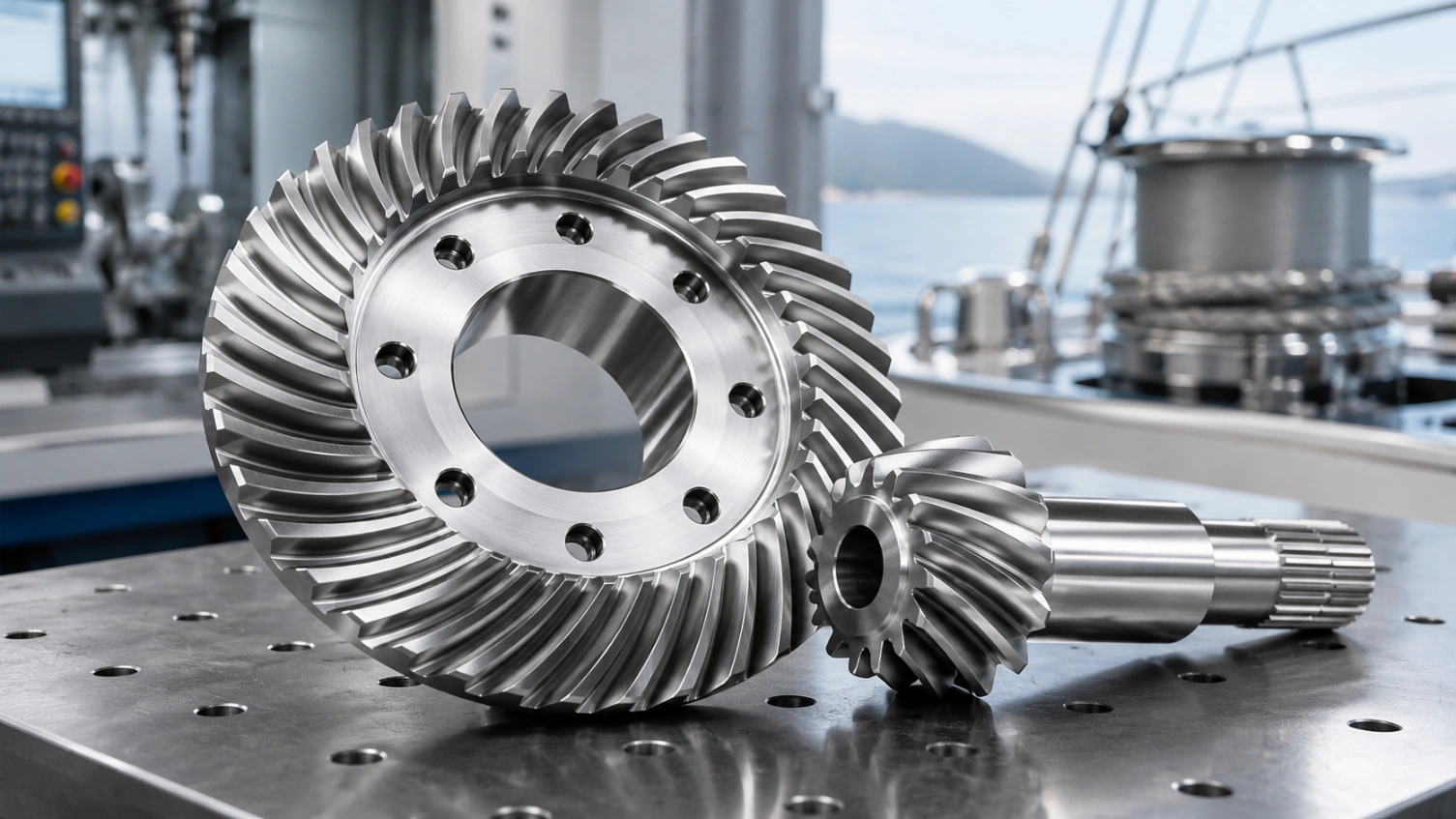
High-precision straight, spiral, Zerol, and miter bevel gears — plus bevel pinion gears, bevel gear shafts, and matched sets — for right-angle (90°) and non-90° shaft drives. Module 0.5–16, shaft angles 45°–135°. Gleason & Klingelnberg ground to AGMA 10 / DIN 6, lapped and contact-pattern verified. Made in our China factory, customized quotation in 48 hours.
Spiral, straight, Zerol, miter, bevel pinion shafts, right-angle and non-90° sets, anti-backlash, miniature and large diameter — any bevel gear configuration your design calls for.
Spiral Bevel Gears
Curved, angled teeth (35° spiral angle standard) for gradual, low-noise engagement. The dominant choice for automotive differentials, high-speed industrial right-angle drives, and aerospace gearboxes. Custom spiral bevel gears in matched pairs.
GleasonLapped Pair
Straight Bevel Gears
Straight-tooth, straight-cut bevel gears radiating from the apex. Produced on Coniflex or Revacycle machines. Simpler and lower cost than spiral bevel gears — the preferred straight bevel gear set for hand tools, low-speed drives, and applications where cost dominates.
ConiflexLow-Speed
Zerol Bevel Gears
Curved teeth with zero spiral angle — combines the low axial thrust of straight bevel with the smoother engagement of curved teeth. Quieter than straight bevel, less expensive than spiral bevel. Custom Zerol bevel gear pairs cut on Gleason machines.
Zero SpiralLow Thrust
Miter Bevel Gears (1:1 Ratio)
Bevel gear pairs with equal tooth counts and 90° shaft angle — used purely to change rotation direction, not speed. Always replaced as a matched miter pair. Common in machine tool right-angle heads, camera pan drives, and conveyor corner units.
1:1Direction Change
Bevel Pinion Gears & Pinion Shafts
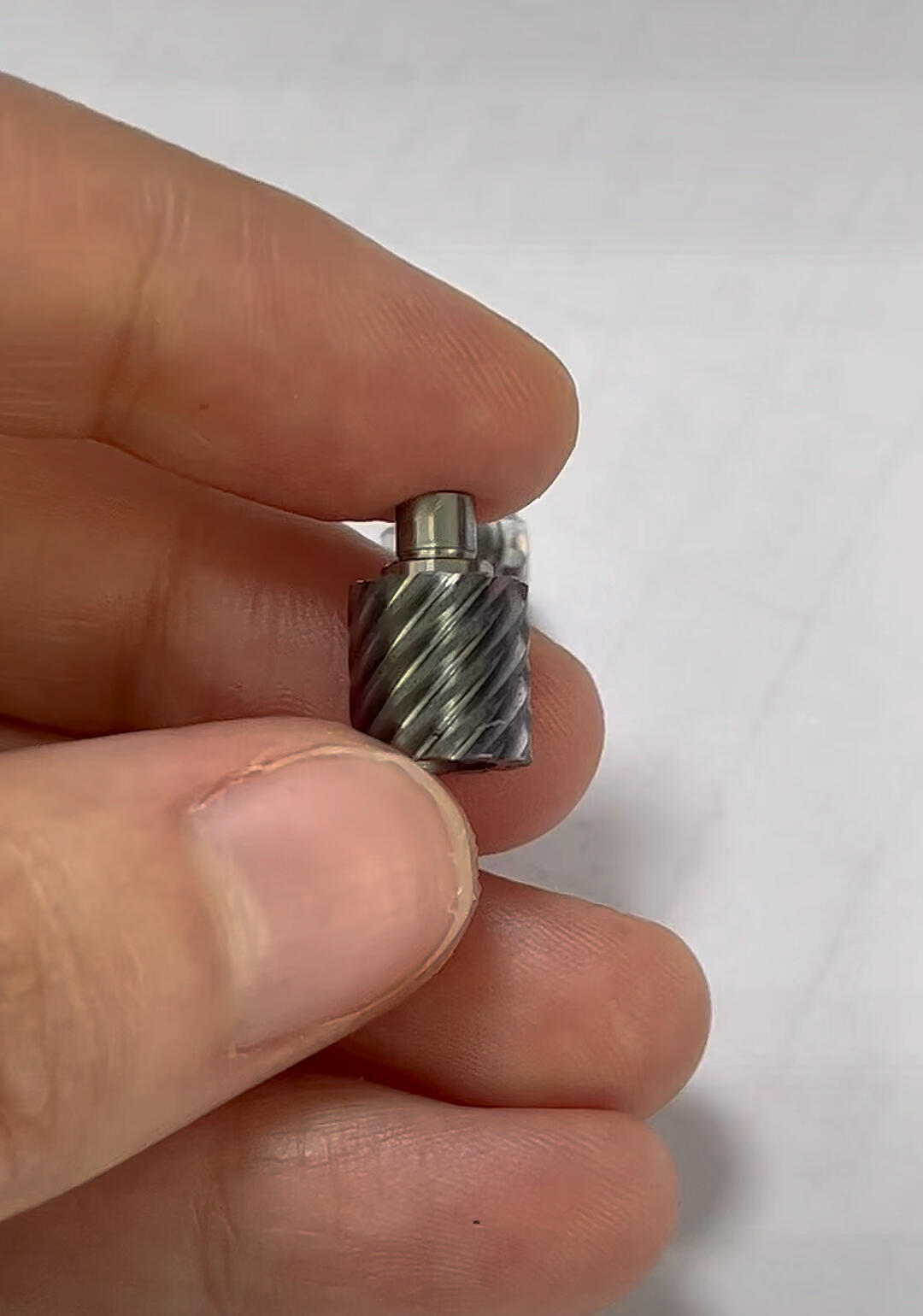
Bevel pinion gear and shaft machined as one part for maximum concentricity (TIR ≤ 0.010 mm) — eliminates assembly tolerance stack. Standard solution for spiral bevel pinion gear assemblies in automotive differentials and robotic wrist drives.
Bevel + ShaftConcentric
Right-Angle & Non-90° Bevel Sets
90° right-angle bevel gears are the standard, but we regularly produce 45°, 60°, 75°, and 135° shaft-angle bevel gears for specialty drives — surgical instruments, articulating handwheels, and custom robot joints. Both gear and pinion redesigned for the shaft angle.
90° · 45°Non-Std
Anti-Backlash & Zero-Backlash Bevel Gears
Spring-loaded split designs or precision-ground / lapped pairs achieving sub-arcminute lash. For servo-positioned right-angle drives, optical instruments, surgical robotics, and indexing tables where bevel gear backlash directly affects position accuracy.
ServoSub-arcmin
Miniature, Small & Large Diameter Bevel Gears
From micro / miniature bevel gears (M 0.3, sub-15 mm OD) for medical and optical instruments, to large diameter bevel gears (OD up to 600 mm) for heavy industrial gearboxes and marine drives. Full size range in steel, brass, stainless, aluminum, and plastic.
M 0.3–16OD ≤ 600mm
Technical Specs
Bevel Gear Machining Capabilities
From face-milling and face-hobbing of spiral bevel gears to straight bevel hobbing and 5-axis CNC bevel gear cutting — four dedicated bevel gear manufacturing processes covering every type and accuracy requirement. Full bevel gear cutting services from prototype through production.
Our Gleason-format CNC spiral bevel gear cutting and grinding machines produce matched spiral bevel gear sets with optimised tooth contact patterns. Klingelnberg face-hobbing also available on request. Gear and pinion are always cut, ground, and lapped as a matched pair — the proven spiral bevel gear manufacturing process for automotive differentials, marine drives, and industrial right-angle gearboxes.
Module range
1 – 16 mm
Max OD (gear)
600 mm
Shaft angle
60°–120° (standard 90°)
Spiral angle
25°–35° (Gleason standard 35°)
Quality grade
AGMA 9–10 / DIN 6 precision
Profile tolerance
±0.006 mm
Lapping included
Yes — contact pattern verified
Lead time
12 – 22 days
Straight Bevel Gear Hobbing & Cutting
Straight bevel gears (including miter gears at 1:1 ratio) are produced on CNC bevel gear hobbing machines using the Coniflex or Revacycle process. Straight bevel gear manufacturing is simpler and lower cost than spiral bevel, and preferred for low-speed, noise-tolerant applications. Straight bevel gear grinding is available for AGMA 9 precision when needed.
5-axis CNC bevel gear milling generates tooth forms directly from solid bar or forging — no dedicated bevel gear machine required. The fastest path for prototype quantities (1–20 pcs) of any tooth form: straight, spiral, Zerol, or non-standard shaft angles. CNC bevel gear cutting is also the only viable process for machined plastic bevel gears.
Module range
1 – 16 mm
Shaft angle
Any — non-standard OK
Tooth form
Straight, spiral, Zerol, custom
Quality grade
AGMA 7–8 / DIN 8
MOQ
1 pc
Lead time (proto)
5 – 10 days
Materials
All metals + engineering plastics
Integrated features
Shaft, hub, keyway in one op
Bevel Gear Lapping, Inspection & Measurement
Every matched spiral bevel gear pair is run-in on a gear lapping machine. The contact pattern is inked, photographed, and compared to the design bearing specification before shipment. Lapped bevel gears arrive quiet and efficient from the first assembly — no trial-and-error at the customer's end. Full bevel gear inspection and measurement report enclosed with every order.
Contact pattern
Inked & photographed per pair
Target bearing
Per Gleason / customer spec
Noise check
Run-in at rated speed in oil bath
Backlash
Measured & reported per DIN 3967
CMM check
Profile, runout, face angle
Report supplied
Yes — per pair, with photos
Applies to
All spiral & Zerol bevel pairs
Materials
50+ Certified Materials
Full mill certificates and spectral analysis on every batch — metal bevel gears in steel, stainless, brass, bronze, aluminum, plus plastic bevel gears in POM, nylon, and PEEK.
Metals
Engineering Plastics
20CrMnTi Steel
Case-hardened, HRC 58–62 surface. The default for hardened steel bevel gears in automotive differentials and heavy spiral bevel sets.
High LoadHardenedAutomotive
42CrMo4 Alloy Steel
Through-hardened forged bevel gear blanks for large-diameter industrial spiral bevel gears where case carburizing depth is insufficient.
Heavy DutyForged Blank
Al 6061-T6 / 7075
Lightweight aluminum bevel gears, anodizable. Aerospace actuators, robot wrist joints, and precision instruments where mass matters.
LightweightAnodizable
C36000 Brass
Free-machining brass bevel gears, low-noise operation. The default for small miter and bevel gear pairs in clocks and instruments.
Low NoiseCorrosion-Res.
Phosphor Bronze
Self-lubricating against steel mate. Bronze bevel gears excel as the wear-resistant element in slow-speed industrial bevel drives.
Self-LubricatingWear-Res.
SUS304 / 316L Stainless
Customized stainless steel bevel gears — food-grade, marine, and medical applications. Passivated for full corrosion immunity.
MarineMedical
POM (Delrin)
Self-lubricating Delrin bevel gears, low friction, often run dry. The default plastic bevel gear material for service robots, consumer products, and quiet right-angle drives.
Self-lubricatedLow Noise
Nylon PA66-GF30
30% glass-filled nylon bevel gears with higher load capacity than POM. Machined plastic bevel gears for tooth precision rather than moulded.
High StrengthLightweight
PEEK
High-temperature PEEK plastic bevel gears, rated to 260°C. Chemical-resistant, sterilizable for surgical and lab instruments — including plastic spiral bevel gear pairs by 5-axis machining.
High TempChemical Res.
Reference
Bevel Gear Standard Specifications
Module, shaft angle, spiral angle, tolerance — the standard bevel gear specifications every drawing should define. A working reference for engineers preparing CAD, RFQs, and bevel gear quotations.
📏Bevel Gear Module Chart (Metric)
Per ISO 678 / DIN 780, bevel gear module sizes follow the same standard series as spur and helical — module always refers to the large end (back cone) for bevel gears:
Series I
Series II
Typical Bevel Use
0.5, 0.8, 1, 1.25, 1.5
0.7, 0.9, 1.125
Miniature & instrument bevel gears
2, 2.5, 3, 4, 5
2.25, 2.75, 3.5, 4.5
Industrial bevel gears, robot wrist
6, 8, 10, 12, 16
5.5, 7, 9, 11, 14
Automotive differentials, heavy industrial
∠Shaft Angle Reference (Σ)
The shaft angle (Σ) is the angle between the gear and pinion axes. 90° (right angle) is by far the most common, but other angles are valid bevel gear configurations:
Shaft Angle Σ
Status
Common Use
90° (right angle)
Default
Automotive, industrial, robotic — 95% of use
45° / 60°
Specialty
Handwheel drives, articulating heads
120° / 135°
Specialty
Surgical instruments, indexing
≠ 90°
Custom
Both gears require non-standard pitch cone angles
🔄Spiral Angle & Hand Reference
Spiral angle (β) defines the curve of teeth on a spiral bevel gear. Hand (left or right) determines axial thrust direction — gear and pinion must have opposite hands:
Spiral Angle β
Gear Type
Notes
0°
Straight bevel
Coniflex/Revacycle, straight tooth, straight cut
0° (curved)
Zerol bevel
Smoother than straight, no axial thrust
35°
Spiral bevel
Gleason standard — automotive, industrial
25°–45°
Spiral bevel
Klingelnberg / specialty
✓AGMA / DIN Quality Grades
Bevel gear standards per AGMA 2005-D03 / ISO 17485 / DIN 3971–3978. Higher precision classes require post-hardening Gleason grinding:
AGMA Class
DIN
Application
7 – 8
8 – 9
Hand tools, conveyors, low-speed
9
7
Industrial bevel gearboxes, automotive standard
10
6
High-speed spiral bevel, precision differentials
11+
4 – 5
High precision bevel gears — aerospace, instruments
ƒKey Bevel Gear Formulas
Pitch cone angle for a 90° shaft angle — defines the cone half-angle for each gear in the pair:
δ₁ = arctan(z₁ / z₂) · δ₂ = arctan(z₂ / z₁)
Mean cone distance Rm = Re − b/2 (where Re = outer cone distance, b = face width). Pitch diameter at large end: d = m × z. Face width recommendation: b ≤ Re/3 to maintain proper tooth proportion.
📐Bevel Gear Drawing Checklist
A complete bevel gear drawing must specify every item below. Missing the spiral hand or shaft angle will block quoting:
• Module (m) — large end
Required
• Tooth count (z₁ / z₂)
Required
• Shaft angle (Σ)
Required
• Tooth form (straight / spiral / Zerol)
Required
• Spiral angle & hand (if spiral)
Required
• Pressure angle (default 20°)
Required
• Face width (b)
Required
• Mounting distance
Required
• AGMA / DIN accuracy class
Required
• Material, heat treatment, finish
Required
Why HXC
Why Choose HXC as Your Bevel Gear Manufacturer
A China bevel gear factory with in-house Gleason cutting, grinding, lapping, and contact-pattern verification — direct factory pricing, customized quotation in 48 hours, no middleman.
🏭
China Bevel Gear Factory in Dongguan
Our HXC bevel gear factory in Dongguan, China runs Gleason cutters, Gleason grinders, Klingelnberg analyzers, and dedicated bevel gear lapping machines — all under one roof. Made in China since 2008, exporting to 35+ countries as a direct china bevel gear manufacturer.
💬
Customized Bevel Gear Quotation in 48h
Upload your drawing — we return a customized bevel gear quotation with material, process (Gleason vs 5-axis), AGMA class, lapping spec, lead time, and unit price. Manufacturer quotation direct from our engineering team — no salesman handoff, no middleman markup on bevel gear price.
🎯
Gleason & Klingelnberg — In-House
Most bevel gear suppliers outsource Gleason cutting and grinding. We don't. Our spiral bevel gear factory has dedicated Gleason 463 / 600HC cutters and Gleason 600G grinders, plus Klingelnberg analyzers — the full spiral bevel gear manufacturing chain in one facility.
🧩
All Types · MOQ 1 pc
Custom spiral bevel gears, straight bevel gears, custom Zerol bevel gear, miter pairs, plastic spiral bevel gear, bevel pinion shafts — one factory, all types. Custom bevel gear manufacturers usually specialize in one process; we run all four in parallel. 1 pc MOQ for prototypes.
Case Studies
Real Bevel Gear Projects
Spiral bevel gear sets, straight bevel gear pairs, and specialty bevel gears for demanding applications — all made in our China factory.
✓ 5-Axis + Hard anodized · Backlash < 0.018 mm · FAI approved
Marine
Spiral Bevel Set — Marine Winch Drive
Material
SUS316L
Ratio
1:3
Treatment
Passivated
Quantity
50 sets
✓ 3-year salt-spray tested · No corrosion in service after 18 months
How It Works
From Drawing to Your Door
Upload your bevel gear drawing — specify shaft angle, module, tooth counts, spiral angle and hand (if applicable), and accuracy class. We handle bevel gear cutting, grinding, lapping, and contact pattern verification.
01
Upload Drawing
Include shaft angle, module, Z, spiral angle, hand, and AGMA/DIN class.
02
Customized Quotation in 48 Hours
Manufacturer quotation direct from our engineering team — Gleason vs 5-axis process recommendation, material, firm lead time, and factory pricing.
03
Production & Lapping
Bevel gear cutting, heat treatment, grinding, lapping, and contact pattern verification for every matched pair.
04
Ship Worldwide from China
Matched pairs marked and packed together. Full inspection report and contact pattern photos enclosed. DHL / FedEx / sea freight.
Quality
Zero-Defect Commitment
Every bevel gear pair leaving our China factory passes profile measurement, CMM inspection, and contact pattern verification before shipment.
Certifications & Equipment
✓
ISO 9001:2015
All bevel gear manufacturing processes certified under our QMS
📐
AGMA 2005 / DIN 3971 Standards
Bevel gear tolerances to AGMA 2005-D03 and DIN 3971 — spiral angle, pitch cone, tooth thickness all reported.
🔭
Gleason 300GMM Analyser
Dedicated bevel gear analyser measures tooth surface topography, flank form deviation, and spiral angle on every production batch.
📄
Contact Pattern Photos
Every matched spiral bevel pair is lapped and contact pattern is inked, photographed, and approved before shipment.
4-Stage Inspection Protocol
1
Material & Blank Check
Spectral analysis confirms alloy. Blank face angle, pitch cone angle, and back cone distance are verified before gear cutting begins.
2
Post-Cutting Measurement
Gleason analyser checks tooth surface topography — pitch, flank form, and spiral angle on gear and pinion before hardening.
3
Post-Grinding & Lapping
After heat treatment and Gleason grinding, the matched pair is run on the lapping machine. Contact pattern is inked and must show central bearing of correct size before approval.
4
Final Outgoing Inspection
CMM verifies mounting dimensions, bore, and face angles. Backlash measured and recorded. Full report with contact pattern photos shipped with every order.
Reviews
Trusted China Bevel Gear Manufacturer
★★★★★
"800 sets of spiral bevel gears for our SUV differential programme. Gleason ground, lapped, contact pattern photos supplied with every batch. Zero noise failures in production assembly. HXC's quality system is as good as our Tier 1 local suppliers — at a much better price."
RH
Robert H.
Drivetrain Engineer · Germany
★★★★★
"Al 7075 bevel gears for our robot wrist — non-standard 110° shaft angle, AGMA 9, 5-axis machined. HXC was the only supplier willing to quote this geometry at prototype quantities. Delivered in 8 days. Contact pattern was perfect."
MT
Marco T.
Robotics Lead Engineer · Italy
★★★★★
"SUS316L spiral bevel sets for a subsea actuator. Critical corrosion requirements — passivated, salt-spray certified, full material traceability. HXC met every requirement. We've been using them for three product generations now."
AK
Annika K.
Subsea Systems Engineer · Norway
FAQ
Bevel Gear — Frequently Asked Questions
Common questions from engineers and buyers about bevel gears, spiral bevel gears, customized bevel gear quotations, and bevel gear manufacturing.
A bevel gear is a gear with teeth cut on a conical surface, designed to transmit power between intersecting shafts — most commonly at 90° (right angle), but other shaft angles are possible. The teeth can be straight (straight bevel gear), spiral (spiral bevel gear), or curved with zero spiral angle (Zerol bevel gear). Bevel gears are the standard solution for right-angle power transmission in automotive differentials, industrial right-angle gearboxes, robot wrist joints, and hand tools.
Straight bevel gears have teeth that radiate straight from the apex, giving simultaneous full-tooth contact — simple, low-cost, but noisy and limited to lower speeds (below ~5 m/s pitch velocity). Spiral bevel gears have curved, angled teeth (spiral angle typically 35°) that engage gradually, like helical gears, producing quieter operation, higher load capacity, and suitability for high speeds. Nearly all automotive differentials and high-speed industrial right-angle drives use spiral bevel gears. Straight bevel gears are preferred for hand tools, low-speed drives, and applications where cost dominates.
Bevel gear price depends on six variables: (1) module & gear OD — larger gears cost more; (2) tooth form — straight bevel cheapest, Zerol mid-range, spiral bevel most expensive due to Gleason cutting and lapping; (3) material — 20CrMnTi carburized is more expensive than 42CrMo4 through-hardened; (4) AGMA accuracy class — AGMA 10 (ground and lapped) is roughly 2–3× the price of AGMA 8 (cut only); (5) heat treatment — carburizing + grinding adds 25–40%; (6) order quantity — 1-piece prototypes cost more per unit than 100-set batches. Send your drawing for a free customized quotation — we typically respond within 48 hours with firm spiral bevel gear price and lead time.
A miter gear is a straight or spiral bevel gear with a 1:1 ratio — both gears in the pair have the same number of teeth and the shaft angle is exactly 90°. Miter gears are used purely to change direction of rotation, not to change speed. They are manufactured in matched pairs and must always be replaced as a pair. Common applications include machine tool right-angle heads, camera pan drives, and conveyor corner units. HXC produces miter bevel gear pairs in all standard modules from M0.5 to M12.
The Gleason system is the dominant American method for designing and manufacturing spiral bevel gears, using face-milling (one tooth space at a time with a cup-shaped cutter). Gleason gears have a tapered tooth depth and are cut as matched pairs — gear and pinion must be used together and are not interchangeable. The alternative Klingelnberg (Palloid) system uses face-hobbing with a conical hob, producing constant tooth depth and theoretically interchangeable gears. HXC uses Gleason-format machines for most spiral bevel production — specify "Gleason" or "Klingelnberg" on your drawing if you have a preference.
The contact pattern (or bearing pattern) is the area of the tooth flank that actually contacts under load — revealed by running the gear pair together with marking compound and examining the ink mark. For spiral bevel gears, the design contact pattern should be a central oval occupying 50–60% of the tooth flank. Edge contact (bearing at the toe or heel) concentrates load and causes early fatigue failure. A correct contact pattern indicates proper mounting distance and offset. HXC inks, photographs, and records the contact pattern for every matched spiral bevel pair before shipment.
Yes — anti-backlash bevel gears use either spring-loaded split designs (two gear halves preloaded against each other) or precision-ground / lapped pairs with controlled tooth thickness. Zero-backlash bevel gears in the strict sense achieve sub-arcminute lash via lapping and selective assembly. Anti-backlash is used in servo-positioned right-angle drives, optical instruments, surgical robotics, and indexing tables where bevel gear backlash directly affects position accuracy. Specify maximum allowable backlash (e.g. ≤0.015 mm) on your drawing; we will recommend the appropriate technique.
Straight bevel gears are the noisiest gear type — their simultaneous full-tooth engagement creates an impulsive load similar to spur gears, but amplified by the conical geometry. Spiral bevel gears are significantly quieter — tooth engagement is gradual and the contact line sweeps across the flank, smoothing the load application. Ground and lapped spiral bevel pairs (AGMA 10 / DIN 6) in a correctly preloaded housing are among the quietest right-angle drive options. Zerol bevel gears (zero spiral angle with curved teeth) are intermediate — quieter than straight bevel, cheaper to produce than spiral bevel.
Yes — bevel gears can be designed for any shaft angle between 45° and 135°. The standard is 90° (right angle), but 45° (used in handwheel drives), 60°, and 120° are also produced regularly. Non-standard shaft angles require custom gear designs — the pitch cone angles, spiral angle, and face angles all change. HXC's engineers design non-standard bevel gear sets from your shaft angle and ratio requirements. For prototype non-standard bevel gears, 5-axis CNC milling is used; for production quantities, dedicated Gleason or Klingelnberg machine setups are created.
Bevel gears require gear oil (not bearing grease) because tooth sliding velocities on spiral bevel flanks are significant. For automotive differentials: SAE 75W-90 or 80W-140 hypoid gear oil (EP additives essential — standard gear oil will cause pitting on spiral bevel flanks). For industrial right-angle gearboxes: ISO VG 220–320 mineral or synthetic gear oil. For low-speed straight bevel gears: grease lubrication is acceptable. Plastic bevel gears (POM, Nylon) can run dry in light-duty applications. Stainless bevel gears in food applications use NSF H1 food-grade gear oil.
HXC's bevel gear factory is located in Dongguan, Guangdong, China — a major precision manufacturing hub in the Pearl River Delta. We have been a Chinese bevel gear manufacturer since 2008, exporting to clients in Germany, USA, Japan, France, Italy, Korea, and 30+ other countries. All gear cutting, heat treatment, Gleason grinding, lapping, and Klingelnberg inspection are performed in-house — no outsourcing to subcontractors. Factory visits and video audits are welcome for procurement teams qualifying new china spiral bevel gear suppliers.
Helical gears transmit power between parallel shafts using angled teeth on a cylindrical body. Bevel gears transmit power between intersecting shafts using teeth on a conical body. For parallel shafts, helical gears are the standard; for right-angle drives, bevel gears are used. A helical bevel gear or bevel-helical gearbox combines both: a bevel stage changes the shaft angle (usually 90°) and a helical stage provides the main speed reduction. This is the dominant configuration in industrial multi-stage right-angle gearboxes.
Both transmit power at 90°, but with fundamental differences: Bevel gears work on intersecting axes (shafts meet if extended), are highly efficient (97–99% per mesh), fully reversible, and limited to moderate ratios (typically 1:1 to 1:6 per stage). Worm gears work on non-intersecting, non-parallel axes (shafts are offset), can achieve high ratios in one stage (5:1 to 100:1), are self-locking at low lead angles, but are less efficient (50–90% depending on ratio and lead angle). Choose bevel for efficiency and reversibility; choose worm for high ratio, compactness, and self-locking.
Gleason-system spiral bevel gears are produced as matched sets because the cutting and grinding corrections applied to one gear are compensated by the mating gear. The tooth surfaces of gear and pinion are designed together to produce the correct contact pattern and backlash — the pinion is not interchangeable with a pinion from a different set, even of nominally identical dimensions. Replacing only one gear of a worn pair will produce incorrect contact pattern, excessive noise, and rapid failure. Always replace gear and pinion together. HXC marks matched pairs with the same serial number before shipment.
Accuracy requirements for bevel gears: AGMA 7–8 / DIN 8–9 for general industrial straight bevel gears — hand tools, conveyors, low-speed drives. AGMA 9 / DIN 7 for industrial spiral bevel gearboxes, standard automotive applications. AGMA 10 / DIN 6 for high-speed spiral bevel drives, precision machine tools, performance automotive differentials. AGMA 11+ / DIN 5 for aerospace and high precision bevel gears — requires Gleason profile grinding after hardening. Higher accuracy class significantly increases lead time and cost due to the grinding and lapping steps. Our engineers will recommend the appropriate class for your speed, load, and noise requirements.
The hand (left or right) of the spiral on a bevel gear determines the direction of the axial thrust force under load. For a right-hand spiral gear: when viewed from the back face, the teeth curve to the right. For a left-hand spiral gear: the teeth curve left. In a standard bevel gear pair, the gear and pinion have opposite hands (one right, one left). The choice of hand affects bearing loading direction — specify based on your housing design so thrust loads are directed toward (not away from) the mounting bearings. Include hand specification on your drawing; if omitted, HXC will contact you to confirm before cutting.
Practical bevel gear ratios range from 1:1 (miter gears) to approximately 1:6 in a single stage. Ratios above 1:5 are possible but result in a very large gear and small pinion — the pinion becomes fragile, and the size difference makes paired lapping more difficult. For high-ratio right-angle drives (>6:1), a spiral bevel stage combined with a helical reduction stage (as in a helical-bevel gearbox) is more practical. Alternatively, worm gears provide high ratios in a single stage at the cost of lower efficiency. HXC produces bevel gear sets up to approximately 1:8 — contact our engineers for larger ratios.
Lead times for bevel gears: Prototype straight bevel pair (5-axis milling): 5–8 days. Small batch straight bevel (50–200 pairs, hobbing): 8–14 days. Spiral bevel prototype (5-axis): 7–12 days. Spiral bevel production (Gleason, hardened + ground + lapped): 14–22 days. Large spiral bevel (>Ø200mm): 18–28 days. Lapping and contact pattern verification add 3–5 days versus non-lapped production. Rush production is available — discuss your timeline when uploading your drawing.
For maximum contact fatigue strength (pitting resistance) and bending fatigue life in spiral bevel gears: 20CrMnTi carburized and case-hardened to HRC 58–62 is the global automotive standard. For larger gears where case depth is insufficient by carburizing: 42CrMo4 through-hardened to HRC 50–55. For aircraft and motorsport bevel gears requiring the best specific strength: M50 or 9310 aircraft-grade steel with vacuum arc remelting (VAR). For corrosive environments: precipitation-hardened stainless steel (17-4PH) offers the best combination of strength and corrosion resistance for bevel gears.
Get a Quote
Send Your Drawing. Get a Quote.
Every enquiry includes a DFM review — tolerance feasibility, material confirmation, and process approach confirmed before production starts. MOQ 1 piece.
24hr
Quote Response
MOQ 1
Prototypes OK
ISO
9001:2015
📐
DFM Review on Every Enquiry
Tolerance feasibility, fixturing strategy, and material confirmation. Specific, actionable feedback — not generic pushback.
🎯
First Article Inspection — Standard
FAI report on every new run. Material certs and surface treatment certs included with every shipment.
🔄
Same Process: Prototype to Production
Process plan from your prototype applies to production batches. No re-qualification when you scale.
⚙
3 / 4 / 5-Axis CNC + Turning
Complex structural parts, shafts, housings, and transmission components. Metals and engineering plastics.
ISO 9001:20153/4/5-Axis MillingCNC TurningCMM InspectionGlobal Delivery