
Annealing is a controlled heat-treatment process used to soften metal, restore ductility, reduce residual stress, and create a more uniform microstructure for subsequent manufacturing.
Rolling, bending, drawing, welding, casting, and machining can all leave a material with work hardening, nonuniform stress, or unstable dimensions. A properly designed thermal cycle changes that internal condition without changing the component’s basic geometry.
The result depends on far more than reaching a furnace setpoint. Material grade, prior processing, section thickness, atmosphere, soak time, heating uniformity, and cooling rate must work together as one controlled process.
The Microscopic Science: What Happens During Annealing?
Manufacturing changes a metal below the visible surface. Plastic deformation increases dislocation density, while thermal gradients and nonuniform forming can leave locked-in residual stresses. These effects may raise strength and hardness, but they can also reduce ductility, complicate machining, and make a part more likely to distort when additional material is removed.
Crystal Lattice and Dislocation Density
During cold working, metal crystals deform and dislocations multiply and interact. As dislocation movement becomes more difficult, the material work-hardens: strength and hardness rise while ductility generally falls.
Annealing supplies enough thermal energy for the structure to move toward a lower-energy condition. The exact response depends on the metal, its prior strain, and the selected temperature-time cycle.
The Three Stages of Microstructural Change
Recovery
Dislocations rearrange and some residual stress is reduced, usually with limited change in grain shape and mechanical properties.
Recrystallization
New, relatively strain-free grains nucleate and grow, lowering hardness and restoring ductility after cold work.
Grain Growth
Extended time or excessive temperature allows grains to coarsen, which may reduce strength and harm the intended property balance.
Phase Diagrams and Critical Temperatures
Steel annealing often uses the iron-carbon phase diagram to identify transformation regions. The A1 temperature marks the eutectoid transformation boundary, while A3 applies to hypoeutectoid steels and Acm applies to hypereutectoid steels. Actual transformation temperatures during heating and cooling also shift with composition and heating rate.
A full anneal may heat an appropriate steel grade above its relevant critical boundary, hold it long enough to establish the required austenitic structure, and then cool it slowly. Subcritical stress relief and process annealing operate below these transformation boundaries. This distinction is important when selecting a route for carbon steel CNC machining.
Important: Annealing temperature is not a universal number. The correct cycle must come from the exact alloy specification, prior condition, section geometry, furnace capability, and required final properties.
Why Anneal? Core Manufacturing Benefits
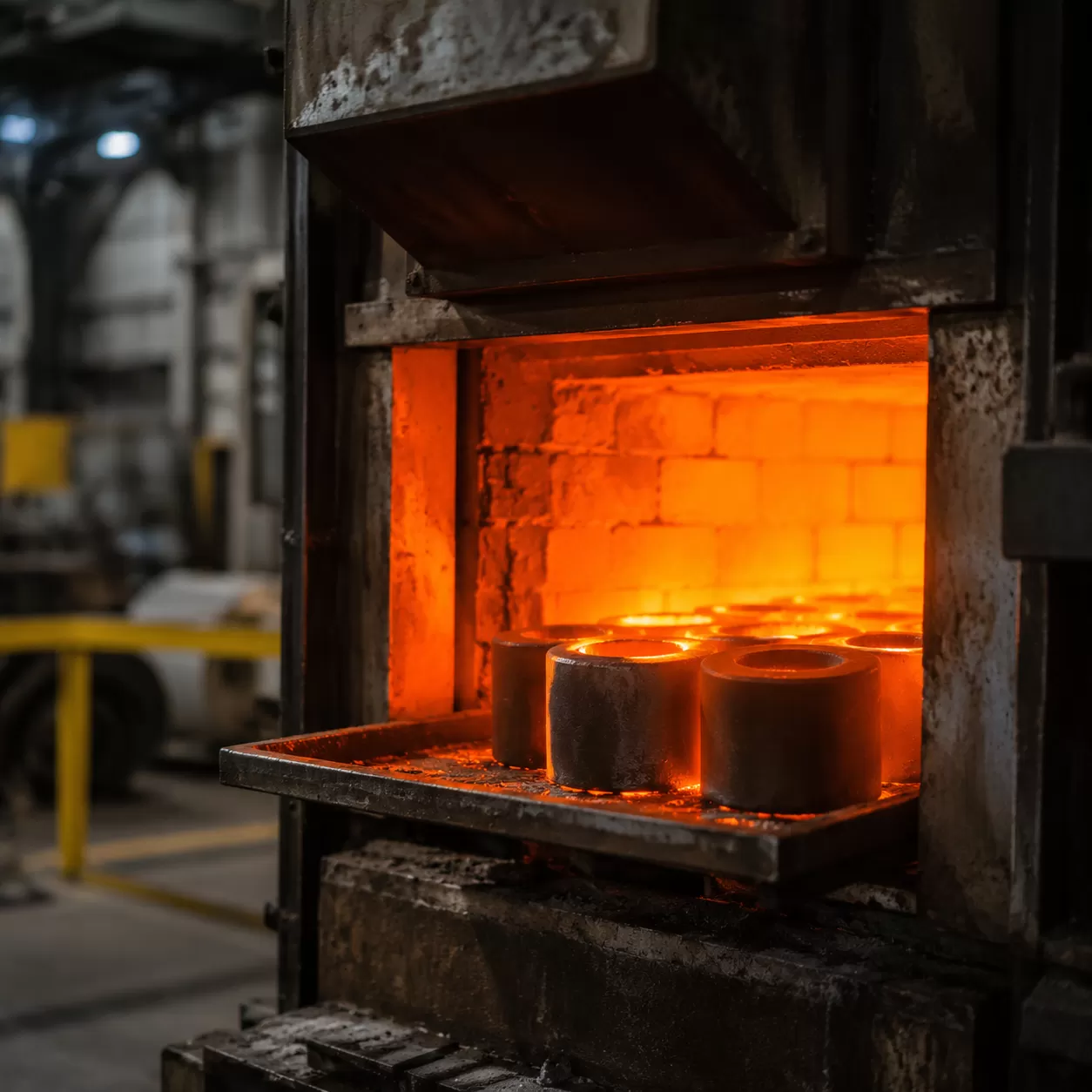
Annealing is used when the current material condition creates risk for forming, machining, dimensional control, or long-term service. The treatment does not automatically improve every property; rather, it deliberately trades some hardness or strength for a more workable and stable state.
Key Performance Advantages
- Improved machinability: Softening selected steels can reduce cutting forces, improve chip formation, and extend tool life before CNC milling or turning.
- Residual-stress reduction: A controlled stress-relief cycle can reduce the distortion risk created by welding, casting, forming, or heavy stock removal.
- Restored ductility: Recrystallization can reverse cold-work hardening and allow further drawing, bending, rolling, or stamping.
- Microstructural uniformity: The correct cycle can create more predictable material behavior across a workpiece.
- Electrical and magnetic adjustment: Certain copper, electrical steel, and specialty-alloy applications use annealing to improve conductivity or magnetic response.
| Manufacturing Challenge | Annealing Response | Potential Production Benefit |
|---|---|---|
| High cutting forces | Reduce hardness in a suitable grade | More stable machining and longer tool life |
| Part movement after unclamping | Reduce residual-stress gradients | Better dimensional stability through finishing |
| Cracking during forming | Restore ductility after cold work | Greater forming depth and fewer rejected parts |
| Variable material response | Develop a more uniform microstructure | More predictable feeds, finishes, and inspection results |
Common Types of Annealing Processes
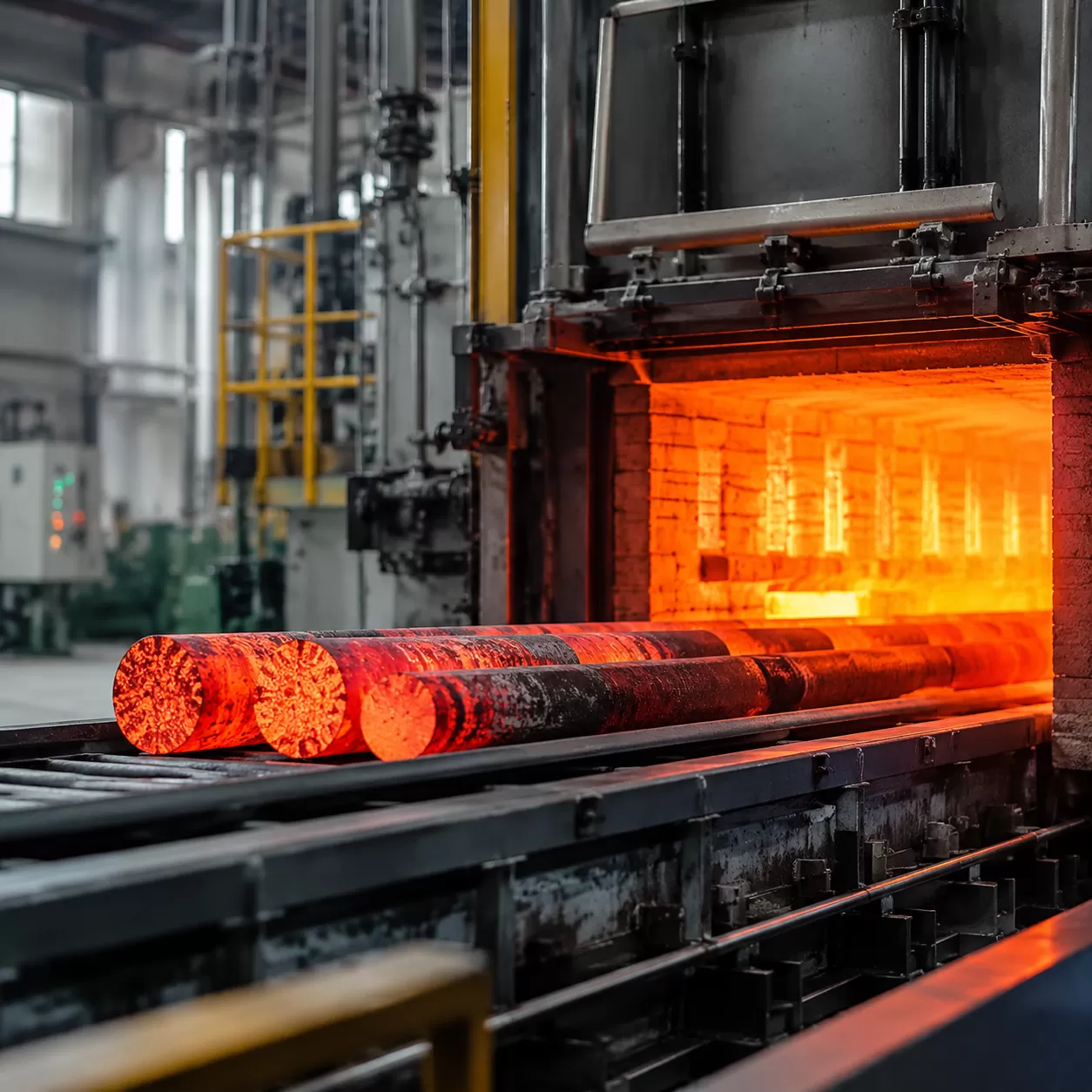
No single annealing cycle solves every manufacturing problem. The process is selected according to alloy family, carbon content, prior deformation, required hardness, and the next production step.
Full Annealing
For suitable steels, full annealing involves heating into the austenitic region, soaking for transformation and temperature uniformity, and cooling slowly, commonly in the furnace. The resulting coarse pearlitic structure is softer and generally easier to machine than normalized or hardened conditions.
Process or Intermediate Annealing
This subcritical treatment is commonly used between cold-working operations in low-carbon steels and non-ferrous alloys. Heating above the material’s recrystallization range restores ductility without using the full phase-transformation route associated with steel full annealing.
Stress-Relief Annealing
Stress relief uses a temperature below the major transformation range to reduce residual stress while limiting changes to hardness and microstructure. It is useful for welded fabrications, castings, and heavily machined components such as vacuum chamber parts.
Spheroidizing Annealing
High-carbon and tool steels can be held or cycled near the eutectoid temperature to convert carbide morphology toward rounded particles in a ferritic matrix. This improves machinability and prepares the material for later hardening. It is particularly relevant to tool and mold steel processing.
The Industrial Annealing Workflow
An annealing recipe is a controlled relationship between temperature, time, atmosphere, load arrangement, and cooling rate. Furnace charts and part thermocouples are often more meaningful than the furnace setpoint alone because thick and thin sections do not heat at the same rate.
Bring the load up gradually enough to limit thermal gradients, distortion, and cracking.
Hold after the required section reaches temperature so transformation or stress relief can proceed uniformly.
Use furnace, air, or another approved cooling route to obtain the intended final structure and properties.
Step 1: Preparation and Uniform Heating
Parts should be clean and arranged so heat can circulate consistently. Protective atmospheres, vacuum furnaces, coatings, or machining allowance may be used when oxidation, scaling, or decarburization must be controlled.
Heating too aggressively can create large surface-to-core temperature differences. Those gradients may distort precision geometries or crack highly constrained and hardenable materials.
Step 2: Soaking and Temperature Equalization
Soak time begins when the controlling section of the load reaches the specified temperature, not simply when the furnace display reaches its setpoint. Required time varies with alloy, section thickness, load density, furnace type, and process objective.
The familiar “one hour per inch” phrase can be a rough historical shop convention for some steel treatments, but it is not a universal annealing rule. Production cycles should follow the applicable material specification, qualified procedure, or metallurgical calculation.
Step 3: Controlled Cooling
- Furnace cooling: Common for full annealing of steel when a slow cooling rate is needed to form a softer ferrite-pearlite structure.
- Still-air cooling: Used in selected stress-relief and non-ferrous cycles where the material does not require an extremely slow furnace cool.
- Controlled or accelerated cooling: Used only when specified for the alloy and desired condition; cooling method can materially change final properties.
For large, asymmetric parts such as a vacuum manifold, cooling uniformity is especially important because different wall thicknesses can otherwise reintroduce stress and movement.
Steel vs. Aluminum vs. Copper Alloys
Ferrous and non-ferrous alloys do not respond to heat in the same way. Steel cycles may involve transformation to and from austenite, while many aluminum, copper, and brass anneals primarily rely on recovery, recrystallization, and grain growth after cold work.
Ferrous Alloys: Carbon, Carbides, and Cooling Curves
In carbon and alloy steels, chemistry and critical temperatures control the phases that form during heating and cooling. Slow cooling from the austenitic region can promote softer ferrite and pearlite rather than the hard martensite associated with rapid quenching. High-carbon steels may instead use spheroidizing to improve machinability before final hardening.
These distinctions are important for bearing steel CNC machining, where carbide condition, hardness, and later heat treatment strongly influence the process route.
Non-Ferrous Alloys: Recrystallization After Cold Work
Aluminum, copper, and brass commonly anneal by recovery and recrystallization of a cold-worked structure rather than by the same austenitic transformations seen in steel. Temperature ranges can overlap broadly across alloy families, but the correct cycle depends on composition, temper, prior reduction, and required grain size.
HXCNC plans separate machining strategies for aluminum alloys, copper, and brass components because their thermal histories also affect burr formation, chip behavior, and dimensional stability.
General Annealing Matrix
| Material Family | Typical Process Logic | Cooling Consideration | Primary Goal |
|---|---|---|---|
| Carbon and low-alloy steel | Subcritical stress relief, full anneal, or spheroidize according to grade | Often furnace-cooled for full annealing | Reduce hardness, stress, or carbide-related machining difficulty |
| Aluminum alloys | Heat to a grade-specific annealing range after cold work | Cooling sensitivity varies; use the specified temper procedure | Restore ductility and reduce work hardening |
| Copper and brass | Recrystallization anneal based on composition and prior deformation | Air cooling or quenching may be acceptable depending on alloy and process | Restore formability and control residual stress |
How Annealing Supports CNC Machining Precision
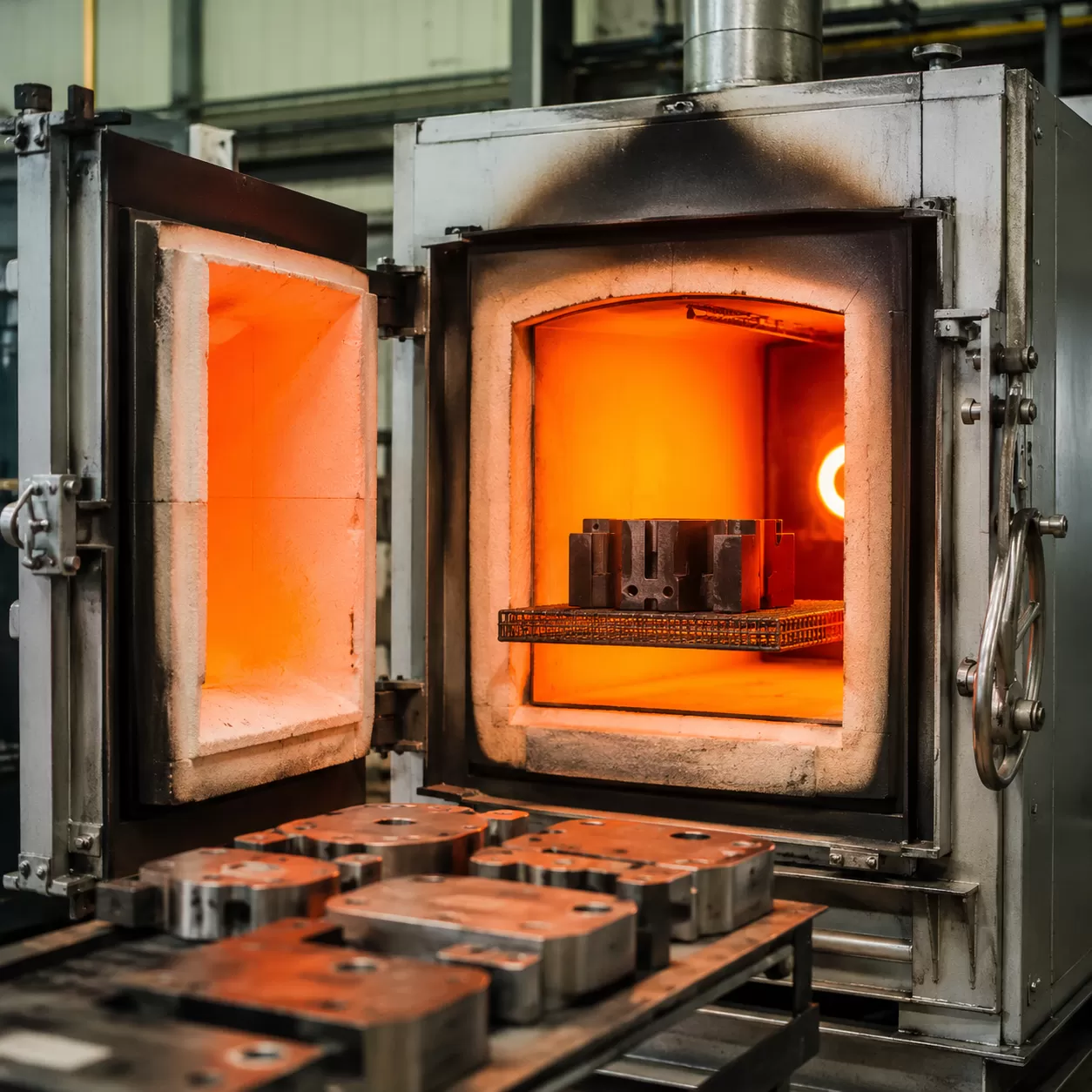
For tight-tolerance components, material stability can be as important as machine accuracy. A capable machining center cannot prevent distortion if the stock contains a strong, asymmetric residual-stress field. HXCNC incorporates material condition and thermal history into process planning for precision CNC machining services.
Reducing Springback and Dimensional Movement
Removing material changes the balance of internal stress. Thin walls, deep pockets, long shafts, and monolithic structures may bow or twist during roughing or after unclamping. Stress relief between roughing and finishing can reduce this risk, although it cannot compensate for poor fixturing, excessive heat input, or an unstable design.
This approach is useful for large components such as a monolithic machined frame, where small movements across a long span can consume the available GD&T tolerance.
Improving Tool Life and Surface Consistency
- More uniform hardness: Reduces sudden changes in cutting force and tool deflection.
- Appropriate softness: Can reduce abrasive wear and edge chipping in difficult steel conditions.
- Predictable chip formation: Supports stable feeds, speeds, and surface finish.
- Lower distortion risk: Helps preserve machining allowance for the finishing operation.
Annealing does not always create a mirror finish by itself. Surface quality still depends on material grade, inclusions, tool geometry, rigidity, coolant, cutting parameters, and the selected finishing process such as precision grinding.
Long-Term Stability in Critical Applications
Residual stress can continue to redistribute during service, particularly under heat cycling or vibration. A validated thermal treatment, combined with stable machining and inspection, helps reduce long-term dimensional drift in semiconductor vacuum equipment parts, aerospace structures, precision tooling, and metrology-sensitive assemblies.
Frequently Asked Questions
What is the difference between annealing and tempering?
Annealing generally aims to soften material, restore ductility, reduce stress, or alter microstructure through a controlled heating and cooling cycle. Tempering is normally performed after steel has been hardened by quenching; it reduces brittleness and adjusts the balance of hardness, strength, and toughness.
Can metal be over-annealed?
Yes. Excessive temperature or holding time can cause unwanted grain growth, oxidation, decarburization, loss of strength, poor surface condition, or dimensional change. The exact failure mode depends on the alloy and furnace environment.
How long does industrial annealing take?
A cycle may take several hours or much longer. Heating rate, load size, section thickness, equalization time, process temperature, and cooling requirements all contribute. The duration should be calculated or qualified for the actual part and furnace rather than selected from one general rule.
Why is furnace cooling used for full annealing?
Slow furnace cooling allows suitable steels to transform toward a softer equilibrium structure and reduces the chance of forming harder transformation products. The required cooling rate depends on grade and section size, so furnace cooling should follow the applicable process specification.