
Ferrous vs. Non-Ferrous Metals: The Core Differences
When selecting industrial manufacturing materials for your next project, the very first decision usually comes down to a fundamental choice: ferrous vs non-ferrous metals. The distinction alters everything from how a part is machined to how it holds up against the elements.
The Element of Iron
The defining factor is simple: iron (Fe). Ferrous metals contain iron, which gives them immense tensile strength but also makes them highly susceptible to rust. Non-ferrous metals contain no intentional iron. By removing iron from the equation, these materials unlock entirely different mechanical properties of alloys, such as natural corrosion resistance and non-magnetic attributes.
Comparative Breakdown
To help you make the right choice for your custom metal fabrication needs, here is a quick look at how these two categories stack up side-by-side:
| Feature | Ferrous Metals | Non-Ferrous Metals |
|---|---|---|
| Iron Content | High | None (or trace amounts) |
| Rust Resistance | Low (Prone to oxidation) | High (Naturally rust-proof) |
| Magnetic Properties | Strongly Magnetic | Non-Magnetic |
| Weight | Generally Heavy | Often Lightweight |
| Common Examples | Carbon Steel, Cast Iron | Aluminum, Copper, Titanium |
The Simple Identification Test
You do not need a laboratory to tell these materials apart. The easiest way to identify them is the magnet test.
- Grab a magnet: If it sticks firmly to the metal, you are dealing with a ferrous material.
- If it slides off: You are holding a non-ferrous metal.
Note: While a few specific ferrous alloys like austenitic stainless steel can exhibit weak magnetic pull, the magnet test remains the fastest, most reliable field check for raw materials.
Fundamental Properties of Non-Ferrous Metals

When you look at why non-ferrous metals dominate critical manufacturing sectors across the United States, it all comes down to their unique chemistry. Because these materials lack a significant amount of iron, they break free from the traditional limitations of ferrous metals, offering distinct mechanical and physical advantages.
Core Material Characteristics
| Property | Industrial Benefit | Common Applications |
|---|---|---|
| Corrosion Resistance | Zero rust formation in moisture | Marine, aerospace, chemical processing |
| High Strength-to-Weight Ratio | Maximum structural strength with low mass | Automotive components, aircraft framing |
| Thermal & Electrical Conductivity | Efficient energy and heat transfer | Electronics, busbars, heat exchangers |
| Non-Magnetic Attributes | No magnetic field interference | MRI equipment, sensitive military electronics |
| Malleability & Ductility | Easy to form, shape, and draw into wire | Deep-drawn parts, custom metal fabrication |
Exceptional Corrosion & Rust Resistance
The most significant advantage of non-ferrous alloys is their natural immunity to rust. Ferrous metals contain iron, which reacts with oxygen and moisture to create iron oxide (rust). Non-ferrous metals develop a microscopic, protective oxide layer on their surface instead. This self-healing barrier completely blocks oxygen from reaching the underlying material, making these metals indispensable for harsh outdoor, marine, and industrial environments.
High Strength-to-Weight Ratio
In modern manufacturing, saving weight without sacrificing structural integrity is crucial. Non-ferrous materials like aluminum and titanium deliver exceptional mechanical properties at a fraction of the weight of traditional steel. This high strength-to-weight ratio allows engineers to design lighter vehicles and aerospace components, directly boosting fuel efficiency and payload capacities.
Superior Thermal and Electrical Conductivity
When your project requires efficient energy transfer, non-ferrous metals are the industry standard. Copper and aluminum offer outstanding electrical and thermal conductivity. They move electricity and dissipate heat with minimal resistance, which prevents component overheating and power loss in heavy-duty industrial machinery.
Non-Magnetic Attributes
Magnetic interference can ruin sensitive electronic systems, medical devices, and precision instruments. Because they lack iron, non-ferrous metals are completely non-magnetic. This makes them the primary choice for complex custom metal fabrication projects used in aerospace wiring, high-voltage power generation, and military radar equipment.
Malleability and Ductility
Fabricating complex geometries requires materials that can bend and stretch without fracturing. Non-ferrous metals feature high malleability and ductility, meaning they can be easily rolled into thin sheets, pressed into complex dies, or drawn into extremely fine wire. This flexibility reduces tooling wear and opens up massive design freedom for stamping, pressing, and precision CNC milling operations.
Major Types of Non-Ferrous Metals & Their Best Applications
When it comes to manufacturing, we rely heavily on non-ferrous metals to do the jobs that iron and steel simply cannot handle. Because they lack iron, these materials won’t rust and offer incredible specialized properties for custom metal fabrication. Here is a breakdown of the heavy hitters we use every day.
Aluminum (Al)
Aluminum is the king of lightweight manufacturing. It is highly conductive, naturally corrosion-resistant, and incredibly easy to shape. We regularly use various aluminum machining grades to produce lightweight structural components. It is the go-to material for aerospace panels, automotive parts, and consumer electronics where saving weight is critical. For instance, we frequently use high-grade aluminum to craft high-stress components like a robot arm link that requires both agility and strength.
Copper (Cu) & Its Essential Alloys
Copper is the gold standard for electrical and thermal conductivity. If electricity or heat needs to move efficiently, copper is involved. We also work extensively with its two most famous copper alloys:
- Brass: A copper-zinc alloy known for low friction and tight sealing. It is ideal for valves, fittings, and musical instruments.
- Bronze: A copper-tin alloy celebrated for its wear resistance. It is the preferred choice for heavy-duty industrial bearings and marine hardware.
Titanium (Ti)
Titanium is the ultimate premium material. It boasts an unmatched strength-to-weight ratio, meaning it is as strong as steel but nearly half the weight. It also handles extreme temperatures and resists aggressive chemical corrosion. We utilize titanium precision parts primarily in high-end aerospace engineering, medical implants, and performance racing components.
Zinc (Zn), Nickel (Ni), and Lead (Pb)
These metals play crucial supporting and specialized roles across industrial manufacturing materials:
- Zinc (Zn): Primarily used for galvanizing steel to prevent rust, or die-casting complex, low-strength components.
- Nickel (Ni): Added to alloys to boost heat and corrosion resistance. It is vital for chemical processing equipment.
- Lead (Pb): Extremely dense and malleable, making it excellent for radiation shielding, heavy-duty batteries, and soundproofing.
Manufacturing Perspective: Machining Non-Ferrous Metals

Why Non-Ferrous Metals Excel in CNC Machining
Non-ferrous metals are the backbone of high-efficiency manufacturing. Unlike heavy ferrous metals, materials like aluminum and copper possess a lower hardness profile and superior thermal conductivity. This means they absorb less heat during cutting, significantly reducing tool wear and preventing catastrophic tool failure.
In the world of precision CNC milling, these materials allow for incredibly high spindle speeds and feed rates. You get faster cycle times, lower energy consumption, and a flawless surface finish straight off the machine. Because these metals do not stick to the cutting edges as easily as certain steels, they are ideal for high-volume production runs where consistency is non-negotiable.
The Unique Engineering Challenges
Machining non-ferrous alloys isn’t without its hurdles. Because metals like aluminum and copper are highly malleable and ductile, they can become “gummy” under intense heat. This leads to Built-Up Edge (BUE) on the cutting tools, which can ruin surface tolerances and cause micro-cracks in the workpiece.
Titanium introduces a completely different set of rules. It has an exceptional strength-to-weight ratio and low thermal conductivity, meaning heat concentrates right at the cutting edge rather than dissipating through the chip. Without precise speed calibration and specialized workholding, titanium parts can deflect, warp, or work-harden instantly, destroying expensive tooling.
HXCNC’s Specialized Machining Solutions
At HXCNC, we have engineered our workflow to master these material quirks. We utilize state-of-the-art multi-axis machining centers equipped with high-pressure through-spindle cooling systems to instantly flush away chips and eliminate heat buildup.
Our facility pairs optimized tool geometries with advanced coatings (like DLC and TiB2) designed specifically to handle aluminum machining grades and sticky copper alloys without material adhesion. Whether your project requires high-tolerance aerospace components or complex encoder shafts utilizing our advanced Swiss turning service, we deliver tight tolerances, burr-free edges, and reliable component integrity every single time.
Sustainability: High Recyclability and Value Lifecycle of Non-Ferrous Metals
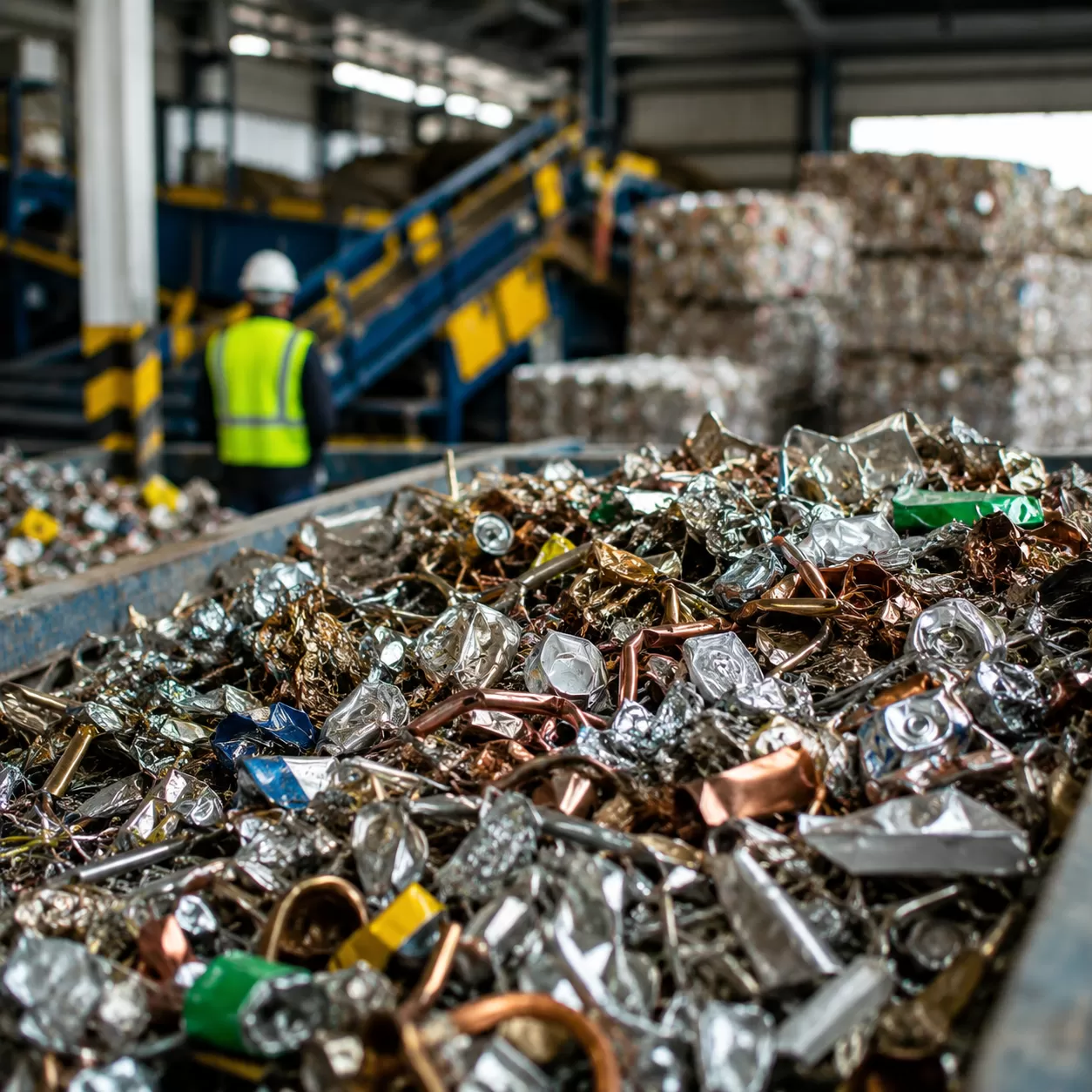
We don’t just look at performance on the shop floor; we look at the entire lifecycle of the materials we use. Non-ferrous metals are absolute champions when it comes to green manufacturing and long-term cost efficiency.
Infinite Circular Economy
Unlike plastics that degrade or ferrous metals that heavily degrade through oxidation, non-ferrous materials possess an infinite circular economy. Aluminum, copper, and titanium can be melted down and repurposed endlessly without losing their core chemical or mechanical properties.
Dramatic Energy Savings
Recycling these materials is incredibly efficient compared to primary production. Refining recycled non-ferrous stock bypasses the heavy environmental toll of raw mining:
- Aluminum recycling saves roughly 95% of the energy required to produce virgin metal from bauxite.
- Copper recycling uses up to 85% less energy than processing raw ore.
Commercial Scrap Value
From a business perspective, the sustainability of these materials directly impacts your bottom line. Because non-ferrous metals maintain their purity, their commercial scrap value remains exceptionally high. Turnings, chips, and solid remnants generated during production are highly sought after by recyclers. This high residual value allows us to offset raw material costs, making advanced fabrication projects far more economical for our partners.
Material Selection Guide: When Should You Choose Non-Ferrous?
Picking the right material can make or break your project’s performance and budget. When comparing ferrous vs non-ferrous metals, the choice usually comes down to environment, weight, and magnetism.
Here is a quick, direct breakdown to help you choose the right industrial manufacturing materials for your specific application.
| Project Requirement | Recommended Metal Type | Key Reason |
|---|---|---|
| High Moisture / Outdoor Use | Non-Ferrous | Superior corrosion resistance; will not rust. |
| Aerospace / Weight-Sensitive | Non-Ferrous | High strength-to-weight ratio. |
| Electrical / Electronics | Non-Ferrous | Excellent electrical and thermal conductivity. |
| Heavy Structural / Budget-Driven | Ferrous | High tensile strength and lower cost per pound. |
Choose Non-Ferrous if…
- You need rust protection: If your component faces outdoor elements, marine environments, or liquids, non-ferrous metals are essential. For instance, our custom zinc alloy die-cast parts offer great dimensional stability without the risk of degradation.
- Weight is a critical factor: For automotive parts, aerospace components, or handheld consumer electronics, you need materials that cut down on weight without sacrificing structural integrity.
- The part must be non-magnetic: Choose these metals for sensitive electronic enclosures, medical imaging equipment, or any application where magnetic interference ruins performance.
- Excellent conductivity is required: If your design involves heat sinks, wiring, or components that need to transfer heat or electricity efficiently, stick to copper or aluminum.
Choose Ferrous if…
- Raw strength and toughness are top priorities: For large-scale construction, heavy machinery, skyscrapers, and industrial piping, the sheer tensile strength of carbon steel or cast iron is unmatched.
- You are working with a tight budget: Ferrous metals are generally much cheaper to source in bulk than non-ferrous options.
- Magnetic properties are a benefit: If your project requires magnetic attraction—like in brake motors, electromagnets, or specific automated sorting systems—ferrous metals are the only way to go.
Frequently Asked Questions
What are 5 examples of non-ferrous metals?
Five of the most common non-ferrous metals used in industrial manufacturing materials include aluminum, copper, titanium, zinc, and nickel. Because they lack iron content, these materials are widely utilized across the United States for everything from consumer electronics to high-strength aerospace components.
Is stainless steel a non-ferrous metal?
No, stainless steel is a ferrous metal. Even though it offers exceptional corrosion resistance and can be non-magnetic in certain grades (like 300-series austenitic stainless steel), its primary base element is still iron.
Why are non-ferrous metals more expensive than ferrous metals?
Non-ferrous options generally carry a higher price tag due to lower natural abundance, complex extraction processes, and high demand for their specialized mechanical properties. However, their raw cost is offset by excellent scrap metal recycling value, superb longevity, and easier processing during precision CNC milling operations.
Can non-ferrous metals rust?
No, non-ferrous metals cannot rust because rust is scientifically defined as iron oxide. While they are completely immune to rusting, they can still corrode or oxidize over time when exposed to harsh chemicals or moisture—forming a protective patina rather than degrading structurally like iron.