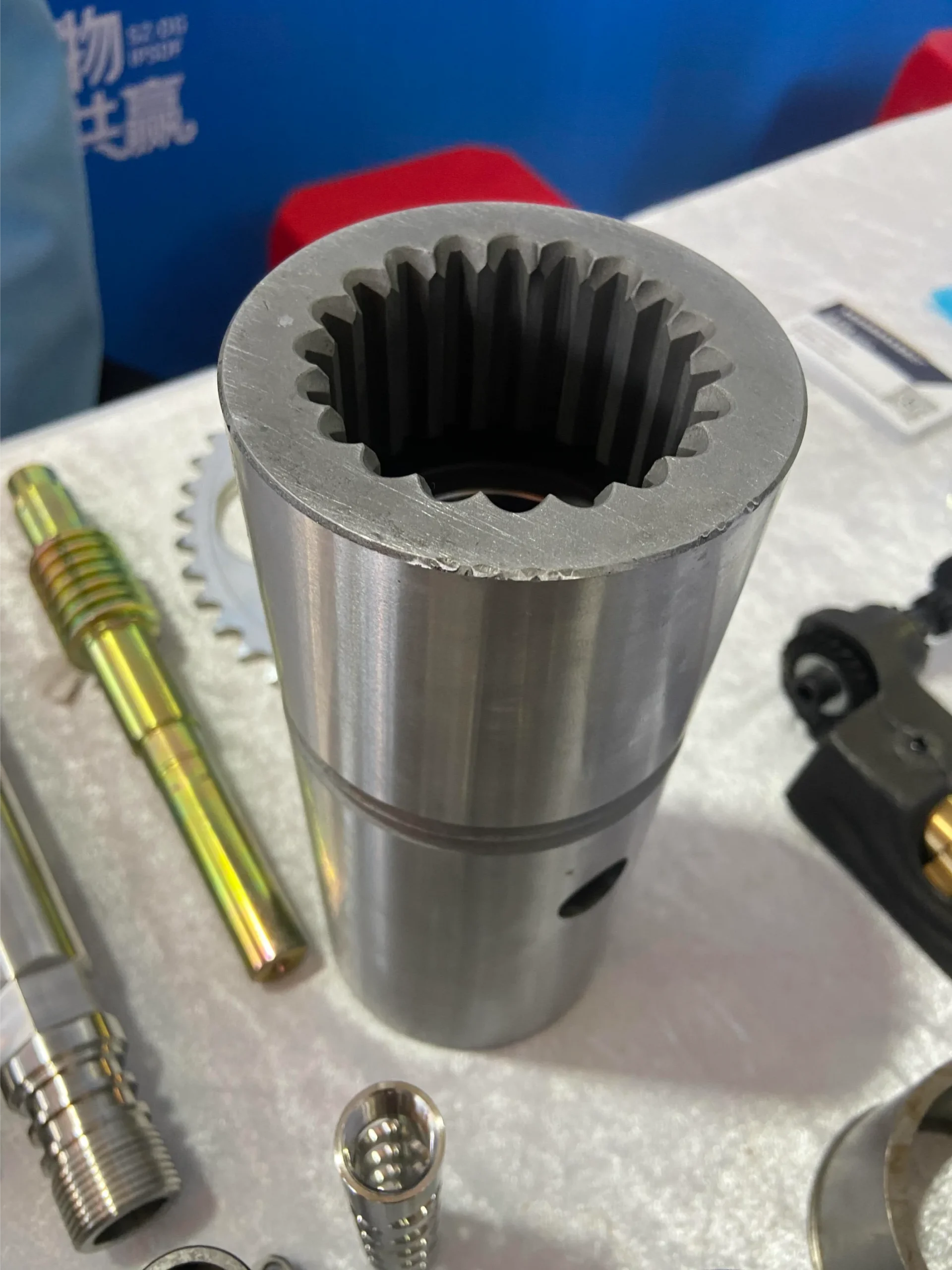
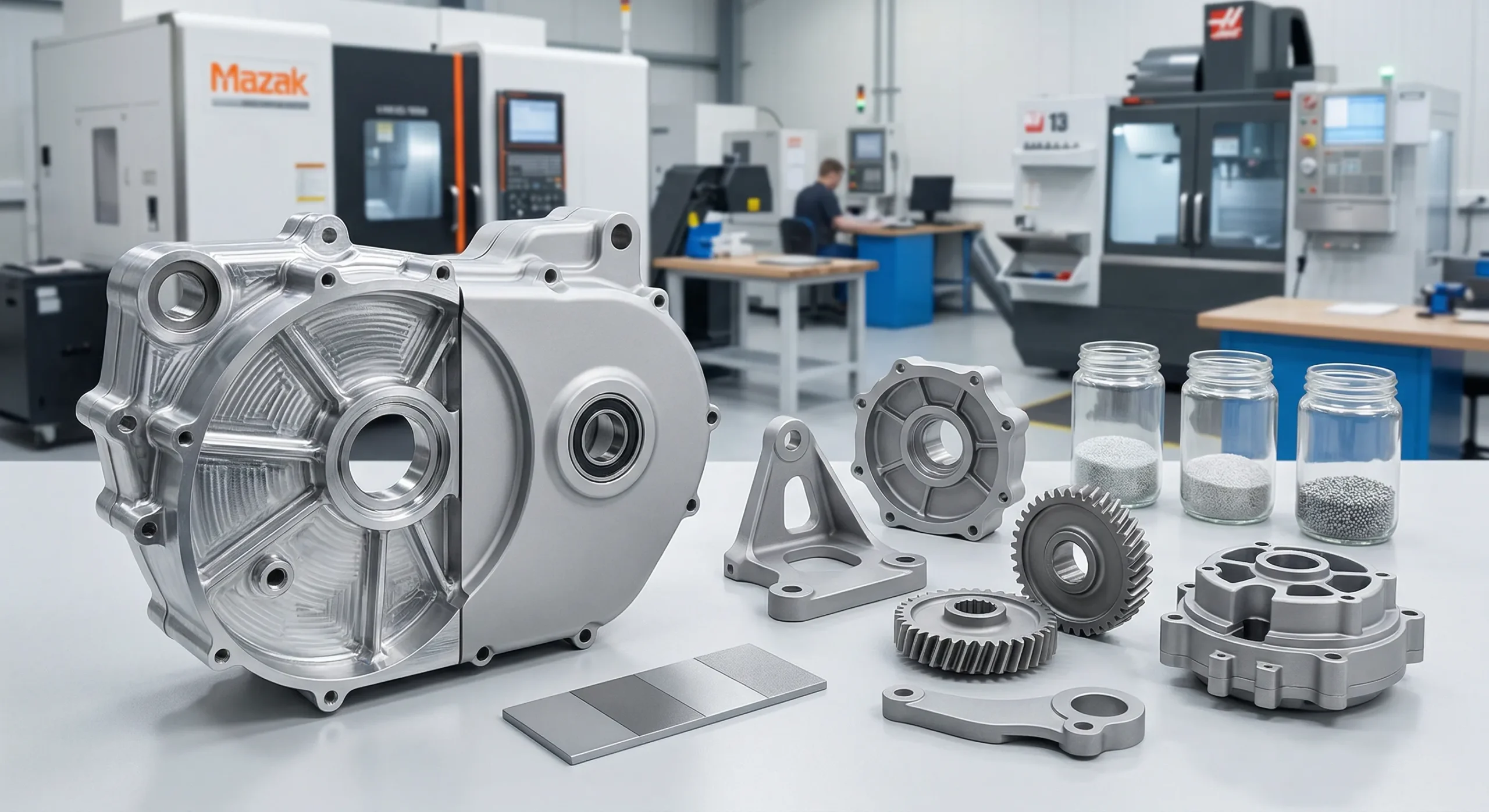
High-precision external spline shafts — involute, parallel-key, serrated, hollow, gear spline shafts, and motor / hydraulic pump spline shafts. Diameter 6–400 mm, ground to DIN 5480 / ISO 4156 / ANSI B92.1 / SAE. Made in our China factory, customized spline shaft quotation in 48 hours.
External involute spline shafts, parallel-sided, serrated, hollow, gear spline shafts, motor / servo spline shafts, hydraulic pump spline shafts, and custom shafts with splines — any configuration your design calls for.
Involute Spline Shafts
External involute splined shafts to DIN 5480 / ISO 4156 / ANSI B92.1. The dominant spline standard worldwide — self-centering, high torque capacity, and inspectable with standard gauges. Metric involute and inch involute, 30° / 37.5° / 45° pressure angle.
DIN 548030° PA
Parallel-Key & Straight-Sided Spline Shafts
Straight-sided spline shafts with flat-flanked teeth per DIN 5462 / 5463 — simpler to machine, lower-cost than involute. Metric parallel spline shaft profiles for machine tools, conveyors, and agricultural drives where load capacity allows.
ParallelDIN 5462
Serrated Spline Shafts
Fine-pitch serrated spline shafts with many small triangular teeth — used for indexable angular positioning (steering columns, control levers) and for permanent press-fit assemblies. Per ANSI B92.2M and SAE serration standards.
Fine PitchIndexable
Hollow Spline Shafts
Hollow spline shafts with internal bore for weight reduction, oil/coolant passage, or cable routing. Common in robot joints, aerospace actuators, and modern automotive driveshafts where mass matters. Bore concentricity ≤ 0.01 mm to spline OD.
HollowLightweight
Gear Spline Shafts
Integrated gear + spline shaft in one part — external spline at one end, helical / bevel / spur gear teeth machined directly on the shaft. The compact solution for transmission input shafts, robot joint outputs, and inline reducers. All features concentric in one setup.
Gear + SplineIntegrated
Motor & Servo Spline Shafts
Precision spline motor shafts for direct-drive servo motors, robot joints, and stepper drives. Tight runout (TIR ≤ 0.005 mm), low inertia, and the DIN 5480 grade 5 accuracy required for backlash-sensitive positioning. Spline motor shaft customization in any module and tooth count.
ServoDIN Grade 5
Hydraulic Pump Spline Shafts
Hydraulic pump spline shaft couplings per SAE J498 for hydraulic gear, vane, and piston pumps. Standard 9T-16/32DP, 13T-16/32DP, and 15T-16/32DP shaft profiles in carburized 8620 or 42CrMo4 — the application HXC has supplied to OEM pump manufacturers for over a decade.
SAE J498Hydraulics
Custom Shafts with Splines (Brass / Plastic / Miniature)
Custom shafts with splines combining unusual materials and features — brass spline shaft for instruments, plastic (POM/PEEK) spline shaft for medical and lab equipment, miniature splines for optical drives. Any single-piece custom shaft with splines integrated.
Brass / PlasticMiniature
Technical Specs
Spline Shaft Manufacturing Capabilities
Four precision spline shaft machining processes — hobbing, grinding, form milling, and broaching — covering every spline profile type and accuracy requirement. Full spline shaft manufacturing process from blank to ground finish under one roof.
⚙️
Spline Hobbing
High-volume production
🔬
Spline Grinding
Post-hardening precision
🏭
5-Axis CNC Milling
Prototype & complex
📐
OD & Profile Grinding
Journal & spline finish
Spline Shaft Hobbing
CNC spline shaft hobbing generates external involute spline profiles in a continuous, fast process — the standard method of machining splines on shafts in production quantities. One hob cuts all teeth simultaneously across the spline length. Ideal for DIN 5480, ISO 4156, and ANSI B92.1 involute spline shafts before heat treatment and final grinding.
Spline OD range
Ø8 – 250 mm
Module range
0.5 – 10 mm
Max spline length
800 mm
Tooth profile
Involute (30°, 37.5°, 45° PA)
Standards
DIN 5480 · ISO 4156 · ANSI B92.1
Quality (pre-grind)
DIN 5480 grade 7–9
Typical quantity
100 – 20,000 pcs
Lead time
7 – 12 days
Post-Hardening Spline Shaft Grinding
After induction hardening or carburizing, spline shaft teeth are profile-ground to restore the involute geometry distorted by heat treatment. Achieves tight tooth thickness tolerances (DIN 5480 grade 5–6), correct over-pin measurement, and Ra ≤ 0.4 µm on the tooth flanks. Essential for automotive transmission and aerospace spline shafts where backlash and fatigue life are critical.
Spline OD range
Ø10 – 180 mm
Quality grade
DIN 5480 grade 5–6 precision
Tooth thickness tol.
±0.005 mm
Surface finish Ra
0.2 – 0.4 µm
Post heat treatment
Yes — induction or carburized
Runout (OD)
≤ 0.008 mm TIR
Lead time
10 – 18 days
5-Axis CNC Milling — Prototype & Special Profiles
5-axis milling generates spline profiles on shafts with complex features — offset splines, interrupted splines, non-standard tooth forms, gear spline shafts, and shafts with integrated flanges or bores. Ideal for prototype quantities (1–20 pcs), customized spline shaft designs, or special spline forms not covered by standard hob tooling.
Spline OD range
Ø6 – 400 mm
Tooth form
Involute, parallel, serrated, custom
Standards
Any — DIN, ISO, ANSI, customer
Integrated features
Flanges, bores, threads, keyways
MOQ
1 pc
Lead time (proto)
5 – 10 days
Materials
All metals + engineering plastics
OD Cylindrical Grinding
Journal diameters, bearing seats, and spline OD are cylindrically ground in the same setup as spline tooth grinding — ensuring concentricity between all diameters. Critical for spline shafts that run in precision bearings where runout must be held to ≤ 0.005 mm TIR.
Diameter range
Ø6 – 300 mm
Max length
1,200 mm
Roundness
≤ 0.002 mm
Cylindricity
≤ 0.003 mm / 100 mm
Runout (to spline)
≤ 0.005 mm TIR
Surface finish Ra
0.2 – 0.8 µm (to spec)
Lead time
Added to spline process — no extra
Materials
50+ Certified Materials
Full mill certificates and spectral analysis on every batch — spline shaft materials in steel, stainless, aluminum, brass, bronze, and engineering plastics.
Metals
Engineering Plastics
20CrMnTi Steel
Case-hardened, HRC 58–62 surface. The default carburized steel spline shaft for automotive transmissions and high-torque drives.
High LoadCarburizedAutomotive
42CrMo4 Alloy Steel
Induction-hardened, HRC 52–58. Standard steel spline shaft material for transmission input shafts and hydraulic pump spline shafts.
InductionFatigue-Res.
Al 6061-T6 / 7075
Lightweight aluminum spline shafts, hard-anodizable. Customized aluminum spline shaft solutions for robot joints, drones, and aerospace actuators.
LightweightAnodizable
C36000 Brass
Free-machining brass spline shafts for instruments, optical drives, and small precision mechanisms where low noise and corrosion resistance matter.
Low NoiseCorrosion-Res.
Phosphor Bronze
Self-lubricating against steel mate. Bronze spline shafts excel as wear-resistant elements in slow-speed sliding spline applications.
Self-LubricatingWear-Res.
SUS304 / 316L Stainless
Stainless steel splined shafts — food, pharma, marine, and cleanroom applications. Passivated for full corrosion immunity. SUS630 (17-4PH) for combined strength + corrosion resistance.
Food / PharmaMarine
POM (Delrin)
Self-lubricating Delrin plastic spline shaft, low friction, often run dry. The default plastic spline shaft for service robots, consumer products, and quiet drives.
Self-lubricatedLow Noise
Nylon PA66-GF30
30% glass-filled nylon plastic spline shaft with higher load capacity than POM. Machined plastic splines for tooth precision rather than moulded.
High StrengthLightweight
PEEK
High-temperature PEEK plastic spline shaft, rated to 260°C. Chemical-resistant, sterilizable for surgical robots and lab instruments.
High TempSterilizable
Reference
Spline Shaft Standard Specifications
Module, pressure angle, fit class, tolerances — the standard metric spline shaft dimensions and ANSI/SAE equivalents every drawing should define. A working reference for engineers preparing CAD, RFQs, and spline shaft quotes.
📏Spline Shaft Module Chart (DIN 5480 Metric)
Per DIN 5480 / ISO 4156, standard metric spline shaft dimensions follow this module series. The 30° pressure angle is standard across the full range:
Module (mn)
Common Z range
Typical Use
0.5, 0.75, 1
14 – 60
Miniature, instruments, servo motor splines
1.25, 1.5, 1.75, 2
14 – 50
Robot joints, small transmissions
2.5, 3, 4, 5
14 – 40
Automotive transmissions, industrial drives
6, 8, 10
14 – 30
Heavy industrial, agricultural, marine
∠Spline Shaft Pressure Angle
Spline shaft pressure angle is higher than for gears — gives wider tooth root and better load distribution. Standard options:
Pressure Angle
Standard
Notes
30°
DIN 5480, ISO 4156
European standard — default for new designs
30° / 37.5° / 45°
ANSI B92.1
American series — 45° gives strongest root
20°
Fine-pitch ANSI
Rare — high tooth count, thin teeth
Serrated
SAE J499 / ANSI B92.2M
60° flat-flank for indexable position
🔧Fit Class & Tolerances (DIN 5480)
DIN 5480 spline shaft tolerances are specified by tooth-thickness tolerance class. Match the shaft class to a complementary hub class:
Shaft Class
Fit Type
Application
e, f, g
Sliding fit
Axial motion required — transmission slip yokes
h, js
Close sliding / locational
Fixed coupling with easy assembly
k, n
Press fit
Permanent assembly, no maintenance
ƒKey Spline Shaft Formulas
Spline shaft pitch diameter (the reference circle for involute spline geometry):
d = mn × z (metric DIN 5480)
Spline OD for external splines: da ≈ mn × (z + 1) — actual value per fit class. Over-pin measurement M_pin uses precision pins of known diameter placed in opposing tooth spaces. Span measured with micrometer:
M_pin = d + 2 × (inv α + s/d − π/z) × ... (see DIN 5480-1)
✓Spline Shaft Standards Cross-Reference
Choose the standard based on geography and end-application. HXC produces to all four:
Standard
Region / Use
Profile
DIN 5480
European industrial & automotive
Involute, metric, 30° PA
ISO 4156
International (≈ DIN 5480)
Involute, metric, 30° PA
ANSI B92.1 / B92.2M
North America
Involute, inch DP / metric, 30°-45° PA
SAE J498 / J499
Hydraulic pumps, ag equip.
Involute & serrated, inch DP
📐Spline Shaft Drawing & GD&T Checklist
A complete splined shaft engineering drawing must specify every item below. Spline shaft GD&T (concentricity, runout, perpendicularity) should reference the bearing journals as datum:
• Standard (DIN 5480 / ISO 4156 / ANSI)
Required
• Module (mn) or DP, tooth count (z)
Required
• Pressure angle (default 30°)
Required
• Fit class (e.g. 9H / 9e)
Required
• Spline OD, pitch dia, root dia
Required
• Spline length & chamfers
Required
• Runout (to journal datum)
Required
• Surface finish on flanks (Ra)
Recommended
• Material, heat treatment, hardness
Required
Why HXC
Why Choose HXC as Your Spline Shaft Manufacturer
A China CNC spline shaft factory with in-house hobbing, induction hardening, profile grinding, and 100% gauged inspection — direct factory pricing, customized spline shaft quotation in 48 hours, no middleman.
🏭
China CNC Spline Shaft Factory in Dongguan
Our HXC CNC spline shaft factory in Dongguan, China runs spline hobbing centres, induction hardening cells, profile grinders, and a Zeiss CMM + Klingelnberg lab — the full spline shaft manufacturing process in one facility. Made in China since 2008, exporting to 35+ countries as a direct china cnc spline shaft manufacturer.
💬
Customized Spline Shaft Quotation in 48h
Send your drawing — we return a customized spline shaft quotation with material, process, fit class, lead time, and unit price. Manufacturer quotation direct from our engineering team — no salesman handoff, no middleman markup on spline shaft quotes or parts processing quotes.
⚙️
Application Specialist — All Spline Shaft Types
Hydraulic pump spline shaft manufacturer (SAE J498), gear spline shaft supplier (integrated gear + spline), hollow spline shaft manufacturer (lightweight robot joints), precision spline motor shaft producer — all under one roof. One factory, every spline application.
🧪
Full Material Range · MOQ 1 pc
Steel spline shaft manufacturers, stainless steel splined shaft suppliers, aluminum spline shaft manufacturers, brass, bronze, plus plastic (POM / PEEK) — one source for all materials. Customized cnc spline shaft from 1-piece prototype to 20,000-piece production with no tooling fee for standard modules.
Case Studies
Real Spline Shaft Projects
From automotive transmission input shafts to robot joint spline shafts — verified results from our China factory customers.
✓ Shot peened · Full CMM · FAI approved first article
Pharma / Food
Stainless Spline Shaft — Pharma Pump
Material
SUS316L
Standard
ISO 4156
Finish
Passivated
Qty
150 pcs
✓ Ra 0.4µm on flanks · Full material cert · FDA-compatible
How It Works
From Drawing to Ground Spline Shaft
Upload your spline shaft drawing — include spline standard, module/pitch, tooth count, pressure angle, and fit class. We handle the rest from our China factory.
01
Upload Drawing
DIN 5480, ISO 4156, ANSI B92.1, SAE J498 or custom. Include spline OD, module, Z, PA, and fit class.
02
Customized Quotation in 48 Hours
Manufacturer quotation direct from our engineering team — hobbing vs grinding recommendation, material, surface treatment, lead time, and factory pricing.
03
Hob → Harden → Grind
Spline hobbing, heat treatment, tooth grinding, OD grinding — all in one production cell, no outsourcing.
04
Gauge & CMM Check, Ship
100% go/no-go spline gauge + CMM over-pin measurement. Full report shipped with every order from China.
Quality
Zero-Defect Commitment
Every spline shaft leaving our China factory is 100% go/no-go gauge checked and CMM over-pin measured before shipment. No sampling — every piece.
Spline gauges (go/no-go) calibrated to all three standards. Over-pin/over-ball measurement for every lot.
🔭
Zeiss CMM + Klingelnberg
CMM measures spline OD, runout, cylindricity, and positional tolerances. Klingelnberg verifies involute profile on precision-class splines.
📄
Full Dimensional Report
Over-pin measurement, runout, surface finish, hardness — all reported and shipped with every order.
4-Stage Inspection
1
Material & Blank Check
Spectral analysis confirms alloy grade. Blank OD, length, and straightness verified before spline hobbing begins.
2
Post-Hobbing Measurement
Over-pin measurement and visual inspection after hobbing. Any systematic tooth form error corrected before heat treatment.
3
Post-Hardening Check
Hardness (Rockwell) and case depth verified by coupon sample after each furnace batch. Dimensional check to confirm distortion is within grind stock allowance.
4
Final: 100% Gauge + CMM
Every finished spline shaft is 100% go/no-go gauged and over-pin measured. CMM verifies OD runout, straightness, and key dimensions. No sampling — every piece reported.
Reviews
Trusted China Spline Shaft Manufacturer
★★★★★
"2,000 pcs of DIN 5480 transmission input shafts in 42CrMo4, induction hardened and ground. HXC provided 100% gauge check reports with every lot. Zero rejections at our incoming inspection over 8 shipments. They understand transmission quality requirements."
MH
Markus H.
Transmission Purchasing · Germany
★★★★★
"Titanium spline shafts for our flight control actuator — ANSI B92.1, shot peened, full CMM report. Only two suppliers worldwide could meet our material and tolerance spec. HXC was faster and cheaper. FAI approved in one cycle."
NF
Nicolas F.
Aerospace Supplier Quality · France
★★★★★
"SUS316L spline shafts for our pharmaceutical filling machine pumps — ISO 4156, passivated, Ra 0.4µm. HXC's quality documentation was exactly what our FDA validation process required. 150 pcs delivered on time with zero NCRs."
KP
Katarzyna P.
Mechanical Engineer · Poland
FAQ
Spline Shaft — Frequently Asked Questions
Technical and sourcing questions about spline shafts, customized spline shaft quotations, and spline shaft manufacturing — answered by our engineers.
A spline shaft (also called a splined shaft) is a shaft with longitudinal teeth (splines) machined along its outer surface that mesh with matching internal splines (in a hub, sleeve, or coupling) to transmit torque while permitting axial sliding or precise angular positioning. Unlike a simple keyed shaft (one key, one keyway), a spline shaft distributes torque across multiple teeth, giving higher torque capacity, better concentricity, and lower stress concentration. Spline shafts are used wherever torque must be transmitted between a shaft and a sliding or fixed hub — automotive transmissions, robot joints, hydraulic pumps, and aerospace actuators.
Custom spline shaft pricing depends on six variables: (1) spline OD & module — larger and finer-pitch shafts cost more; (2) material — 20CrMnTi carburized steel is more expensive than 42CrMo4 induction-hardened; (3) accuracy class — DIN 5480 grade 5 (ground) is roughly 2× the price of grade 7 (hobbed only); (4) heat treatment — induction hardening + grinding adds 25–40%; (5) length and special features — long shafts, hollow shafts, and gear spline shafts cost more than simple short splines; (6) order quantity — prototypes cost more per unit than 100+ batches. Send your drawing for free customized spline shaft quotation — we respond within 48 hours with firm price, lead time, and spline shaft parts processing quotes.
Involute splines (covered by DIN 5480, ISO 4156, ANSI B92.1) have tooth profiles with an involute curve — the same profile geometry as gear teeth. This gives self-centering under load, high torque capacity, and the ability to be manufactured and inspected using the same equipment as gears. Parallel-key splines (DIN 5462/5463) have straight, flat-sided teeth with a rectangular cross-section — simpler to machine but lower load capacity and no self-centering. Involute splines are preferred for automotive and aerospace applications; parallel-key splines for lighter-duty machine tool and conveyor applications.
The four main standards are: DIN 5480 (German/European) — involute splines, metric module, 30° pressure angle, the dominant standard in European automotive and industrial applications. ISO 4156 — closely aligned with DIN 5480 but with some differences in fit class definitions; preferred for international procurement. ANSI B92.1 (imperial, diametral pitch) and ANSI B92.2M (metric) — American standards, widely used in North American automotive and hydraulic applications. SAE J498 for hydraulic pump couplings. HXC produces spline shafts to all four standards — specify your standard and fit class on the drawing.
The standard spline shaft manufacturing process for precision splines: (1) Blank turning — shaft OD, journals, and features machined to near-net shape with grinding stock. (2) Spline hobbing — involute spline teeth generated by CNC gear hobbing. (3) Heat treatment — induction hardening of spline zone or full carburizing, depending on application. (4) Spline tooth grinding — post-hardening profile grinding restores DIN 5480 grade 5–6 accuracy. (5) OD cylindrical grinding — bearing journals and datum diameters ground to final size. (6) Inspection — 100% go/no-go gauge and over-pin measurement.
Fretting is micro-slip wear at the spline tooth contact surface — a common failure mode in spline couplings subjected to cyclic torsional loads with vibration. It produces characteristic oxidized wear debris (fretting corrosion) and can progress to fretting fatigue cracking of the tooth root. Prevention methods: (1) Tight fit class — reduces relative micro-motion; (2) Surface hardening — hard tooth flanks resist micro-slip wear; (3) Lubrication — spline grease (MoS₂ or NLGI 2) in the coupling; (4) Increased tooth count — distributes load over more teeth; (5) Shot peening — compressive stress in the root resists crack initiation.
DIN 5480 defines spline fit by tolerance class and fit type. The shaft (external spline) is graded by tooth thickness tolerance (e.g., e, f, g for sliding fit; js for transition fit; k, n for press fit). The hub (internal spline) has a complementary grade. Common choices: Sliding fit (f/H) — for splines that must slide axially or be assembled with hand force; typical in transmissions and hydraulic pump couplings. Transition fit (js/JS) — for fixed couplings with some assembly tolerance. Press fit (k/K, n/N) — for permanent assemblies. Always specify both shaft and hub fit class on the drawing — mismatched classes are a frequent design error.
Spline shaft inspection uses three complementary methods: (1) Go/no-go spline gauges — the most practical method for production inspection. The "go" gauge (mating plug) verifies the total composite tolerance including tooth form, pitch, and concentricity in one functional check. The "no-go" gauge checks the tooth thickness is not too thin. (2) Over-pin (over-ball) measurement — two precision pins of known diameter placed in opposite tooth spaces and the span measured with a micrometer. Directly measures effective tooth thickness. (3) CMM with gear module — for precision-class splines requiring individual tooth profile, pitch, helix, and runout measurement per DIN 5480 or ISO 4156. HXC uses all three methods, with 100% go/no-go gauging and lot-sample CMM measurement.
A keyway shaft transmits torque through a single rectangular key fitting in a slot (keyway) machined in both shaft and hub. Simple, low-cost, but: high stress concentration at the keyway ends; poor concentricity (the hub can rock slightly on the key); limited torque capacity (only one contact surface). A spline shaft transmits torque through multiple teeth distributed around the circumference: much higher torque capacity per unit shaft diameter; excellent concentricity (self-centering involute profile); allows axial sliding without losing torque transmission; better fatigue life because stress is distributed. For applications above ~50 Nm or requiring high concentricity, spline shafts are significantly better than keyed shafts.
HXC's CNC spline shaft factory is located in Dongguan, Guangdong, China — a major precision manufacturing hub in the Pearl River Delta. We have been a Chinese spline shaft manufacturer since 2008, exporting to clients in Germany, USA, Japan, France, Italy, Korea, and 30+ other countries. All spline shaft machining, induction hardening, grinding, and CMM inspection are performed in-house at our China factory — no outsourcing. Factory visits and video audits are welcome for procurement teams qualifying new china cnc spline shaft suppliers.
Yes — hollow spline shafts are a HXC specialty. We machine hollow splined shafts from gun-drilled bar stock or seamless tube, with internal bores for weight reduction, oil / coolant passage, or cable routing. Common applications include robot joint shafts (saves ~40% mass vs solid), aerospace actuators, modern automotive driveshafts, and racing transmissions. Bore concentricity is held to ≤ 0.01 mm relative to the spline pitch circle. Send your hollow spline shaft drawing — we will review wall thickness, heat treatment distortion risk, and offer a customized quotation as part of our free DFM analysis.
Spline shaft material properties drive the application: 42CrMo4 (induction-hardened, HRC 52–58) is the standard for automotive transmission spline shafts and hydraulic pump spline shaft material steel — good fatigue resistance, predictable heat treatment, excellent machinability. 20CrMnTi (carburized, HRC 58–62) for maximum contact fatigue strength in high-torque drive shaft splines. SUS316L stainless for food, pharma, and marine. Al 7075-T6 (hard-anodized) for lightweight robot joint splines. Grade 5 titanium for aerospace. 17-4PH stainless for marine and defence. PEEK for medical sterilizable splines.
The most common pressure angles for involute spline shafts are: 30° (DIN 5480, ISO 4156) — the European metric standard; high pressure angle provides a wide tooth root, good load capacity, and self-centering. 37.5° and 45° — used in some ANSI B92.1 series for maximum root strength and minimal radial load on bearings. 20° — used in some fine-pitch splines where a larger number of thin teeth is preferred. The pressure angle affects tooth strength, self-centering stiffness, and the specific spline gauge required for inspection. Always specify the pressure angle explicitly — do not rely on the standard alone, as multiple PA options exist within each standard.
Standard parallel-axis spline shafts are designed primarily for torque transmission — they can transmit axial loads only if the spline is designed with an axial shoulder or retaining ring, as the tooth flanks themselves are not loaded axially in a standard involute spline coupling. For splines that must also transmit significant axial loads, a helical spline (similar to a helical gear profile) converts torque into an axial preload force — used in some aircraft engine accessory drives. For light axial loads (preload only), a sliding fit spline with a retaining snap ring on the shaft end is the simplest solution. HXC designs spline shafts for combined torque and axial load if required — include your load requirements in the drawing notes.
Spline shaft torque capacity depends on spline OD, module, tooth count, face width, and material hardness. As a rough guide: a DIN 5480 involute spline shaft with m1.5 / 30T / Ø45mm in 42CrMo4 (induction hardened) can transmit approximately 500–800 Nm continuously. Capacity scales roughly with the cube of the spline OD for the same module. Key design limits: tooth shear stress (root shear), contact stress (flank Hertzian pressure), and fretting fatigue at the tooth root. HXC engineers can calculate spline torque capacity and recommend module/tooth count for your application as part of the free DFM review.
Lubrication depends on the coupling type: Fixed spline couplings (no axial sliding in service): a one-time application of molybdenum disulfide (MoS₂) grease or anti-seize compound at assembly is sufficient. Sliding spline couplings (spline slides axially during operation, e.g., driveshaft slip yokes): require a spline-specific grease (NLGI 2 lithium complex with MoS₂ or graphite) replenished per maintenance schedule. Oil-bath environments (gearbox internals): lubricated by the transmission oil — ensure the oil type is compatible with spline material (EP additives needed for steel splines). Stainless and titanium splines are more tolerant of dry running but still benefit from lubrication.
DIN 5480 accuracy grades: Grade 8–9 — hobbed only, no grinding; adequate for slow-speed, low-load industrial spline couplings and large agricultural equipment. Grade 7 — hobbed and lightly deburred; general industrial and automotive non-critical applications. Grade 6 — hobbed + ground; standard for automotive transmissions, hydraulic pump splines, and robot joint drives. Grade 5 — precision ground; for servo robot joints, aerospace actuators, and precision instrument drives where backlash must be tightly controlled. Each step down in grade roughly doubles the inspection and manufacturing cost. Our engineers will recommend the correct grade based on your torque, speed, and positional accuracy requirements.
Lead times for spline shafts: Prototype (1–5 pcs), 5-axis milled: 5–8 days. Small batch (10–50 pcs), hobbed + ground, DIN 5480 grade 6: 8–14 days. Production batch (100–2,000 pcs), hobbed + hardened + ground: 12–18 days. Stainless or titanium spline shafts: add 3–5 days for passivation or additional machining difficulty. Long shafts (>500mm): add 2–3 days for straightness correction after heat treatment. Rush production is available — discuss your timeline when uploading your drawing.
Yes — we regularly manufacture gear spline shafts that combine external splines, external gear teeth, bearing journals, threaded ends, and mounting flanges in a single shaft. All features are produced in a sequenced operation set ensuring concentricity between the spline, gear, and bearing seats. Examples include: automotive transmission shafts with involute splines at one end and helical gear teeth in the middle; robot joint shafts with splines and integrated bevel gear; hydraulic motor shafts with splines and flange mounting. These are the most complex precision shafts we make — and the most common custom request. Send us your drawing for a free DFM review and quotation.
Get a Quote
Send Your Drawing. Get a Quote.
Every enquiry includes a DFM review — tolerance feasibility, material confirmation, and process approach confirmed before production starts. MOQ 1 piece.
24hr
Quote Response
MOQ 1
Prototypes OK
ISO
9001:2015
📐
DFM Review on Every Enquiry
Tolerance feasibility, fixturing strategy, and material confirmation. Specific, actionable feedback — not generic pushback.
🎯
First Article Inspection — Standard
FAI report on every new run. Material certs and surface treatment certs included with every shipment.
🔄
Same Process: Prototype to Production
Process plan from your prototype applies to production batches. No re-qualification when you scale.
⚙
3 / 4 / 5-Axis CNC + Turning
Complex structural parts, shafts, housings, and transmission components. Metals and engineering plastics.
ISO 9001:20153/4/5-Axis MillingCNC TurningCMM InspectionGlobal Delivery