Traitements de surface
Surface Finishing for Tool & Mold Steel Parts
Surface treatment choice in mold steel determines mold life, part appearance, and release behaviour — not cosmetics.
✨
Mirror Polish (SPI A1/A2)
Hand polishing to SPI A2 (Ra ≤0.025μm, diamond paste) for transparent and optical injection mold cavities. S136 and NAK80 specified — low sulphide prevents pitting at fine grades. Ra measured by profilometer. Recast layer from EDM must be removed before polishing.
S136 / NAK80Optical parts
🔥
Gas / Plasma Nitriding (H13)
HV 900+, case 0.1–0.2mm. Mandatory on all H13 die-casting cavity surfaces — thermal fatigue resistance and aluminum erosion protection. Applied after all machining, EDM, and reference face grinding. Last process before assembly. Not optional on die-casting molds.
H13 die-castingHot runner
💠
PVD TiN / TiAlN Coating
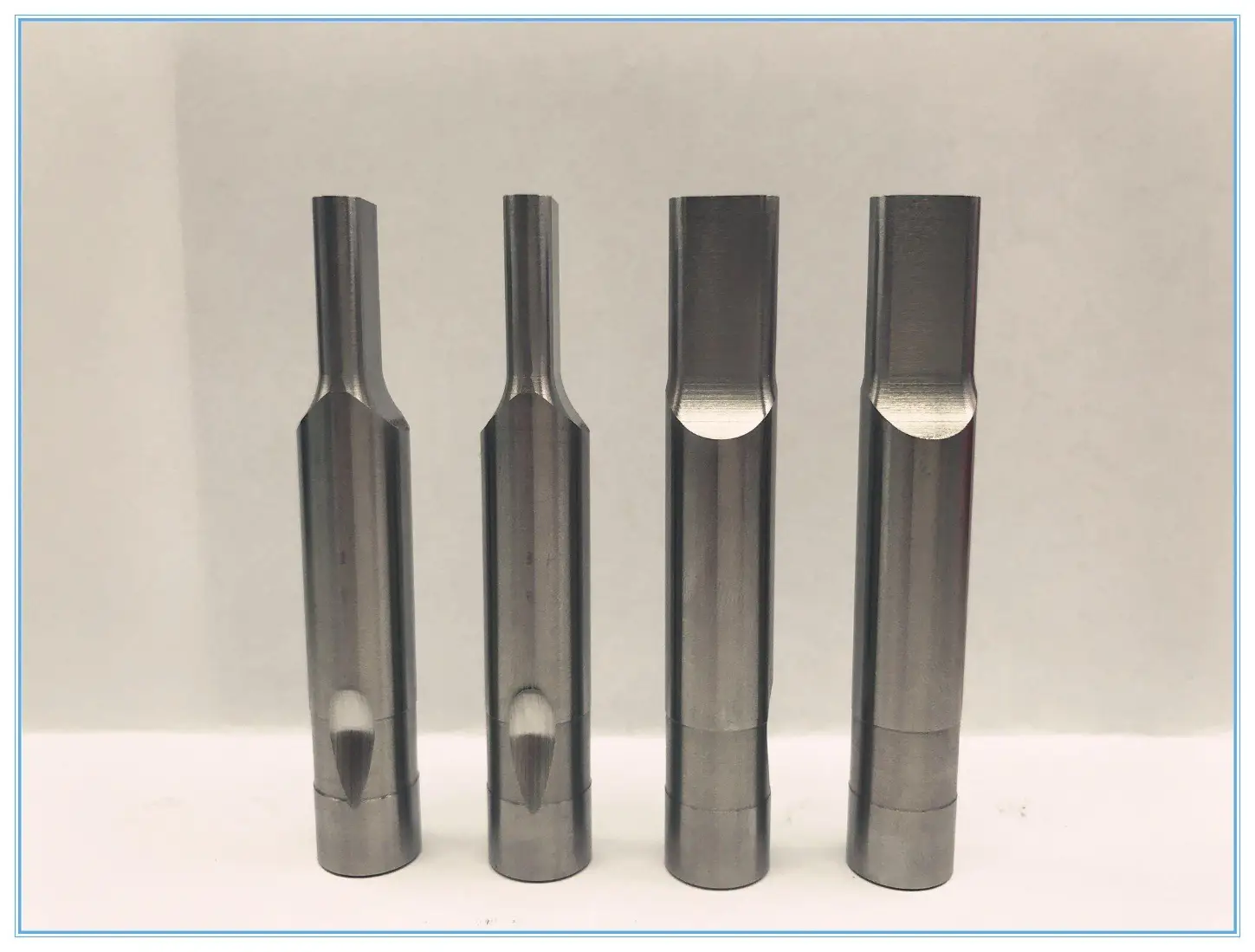
2–4μm PVD coating on punches and forming dies — HV 2300–3500 surface hardness, reduced friction and adhesion of punched material. Extends punch life 3–5× in stainless and high-strength steel blanking. Applied after final grinding; dimensional change 2–4μm per surface accounted for in grinding.
PunchesForming dies
🔲
Black Oxide / Phosphate
Hot black oxide or zinc phosphate for mild corrosion protection on tool steel parts during storage and transit. Zero dimensional change — preserves all ground tolerances. Standard for guide posts, wear plates, and fixture components not requiring other treatments.
Guide postsTransit
🌟
VDI / SPI Bead Blast Texture
Glass bead or alumina blast to produce controlled matte texture on injection mold cavity surfaces: SPI D1–D3 (Ra 0.8–3.2μm) or custom EDM-matched texture. Used for structural and decorative texture on injection-molded parts. Applied after all machining and EDM — must not reach polished surfaces.
Textured moldsSPI D1–D3
❄
Cryogenic Treatment (D2)
-196°C cryogenic treatment after quench converts retained austenite in D2 to martensite — improving dimensional stability and wear resistance. Used for precision gauge blocks and wear plates where long-term dimensional stability matters. Reduces punch and die wear by 15–25% in high-cycle blanking.
Gauge blocksPlaques d'usure
Flux de production
De dessin à Hardened, Ground, Polished Tool Part
01
Revue DFM
Grade selection, HT sequence, EDM vs mill feasibility, polish grade, and nitriding scope confirmed. 24hr.
02
Fraisage CNC
Rough and semi-finish milling of 3D profile. Cooling channels drilled. HT allowance left on all surfaces.
03
Traitement thermique
Harden and temper to specification. Cryogenic treatment where specified. Hardness test per piece.
04
EDM / Wire EDM
Wire EDM profiles ±0.003mm; sinker EDM corners, ribs, textures ±0.005mm — all in hardened steel.
05
Grind & Polish
Reference faces ground ±0.003mm; guide features h5/H6. Mirror polish to SPI A1/A2 where required.
06
Treat & Deliver
Nitriding / PVD / black oxide as specified. CMM 3D profile report. HT record + mat cert enclosed.
Notre Avantage
Why Mold Makers Specify Our Tool Steel Parts
Seq
Correct Process Sequence — HT Before EDM
D2 punches and die cavities wire EDM profiled after hardening — not before. Hardening after wire EDM introduces 0.05–0.2mm distortion that compromises the profile tolerance. This is the most common mistake in tool steel manufacturing. We machine in the correct sequence every time.
Nit
H13 Die-Casting — Nitriding Not Optional
H13 die-casting cavity surfaces nitrided to HV 900+ as standard — not as a premium option. Nitriding is the primary defence against thermal fatigue cracking and molten aluminum erosion. A die-casting mold without nitrided cavity surfaces is undersupplied, regardless of base steel hardness.
A2
SPI A2 Ra ≤0.025μm — Profilometer Verified
Mirror polish Ra measured by profilometer and documented — not claimed from visual inspection. S136 and NAK80 specified (not P20) for mirror polish — low sulphide content is the material property that determines whether fine polishing produces a uniform mirror or a pitted surface.
CMM
3D Profile CMM — Deviation Colour Map
Mold core and cavity 3D profiles CMM-verified with full deviation colour map report — showing actual form error vs CAD on all surfaces, not just reference faces. Features requiring rework identified before tool assembly. Matched punch/die sets CMM-verified as pairs for blanking clearance confirmation.
Foire aux questions
Tool Steel & Mold Steel — Questions fréquentes
Technical questions about tool steel grades, EDM, polishing, heat treatment sequence, and die-casting nitriding.
Injection molds: P20 (pre-hardened HRC 28–34, large bodies), H13 (HRC 44–52, die-casting and hot runner), S136 (HRC 48–52, mirror polish and PVC), NAK80 (HRC 37–43, excellent EDM). Stamping dies: D2/SKD11 (HRC 58–62, cold work wear), M2/SKH51 (HRC 62–65, high-speed punch hot hardness). Die-casting: H13/H11 (thermal fatigue resistance, nitrided). Guide posts/wear: SUJ2/GCr15 (HRC 60–64, matched pairs).
Three-process combination: (1) fraisage CNC — rough and semi-finish 3D profile, Ra ≤0.4μm in pre-hardened P20/NAK80; (2) EDM sinker — sharp internal corners (R<0.1mm), deep ribs, textured surfaces, accuracy ±0.005mm; (3) Meulage — reference faces ±0.003mm, guide features h5/H6, all post-HT. Final surface: hand polish to SPI A1/A2 for cosmetic cavities; bead blast for texture. Wire EDM for stamping punch and die profiles ±0.003mm in fully hardened steel.
Wire EDM profile accuracy: ±0.003mm on punch and die cavity profiles — standard for blanking clearance control. Punch OD/die bore after wire EDM: ±0.003mm. Grinding: punch OD h5/h6; die plate reference face flatness ±0.003mm. Clearance control: punch and die profiles held to ±0.003mm each — total pair clearance per side maintained within ±0.006mm of nominal, typically 5–12% of material thickness.
H13 die-casting sequence: (1) rough machine in annealed state; (2) stress relief anneal; (3) harden to HRC 44–52; (4) finish grind reference faces and guide holes; (5) EDM detail features; (6) gas or plasma nitriding HV 900+, case 0.1–0.2mm — mandatory for thermal fatigue and aluminum erosion resistance; (7) polish cavity faces Ra ≤0.2μm after nitriding. Nitriding is the last machining process before assembly. Heat treatment record and nitriding certificate included with every H13 die-casting component.
EDM (electrical discharge machining) removes material by controlled spark erosion — enabling features impossible by milling. Sinker EDM: internal corners R<0.1mm, deep ribs (W:D >1:5), cavity textures, ±0.005mm accuracy. Wire EDM: complex 2D profiles through full plate thickness — standard for punch profiles and die cavity through-holes, ±0.003mm accuracy. Key advantage: EDM accuracy is independent of material hardness — D2 at HRC 62 is machined to the same accuracy as annealed steel. This allows wire EDM after hardening — the correct sequence that avoids HT distortion affecting profile accuracy.
SPI grades supplied: A1 (Ra ≤0.012μm, diamond paste — optical clear); A2 (Ra ≤0.025μm — standard transparent/cosmetic); A3 (Ra ≤0.05μm); B1 (Ra ≤0.1μm, fine stone); C1 (Ra ≤0.4μm, stone polished); D1–D3 (bead blast matte). VDI 3400 EDM textures from VDI 12 to VDI 45. S136 and NAK80 specified for SPI A1/A2 — P20 limited to ~B1 due to sulphide pitting at fine polish grades. Ra measured by profilometer and documented.
Yes — supplied as CMM-verified matched pairs. Guide post: SUJ2 HRC 60–64, OD h5 (±0.003mm), cylindricity ≤0.003mm full length, Ra ≤0.1μm. Guide bushing: bore H6, OD/bore concentricity ≤0.003mm. Clearance per side: 0.008–0.015mm. Both from matching hardness SUJ2 — dissimilar hardness pairs wear asymmetrically. Standard Ø12–Ø60mm; custom to drawing. Bronze self-lubricating bushing option. CMM report enclosed with every set.
MOQ : 1 pièce. Lead times: simple hardened/ground parts (guide posts, pins, wear plates): 7–14 working days. Complex 3D mold cores/cavities (CNC + EDM + HT + polish): 15–25 working days. H13 die-casting with nitriding: 18–28 working days. Stamping punch/die sets with wire EDM: 10–18 working days. Urgent tooling repair: expedited service available — please discuss schedule. All parts with dimensional inspection report and HT record.
Structured data (FAQPage + ItemList + Product schema) embedded in page head · Eligible for Google FAQ rich results