
POM / Acetal / Delrin CNC Machining
POM / Acétal
Usinage CNC
POM-H (Delrin)
POM-C (Copolymer)
Automation Parts
Gears & Bushings
Jigs & Guide Parts
Precision CNC machining of POM homopolymer (Delrin) and POM copolymer (Acetal) for automation components, gears, sliders, bushings, jigs, and guide parts — where metal is too heavy or corrosive, and where dimensional stability, self-lubrication, and consistent tolerance across production quantities are essential.

Friction Coeff.
0.1–0.3

POM-H Delrin Homopolymer ✦
POM-C Acetal Copolymer ✦
Automation Equipment Components ✦
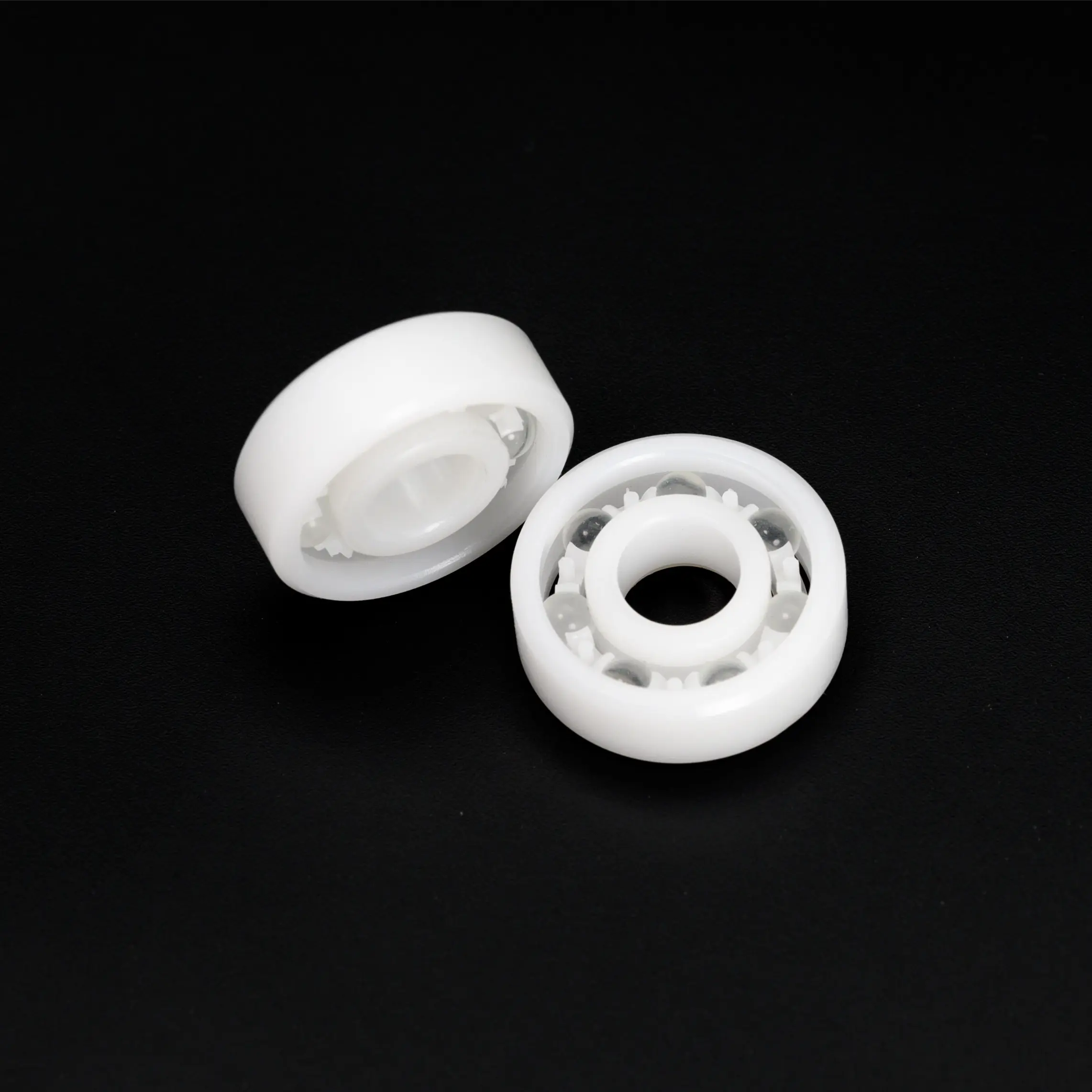
Precision Plastic Gears ✦
Linear Sliders & Carriages ✦
Self-Lubricating Bushings ✦
Inspection Jigs & Fixtures ✦
Guide Rails & Director Parts ✦
FDA-Compliant Food Contact ✦
POM-H Delrin Homopolymer ✦
POM-C Acetal Copolymer ✦
Automation Equipment Components ✦
Precision Plastic Gears ✦
Linear Sliders & Carriages ✦
Self-Lubricating Bushings ✦
Inspection Jigs & Fixtures ✦
Guide Rails & Director Parts ✦
FDA-Compliant Food Contact ✦
Grades de matériaux
Two POM Grades — Know Which One to Specify
POM-H
DuPont Delrin® · ISO 9988 · ASTM D4181
Higher Stiffness & Fatigue Strength — Preferred for Gears
POM homopolymer (trade name Delrin, manufactured by DuPont) is the higher-performance variant: marginally stiffer, harder, and with better fatigue strength than POM copolymer — making it the preferred grade for precision gears, snap-fit mechanisms, and high-cycle mechanical parts. However, POM-H rod stock above approximately 50 mm diameter has inherent centerline porosity (a void at the geometric center created during extrusion) that can be exposed when machining parts with large center bores. For solid or near-solid cross-sections, POM-H is the first choice.
3,100 MPa
Module de flexion
68 MPa
Résistance à la traction
M90 / R120
Hardness (Rockwell)
Excellent
Usinabilité
EngrenagesSnap-FitsCamesSièges de soupapeSolid Blocks
View POM-H Details
Propriétés clés
| Densité | 1.42 g/cm³ |
| Point de fusion | 175–180 °C |
| Température maximale de service | 90–100 °C (cont.) |
| Water Absorption | 0.2% (24h) |
| Friction Coeff. (dry) | 0.15–0.35 |
| Colors Available | Natural, Black |
Advantages over POM-C
Higher flexural modulus — stiffer under load
Higher fatigue endurance — better for cyclic loading
Slightly better surface hardness
⚠ Centerline porosity in rod > 50 mm — avoid for parts with large center bores
POM-C
Acetal Copolymer · Hostaform® · Celcon® · ISO 9988
Homogeneous Structure — No Porosity, Better Chemical Resistance
POM copolymer (also called acetal copolymer, trade names Hostaform and Celcon) has a uniform cross-section with no centerline porosity — making it the correct choice for parts with large center bores, thin walls, or precise bore-to-OD concentricity requirements. Marginally softer and less stiff than POM-H, but the difference is small in practice. POM-C offers better chemical resistance (particularly to alkaline cleaners and some organic solvents) and is slightly less prone to stress cracking. Available in FDA-compliant natural and food-safe colors.
2 800 MPa
Module de flexion
62 MPa
Résistance à la traction
M80 / R115
Hardness (Rockwell)
Excellent
Usinabilité
DouillesGlissièresJigsGuide PartsBored PartsContact alimentaire
View POM-C Details
Propriétés clés
| Densité | 1.41 g/cm³ |
| Point de fusion | 162–168 °C |
| Température maximale de service | 90–100 °C (cont.) |
| Water Absorption | 0.2% (24h) |
| Friction Coeff. (dry) | 0.15–0.35 |
| Colors Available | Natural, Black, Blue, Red |
Advantages over POM-H
No centerline porosity — uniform structure throughout
Better chemical resistance — alkaline and solvent environments
Less prone to stress-cracking in aggressive media
FDA-compliant grades available (natural and color)
Metal-detectable blue grade for food processing equipment
✓ Choose POM-H (Delrin) when…
→ Maximum stiffness for gears, cams, and snap-fit mechanisms
→ Solid cross-section parts with no or small center bore
→ High-cycle fatigue loading applications
→ Mild chemical environments (not alkaline cleaners)
✓ Choose POM-C (Copolymer) when…
→ Parts with large center bores or thin walls — no porosity risk
→ Food contact, FDA compliance, or hygienic environments
→ Exposure to alkaline cleaners, detergents, or mild solvents
→ Metal-detectable blue grade for food processing equipment
Application Areas
Six Applications Where POM Excels
 Automatisation
Automation Equipment Components
Pick-and-place end effectors, conveyor guide rails, sensor mounts, pneumatic actuator bodies, and mechanical stop blocks — POM's combination of light weight, dimensional stability, and self-lubrication makes it the first-choice plastic for automated assembly and handling machinery. Does not corrode, does not require lubrication, and maintains its dimensions under the cyclic loads of high-speed automation.
GradePOM-C or POM-H
Tolérance±0.03–0.05 mm typical
AvantageLight, stiff, non-corroding, self-lubricating
 Engrenages
Precision Plastic Gears
Spur gears, helical gears, bevel gears, and worm wheels in POM-H (Delrin) for light-to-medium load drives where quiet operation, corrosion resistance, and elimination of lubrication are required. POM gears run against metal or plastic mating gears with minimal noise and no lubrication in clean environments. Preferred over nylon for dimensional stability across humidity changes — gear mesh does not tighten in wet conditions.
GradePOM-H preferred (stiffer)
ProcessusTournage CNC + Engrenage à profil
AvantageQuiet, oil-free, stable mesh
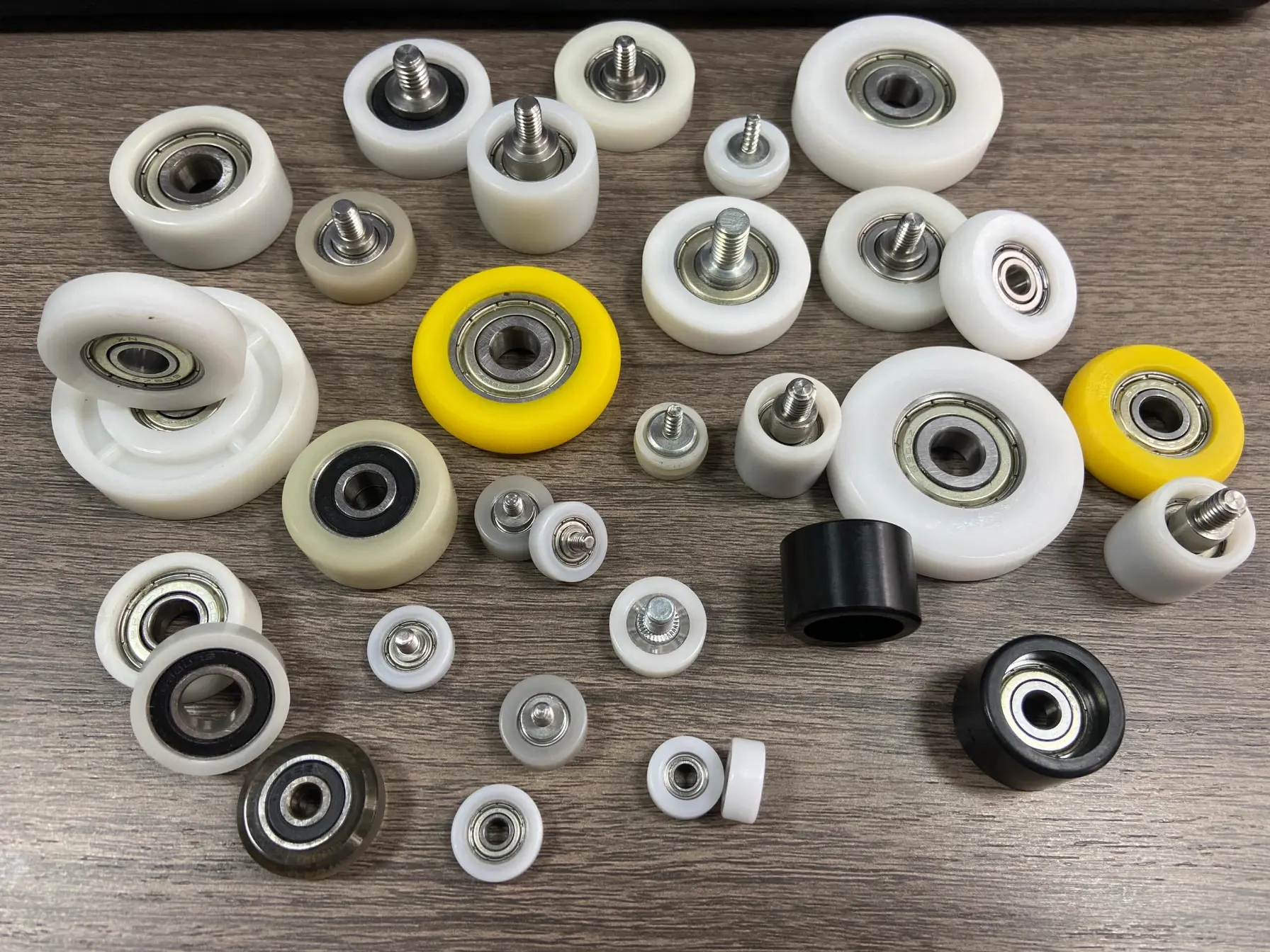
Linear Sliders & Carriages
Linear slide blocks, dovetail sliders, T-slot carriages, and linear bearing housings machined from POM-C. POM's low friction coefficient (0.1–0.3 against steel) and excellent wear resistance allow smooth sliding motion against anodized aluminum, stainless steel, and hardened guide rails without lubrication in many cases. Dimensional stability ensures consistent sliding clearance across temperature variations in factory environments.
GradePOM-C preferred (no porosity)
Tolérance±0.02–0.03 mm on guide slots
AvantageSelf-lubricating, quiet, corrosion-free
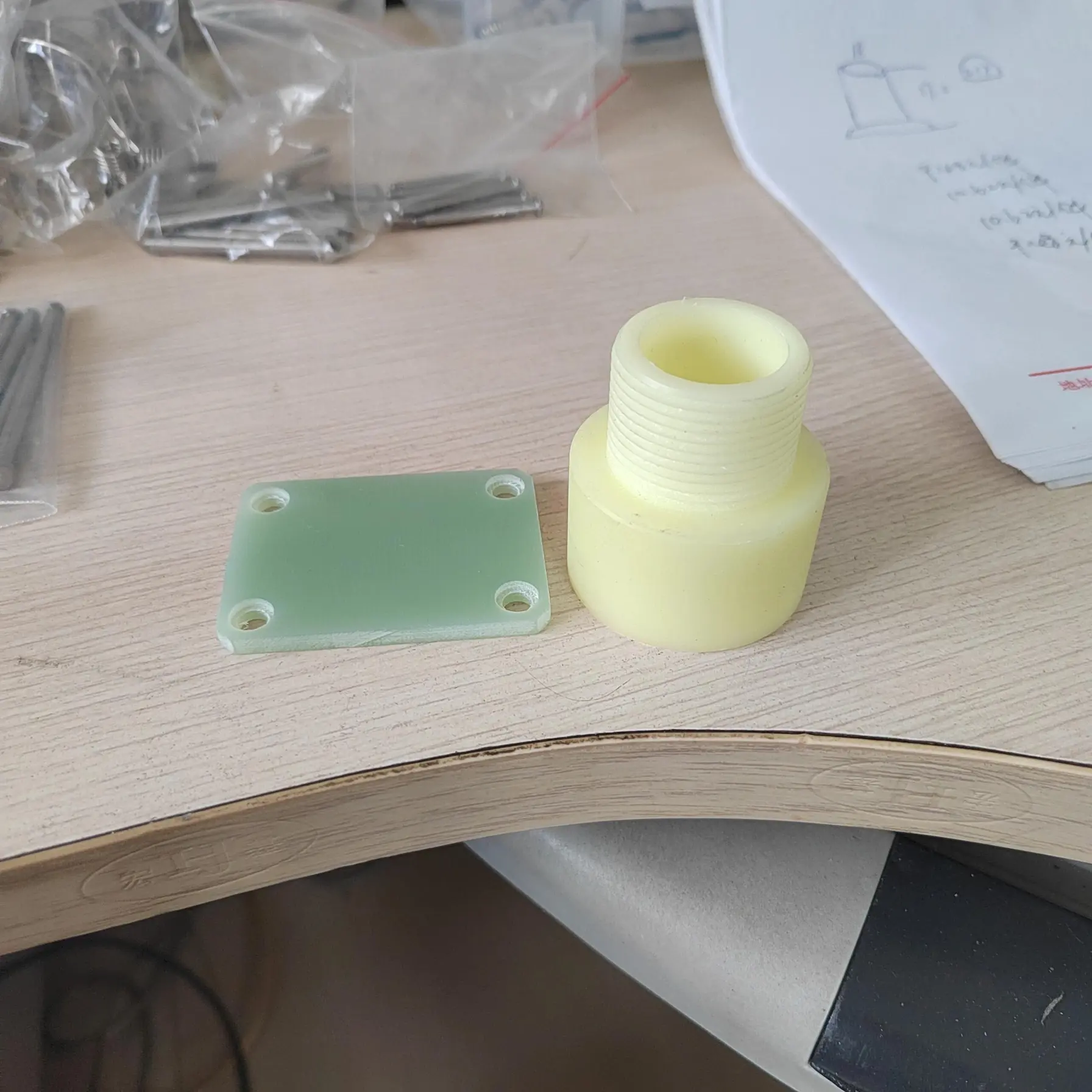 Douilles
Self-Lubricating Bushings & Sleeves
Shaft bushings, flanged bushings, sleeve bearings, and thrust washers in POM for light-to-medium radial loads where metal bushings would corrode, create galvanic problems, or require regular greasing. POM bushings run dry against steel or aluminum shafts in light machinery, conveyor drives, food processing equipment, and packaging machinery. Unlike bronze, no lubrication is needed — and unlike PTFE, POM holds tight bore tolerances under load.
GradePOM-C (no bore porosity)
ToléranceH7/H8 bore fit, ±0.02 mm
AvantageOil-free, lightweight, FDA-grade available
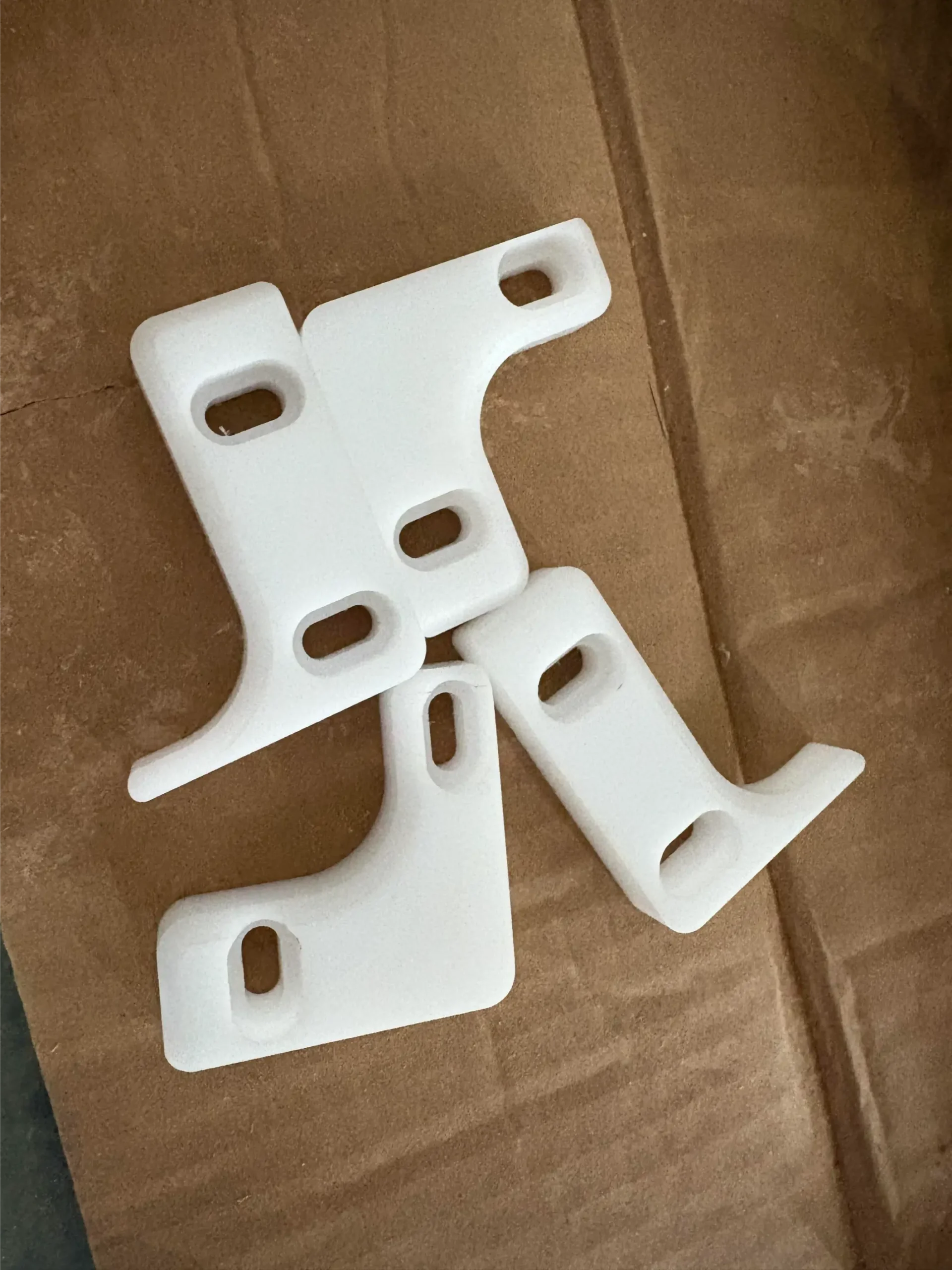 Gabarits & Fixations
Inspection Jigs & Assembly Fixtures
Go/no-go gauges, assembly alignment jigs, pick-and-place nests, welding fixtures, and component holders machined from POM for production quality control and assembly. POM's combination of stiffness, dimensional stability (extremely low moisture absorption — does not swell like nylon), ease of machining, and non-conductive properties make it the standard plastic for precision tooling fixtures. Dimensions remain stable whether the factory is dry or humid.
GradePOM-C or POM-H
Tolérance±0.02–0.05 mm
AvantageHumidity-stable, non-conductive, machinable
 Guide Parts
Guide Rails, Wear Strips & Director Parts
Conveyor guide rails, product directors, wear strips, and lane dividers machined or cut from POM plate and rod stock for food and beverage, pharmaceutical, and general packaging conveyor systems. POM glides smoothly under bottle, can, and package loads without lubrication, resists cleaning agents and disinfectants, and meets FDA food contact requirements in natural/white POM-C grade. Replaceable wear components that outlast most alternative plastics in sliding contact.
GradePOM-C natural or blue (FDA)
ProcessusFraisage CNC · Routing · Perçage
AvantageFDA-safe, self-lubricating, cleanable
Comparaison des matériaux
POM vs Nylon vs PTFE — Choose the Right Plastic
| Propriété | POM-H (Delrin) | POM-C (Copolymer) | PA6 Nylon | PTFE |
|---|---|---|---|---|
| Résistance à la traction | 68 MPa — Highest | 62 MPa | 70–80 MPa | 14–35 MPa |
| Module de flexion | 3,100 MPa — Stiffest | 2 800 MPa | 2,500–3,000 MPa | 650 MPa |
| Water Absorption (24h) | 0.2% — Excellent | 0.2% — Excellent | 1.5–3.0% — Significant | 0.01% |
| Stabilité dimensionnelle | Excellent | Excellent | Moderate — swells with moisture | Bon |
| Friction Coeff. (dry) | 0.15–0.35 | 0.15–0.35 | 0.3–0.5 | 0.04–0.20 — Lowest |
| Usinabilité | ★★★★★ Excellent | ★★★★★ Excellent | ★★★★ Bon | ★★★ Moderate (gummy) |
| Tolerance Achievable | ±0,02 mm | ±0.02 mm (no porosity) | ±0.05 mm (moisture-dependent) | ±0.05–0.10 mm |
| Température maximale de service | 90–100 °C | 90–100 °C | 80–120 °C | 260 °C |
| Porosité en ligne centrale | Yes — large rod >50 mm | None — homogeneous | Aucun | Aucun |
| FDA Food Contact | Yes (natural grade) | Yes — natural & color grades | Yes (food-grade PA) | Oui |
| Meilleur pour | Gears, cams, snap-fits, solid parts | Bushings, sliders, bored parts, food contact | High-temperature, high-impact parts | Chemical resistance, extreme low friction |
Notes de usinage
Machining POM / Acetal — Considérations clés
⚠
Points à surveiller!
Thermal expansion — 10× larger than steelPOM has a coefficient of thermal expansion (CTE) of approximately 110–140 ppm/K — about 10 times higher than carbon steel. Parts machined at 20°C will be slightly larger in a 40°C factory environment. For precision bore-to-shaft fits, the operating temperature range must be factored into clearance calculations. A 50 mm POM bushing will expand by approximately 0.3 mm in diameter per 10°C temperature rise — significant for tight clearance fits against steel shafts.
!
POM-H centerline porosity in large rod — specify POM-C for bored partsPOM-H rod stock above approximately 50 mm diameter develops a center void during extrusion as the outer material solidifies before the core. When a bore is machined through the center of the rod (e.g., a bushing with bore diameter >40% of rod diameter), this void is exposed — producing a rough, porous bore surface. Always specify POM-C for bushings, sleeves, and any part with a significant center bore from large-diameter rod.
!
Stress relief before precision machining of thick stockPOM rod and plate stock contains residual stresses from the extrusion or pressing process. Parts machined from thick stock without prior stress relief may distort after machining as internal stresses are released — particularly on thin-walled or asymmetric parts. For precision jigs, fixtures, and gear blanks from thick stock, anneal at 120°C for 2–4 hours before final machining.
!
Chip management — long chips at some parametersPOM can produce long, continuous chips at certain speed/feed combinations — particularly on deep bores and slots. These chips can re-cut the surface if not cleared. Spiral flute drills, peck-drilling cycles on deep holes, and chip-breaking inserts on turning operations prevent chip nesting and surface damage in production runs.
!
No flood coolant needed — compressed air or mist preferredPOM is machined most effectively with compressed air cooling or light mist. Flood coolant can cause thermal shock and dimensional variation on precision parts. The material's inherent low friction means cutting temperatures are modest — air cooling is sufficient for virtually all POM machining operations and avoids dimensional uncertainty from coolant-induced temperature changes.
✓
Why POM is a Joy to Machine✓
One of the most machinable engineering plasticsPOM produces clean, broken chips, holds tight tolerances consistently, and gives excellent surface finish with sharp HSS or carbide tooling. Unlike nylon (which strings and furs), PTFE (gummy and difficult to hold tolerance), or polycarbonate (prone to stress cracking), POM behaves predictably and repeatably from the first piece to the ten-thousandth.
✓
Humidity-stable — tolerance is what you machine, not what the weather isPOM absorbs less than 0.2% water — compared to 1.5–3% for nylon. This means that dimensions measured on the shop floor are the same as dimensions in the customer's assembly hall, whether it's summer or winter. For precision jigs and automation components, this is the critical advantage over nylon.
✓
Self-lubricating — no oiling required in the finished partPOM's inherent low surface energy and crystalline structure provide a self-lubricating surface against metal mating parts. Bushings, sliders, and guide parts run dry against steel and aluminum without seizing or excessive wear in most light-load applications — eliminating the need for lubrication access holes, grease nipples, and maintenance schedules.
✓
Fast cycle times — production-economical at any volumePOM machines significantly faster than engineering metals — CNC turning and milling cycle times are typically 3–5× shorter than equivalent aluminum parts, and 8–15× shorter than stainless steel. This makes POM machined parts economically attractive even for low-to-medium volumes where injection moulding tooling costs are unjustifiable.
✓
No secondary deburring needed in most applicationsPOM machines with minimal burr formation when sharp tooling is maintained. Most POM parts require only light deflashing — no dedicated deburring operation. This reduces process steps, handling, and potential for part damage versus metals that require extensive deburring of threaded holes and edges.
Capacité de fabrication
Comment nous usinons POM Parts
PROCESSUS / 01
CNC Turning — Bushings, Shafts & Collars
Precision CNC turning of POM-C and POM-H bushings, flanged sleeves, spacers, shaft collars, and rotational components. H7/H8 bore tolerances and f7/g6 shaft fits routinely held. Air or mist cooling. No burrs on bores or ODs with sharp tooling.
PROCESSUS / 02
CNC Milling — Jigs, Fixtures & Blocks
Flat milling, pocket milling, and profiling of POM jigs, inspection fixtures, automation blocks, and mounting plates. Clean edge definition with sharp carbide. Stress relief protocol applied to thick-section parts before final machining to ensure dimensional stability post-delivery.
PROCESSUS / 03
Gear Hobbing — Plastic Gears & Worm Wheels
Gear hobbing of POM-H spur gears, helical gears, and worm wheels to DIN 6–8 quality. POM-H's stiffness and low moisture absorption ensure consistent tooth-to-tooth pitch and backlash across operating conditions. Module 0.5–6 hobbed in-house.
PROCESS / 04
Drilling, Threading & Tapping
Precision hole drilling, metric and UNC tapping, and thread milling in POM. POM threads hold well when tapped with spiral flute taps (prevents chip packing). For high-cycle applications, threaded inserts (brass or stainless) can be ultrasonically installed in POM for superior thread pull-out strength.
PROCESS / 05
Routing & Profile Cutting — Guide Rails & Wear Strips
CNC routing of POM plate and strip stock for conveyor guide rails, wear strips, and lane guide systems in food, beverage, and packaging industries. FDA-compliant natural or blue POM-C stock. Custom profiles, mounting holes, and recesses machined to drawing. Long-length rails up to 2,000 mm.
PROCESS / 06
Inspection & Material Documentation
Dimensional inspection with CMM on precision POM parts. Material certificates referencing ISO 9988, FDA 21 CFR 177.2470 (food contact), or RoHS compliance provided. First article inspection (FAI) reports on all new part numbers. Batch traceability for medical and food-industry customers.
Secteurs desservis
Where POM / Acetal Replaces Metal
Automatisation
POM-C / POM-H
Food & Beverage
POM-C FDA
Pharmaceutique
POM-C FDA
Emballage
POM-C guides
Instruments
POM-H jigs
Automobile
POM-H gears
De barre / plaque à pièce finie
Comment nous produisons POM Parts
ÉTAPE 01
Grade & Stock Selection
POM-H or POM-C selected based on part geometry and requirements. Rod or plate form confirmed. Centerline porosity risk assessed for POM-H bored parts. FDA cert verified if required.
ÉTAPE 02
Détente des contraintes (si nécessaire)
Thick-section jig and fixture blanks annealed at 120°C for 2–4 hours before final machining. Releases extrusion/pressing stresses — prevents post-delivery distortion on precision parts.
ÉTAPE 03
Usinage CNC
Turning, milling, routing, gear hobbing, and drilling with sharp carbide tooling. Air or mist cooling. Consistent chip clearance. Temperature checked on long production runs to confirm dimensional stability.
ÉTAPE 04
Opérations secondaires
Ultrasonic threaded insert installation, tapping, reaming to final bore size, and light deflashing. No dedicated deburring required in most cases — sharp tooling leaves clean edges.
ÉTAPE 05
Contrôle et livraison
CMM dimensional check, bore gauge verification, surface finish inspection. Material cert (FDA compliance where applicable) and FAI report shipped with order.
Post-traitement
Options de post-traitement pour POM Parts
POM parts are typically supplied as-machined — the material's inherent surface properties are the functional requirement. When additional surface modification, joining, or enhanced thread pull-out strength is needed, the following options are available.
Inserts filetés (Ultrason)
Brass or stainless steel threaded inserts installed ultrasonically into POM parts for high-cycle fastener applications. Insert pull-out strength 5–10× higher than direct-tapped POM threads. Standard sizes M2 to M12. Required for parts where screws are repeatedly tightened and loosened — automation covers, jig adjustment blocks, and equipment panels.
Gravure Laser & Marquage de Pièces
Laser engraving of part numbers, serial numbers, logos, and dimensional references directly onto POM jigs and fixtures. White POM-H and POM-C produce a clear dark marking. Black POM can be laser-marked light for contrast. Used for traceability on inspection jigs, calibration tools, and production fixtures.
Electroless Nickel (Specialized)
Electroless nickel plating on POM is possible after surface activation (plasma or chemical etching) for specialized applications requiring a conductive or harder surface layer — such as shielded automation covers or wear-resistant guide surfaces. Dimensional tolerance impact (typically 10–25 μm deposit) must be factored into pre-plate machining dimensions.
Soudage Ultrasonique & Rotation
Two POM parts can be permanently joined by ultrasonic welding or spin welding — creating a hermetic seal without adhesives. Used for enclosures, sealed fluid ports, and two-piece assemblies that must be sealed after internal component installation. Joint strength approaches base material strength with correct joint design (energy director geometry).
POM-H / C
Both Grades in Stock
±0.02mm
Tolérance de précision
0.2%
Water Absorption
24hr
Délai de devis
Pourquoi travailler avec nous
Pourquoi nous choisir pour POM Machining
CLP
Centerline Porosity Advisory — Right Grade, Right Part
We review every POM order for centerline porosity risk before quoting. If a POM-H part has a bore exceeding the safe ratio for the rod diameter, we advise switching to POM-C — preventing delivery of parts with porous bores that only show up during customer assembly.
BUTÉE
Thermal Expansion Fit Calculation — Clearances That Work in Service
For bushing and slider fits, we calculate the bore and shaft clearance at your operating temperature — not just room temperature. POM expands 10× faster than steel; the correct fit on the drawing needs to be correct in the machine, not just in the workshop.
FDA
FDA-Compliant Grades with Full Certification
Natural and blue metal-detectable POM-C in FDA 21 CFR 177.2470 compliant grades stocked and supplied with material certification. Food processing, pharmaceutical, and hygienic equipment customers receive full FDA documentation with every delivery — no document chasing.
VOL
High-Volume Production at Competitive Per-Piece Cost
POM's fast cycle times make it one of the most economical CNC plastics at volume. Bar-fed turning of bushings and sliders at 2,000–10,000 pcs/month with consistent quality — the right economics for automation OEMs sourcing standard wear components.
FAQ
Foire Aux Questions
Common questions about POM, Acetal, and Delrin — grade selection, porosity, tolerances, food contact compliance, machining considerations, and post-processing.
Le POM (Polyoxyméthylène, également appelé Acétal ou Delrin — Delrin étant la marque déposée de DuPont pour l'acétal homopolymère) est un thermoplastique semi-cristallin d'ingénierie connu pour sa combinaison exceptionnelle de rigidité, de faible friction, d'excellente usinabilité et de stabilité dimensionnelle. C'est l'un des plastiques les plus usinés car il produit des copeaux propres, maintient des tolérances strictes et ne nécessite pas de finition secondaire pour la plupart des applications. Le POM est utilisé pour les engrenages, les bagues, les glissières, les composants d'automatisation, les gabarits et les pièces de guidage où le métal serait trop lourd ou corrosif, et où les plastiques plus souples manqueraient de la rigidité et de la résistance à l'usure requises.
POM-H (homopolymer, trade name Delrin) has slightly higher stiffness, hardness, and fatigue resistance — preferred for gears and mechanical parts. However, POM-H rod stock above approximately 50 mm diameter has centerline porosity (a void at the geometric center) that can be exposed when machining parts with large center bores. POM-C (copolymer) is more homogeneous — no center porosity — making it preferred for precision machined parts with bores, and for parts requiring good chemical resistance. POM-C is also available in FDA-compliant and metal-detectable food-grade colors. For most automation components, bushings, and guide parts, either grade is suitable.
Standard CNC tolerance for POM is ±0.05 mm. For precision bore fits, shaft diameters, and slider guide dimensions, we routinely hold ±0.02–0.03 mm. Note that POM has a higher thermal expansion coefficient than metals (approximately 10× steel): for parts operating across a wide temperature range, thermal expansion must be factored into clearance calculations. A 50 mm POM bushing will expand by approximately 0.3 mm in diameter per 10°C temperature rise — significant for tight clearance fits against steel shafts.
Natural (white/ivory) POM-C and POM-H grades are available in FDA-compliant formulations suitable for direct food contact per FDA 21 CFR 177.2470. For food processing environments, blue metal-detectable POM-C is particularly useful — if any plastic fragment breaks off, it triggers metal detectors on the processing line. For medical device applications, medical-grade POM with full material traceability and biocompatibility documentation per ISO 10993 is available. Always request the FDA certificate from your supplier for regulated applications.
POM has better dimensional stability than nylon (much lower moisture absorption — nylon absorbs 1.5–3% water causing significant dimensional change and swelling), better stiffness, lower coefficient of friction, and better machinability for tight tolerances. Nylon has better impact resistance, higher fatigue strength, and better performance at elevated temperatures. For applications requiring consistent dimensions across humidity changes — precision gears, guide components, and measurement fixtures — POM is strongly preferred over nylon. For high-impact or high-temperature applications, nylon may be more appropriate.
POM is one of the easiest engineering plastics to machine, but several considerations are important: (1) Thermal expansion — POM expands significantly with heat; air or mist cooling is preferred over flood coolant. (2) Stress relief — large POM parts should be annealed before final machining to release residual stresses. (3) Centerline porosity in POM-H rod — for parts with large center bores, specify POM-C to avoid the center void. (4) Sharp tooling — dull tools cause smearing; sharp carbide or HSS gives best results. (5) Chip management — spiral flute tooling prevents re-cutting from long chips in deep features.
POM is available in natural (white/ivory), black, blue, red, and other colors. Natural POM is the most common and has the highest purity for food contact and medical applications. Black POM contains carbon black pigment which provides UV resistance for outdoor applications. Blue and other bright colors are used in food processing equipment for visual identification — some blue grades are also metal-detectable. Color does not significantly affect the base mechanical properties (stiffness, hardness, wear resistance) but may affect UV stability and chemical resistance.
POM has limited bonding options due to its low surface energy. Adhesive bonding is possible with cyanoacrylate after surface activation by UV/ozone or plasma treatment, but bond strength is moderate. Mechanical fastening (screws, press-fit inserts, snap-fits) is the preferred joining method. Threaded inserts can be installed ultrasonically for high-strength fastener points. POM can be welded by ultrasonic welding, hot-plate welding, or spin welding for joining two POM parts. Surface coating is generally not applied as POM has inherent low friction and chemical resistance.