
Choosing between alloy steel and stainless steel is not simply a metal choice. It is a decision about whether mechanical loading or environmental exposure presents the greater risk.
Get it right, and the component can survive cyclic fatigue, impact, heat, or corrosive service with a predictable lifecycle. Get it wrong, and the result may be accelerated tool wear, premature corrosion, avoidable maintenance, or structural failure.
All stainless steels are steel alloys, but not all alloy steels are stainless. The distinction comes down to composition, microstructure, heat-treatment response, and the chromium-rich chemistry that gives stainless steel its passive surface.
At HXCNC, material selection is evaluated through total manufacturing efficiency: tensile and fatigue requirements, corrosion exposure, machining behavior, secondary processing, and lifecycle cost. The comparison below helps narrow the choice before a specific grade is approved.
Peak strength, fatigue resistance, wear performance, and heat-treatment flexibility matter most.
Corrosion resistance, hygiene, appearance, and low maintenance outweigh the higher initial material cost.
Alloy Steel vs. Stainless Steel: The Essential Difference
Both material families can provide high strength and long service life, but they achieve those results differently. Alloy steels use controlled additions such as chromium, nickel, molybdenum, manganese, and vanadium to tune hardenability, toughness, wear resistance, or high-temperature performance. Stainless steel is defined by at least 10.5% chromium, which enables a self-repairing passive oxide film.
The best choice therefore depends on the actual failure mode. A protected transmission shaft may benefit from a heat-treated alloy steel, while a medical housing exposed to repeated sterilization may require stainless steel even if its raw material price is higher. HXCNC’s broader CNC machining materials guide provides additional context for comparing metal families.
Demystifying Alloy Steel: Composition, Types, and Strengths
What Is Alloy Steel?
Alloy steel is steel whose chemistry has been intentionally modified beyond basic iron-carbon composition to achieve targeted properties. Depending on the grade and heat treatment, it can deliver exceptional hardness, toughness, fatigue strength, wear resistance, or stability at elevated temperatures.
Low-Alloy Steel vs. High-Alloy Steel
Classification thresholds vary among standards, but alloy steels are commonly discussed in two broad groups:
- Low-alloy steel: Uses relatively modest alloy additions and is widely selected for shafts, gears, pressure components, structural parts, and other high-load applications.
- High-alloy steel: Contains a larger proportion of alloying elements to deliver specialized behavior in severe heat, wear, oxidation, or chemical environments. Stainless steel itself is generally considered a high-alloy steel family.
Key Alloying Elements and Their Roles
- Manganese: Supports strength and hardenability while helping control sulfur-related brittleness.
- Molybdenum: Improves high-temperature strength, hardenability, and resistance to temper embrittlement.
- Vanadium: Refines grain size and forms hard carbides that improve wear resistance.
- Nickel: Increases toughness, particularly at low temperatures.
- Chromium: Improves hardenability, wear resistance, oxidation resistance, and, at sufficiently high levels, corrosion resistance.
Core Advantages of Alloy Steel
- High strength potential: Many grades respond strongly to quenching and tempering.
- Fatigue and shock resistance: Proper grade and heat-treatment selection can support demanding cyclic loads.
- Wear performance: Hardened surfaces and tough cores are possible through carburizing, nitriding, or induction hardening.
- Cost control: For protected environments, alloy steel often delivers the required mechanical performance at a lower initial material cost than corrosion-resistant alternatives.
For grade-specific manufacturing considerations, see HXCNC’s alloy steel CNC machining capabilities.
Understanding Stainless Steel: The Corrosion-Resistant Family
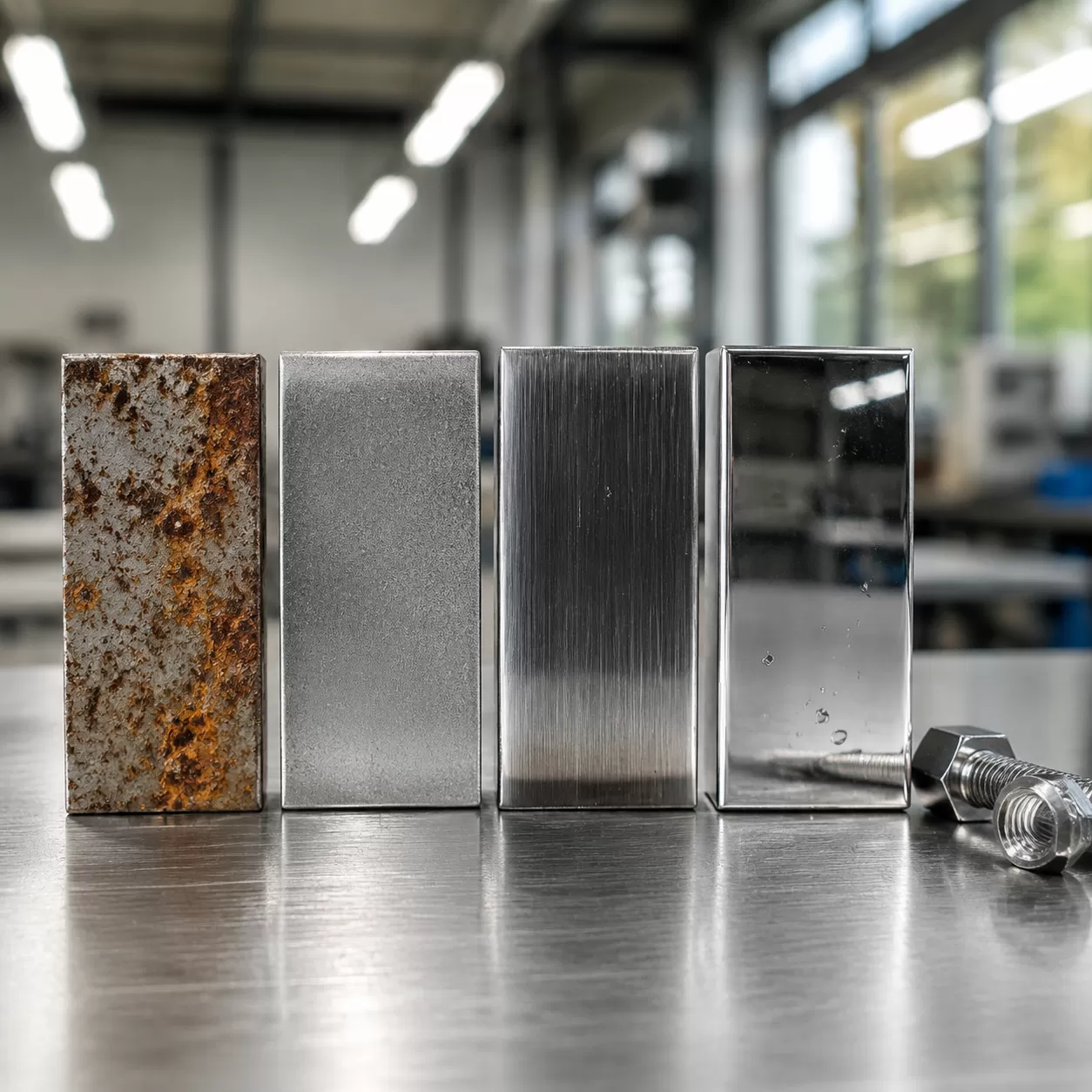
Stainless steel contains at least 10.5% chromium. In the presence of oxygen, chromium forms a thin passive oxide layer that helps prevent the underlying iron from oxidizing. When the surface is lightly damaged and oxygen remains available, this layer can reform.
The Primary Stainless Steel Families
- Austenitic, including 304 and 316: Widely used for corrosion resistance and formability. These grades are generally non-magnetic in the annealed state, although cold working can introduce some magnetism.
- Ferritic: Chromium-based, magnetic grades with relatively low nickel content and good resistance to stress-corrosion cracking in suitable environments.
- Martensitic, including 410 and 420: Heat-treatable grades selected when hardness, strength, and wear resistance are more important than the maximum corrosion resistance of austenitic grades.
- Duplex and precipitation-hardening: Specialized families that combine higher strength with targeted corrosion or heat-treatment performance.
Projects involving 410, 420, and similar grades may benefit from dedicated martensitic stainless steel machining process planning.
Core Advantages of Stainless Steel
- Corrosion resistance: Suitable grades withstand moisture, many chemicals, and repeated washdown.
- Hygienic surfaces: Smooth, cleanable surfaces support food, medical, and semiconductor applications.
- Low maintenance: Many components can operate without paint or sacrificial coatings.
- Appearance and longevity: Stainless surfaces can retain a clean finish over long service periods.
Head-to-Head Material Comparison
Composition and Metallurgy
Alloy steel is an extremely broad category. Its composition is adjusted to obtain specific mechanical or thermal behavior, and final properties often depend heavily on heat treatment. Stainless steel is also compositionally diverse, but every stainless grade contains enough chromium to form a passive corrosion-resistant surface.
Mechanical Performance
Heat-treated alloy steels frequently achieve higher strength and surface hardness than common annealed 304 or 316 stainless steel. That makes them a strong choice for components such as a heavily loaded bearing mount shaft. However, stainless steel cannot be treated as a single low-strength category: martensitic and precipitation-hardening stainless grades can also reach high strength and hardness.
| Selection Factor | Alloy Steel | Stainless Steel |
|---|---|---|
| Defining chemistry | Targeted additions vary by grade and performance goal | At least 10.5% chromium |
| Strength potential | Often very high after appropriate heat treatment | Moderate to very high, depending on stainless family and condition |
| Corrosion resistance | Usually requires coating, plating, oil, or controlled exposure | Inherent, but highly dependent on grade and environment |
| Wear resistance | Excellent in hardened and case-hardened grades | Variable; martensitic grades outperform common austenitic grades |
| Maintenance | May require ongoing corrosion protection | Usually lower in compatible corrosive environments |
| Initial cost | Often lower | Often higher due to chromium, nickel, molybdenum, and processing |
Corrosion and Environmental Durability
Stainless steel generally wins in wet, hygienic, mildly acidic, or outdoor environments, but the exact grade still matters. For example, 316 typically offers better chloride resistance than 304, yet neither is immune to every form of pitting, crevice corrosion, or stress-corrosion cracking.
Most alloy steels require environmental protection. Depending on dimensional requirements and service conditions, that may include oil, paint, conversion coatings, electroplating, or powder coating.
Lifecycle Cost
Alloy steel frequently has the lower purchase price, but raw material cost is only one part of the decision. Protective finishing, inspection, maintenance, downtime, and replacement can make stainless steel more economical over the complete service life. Conversely, stainless steel may be unnecessary over-specification for a dry, enclosed component whose primary risk is fatigue or contact stress.
Engineering rule: Compare candidate grades in their final heat-treated or cold-worked condition. Family-level labels alone are not enough for a production material decision.
Manufacturing and Machinability: The Machinist’s View

Material family changes tool selection, chip control, cutting parameters, coolant strategy, distortion risk, and finishing requirements. HXCNC evaluates these variables during process planning for precision CNC machining.
CNC Machining Performance
There is no universal machinability winner. Free-machining alloy steels can cut predictably, while hardened alloy steels may require rigid setups, coated carbide, ceramic tooling, grinding, or hard turning. Austenitic stainless steels such as 304 and 316 are known for work hardening, heat concentration, and stringy chips. Martensitic stainless behaves differently again, especially after hardening.
The correct comparison must therefore identify the exact grade, hardness, stock condition, tolerance, and surface-finish target. HXCNC separates these process routes across its stainless steel CNC machining and alloy steel manufacturing programs.
Tool Wear, Speeds, and Feeds
- Annealed or pre-hardened alloy steel: Often supports stable chip formation, but cutting parameters must account for hardness, abrasiveness, and alloy content.
- Austenitic stainless steel: Usually benefits from sharp tools, rigid workholding, positive cutting action, consistent feed, and effective coolant delivery.
- Hardened grades: Both alloy and stainless steels may require reduced cutting speed, specialized tool materials, and careful control of tool engagement.
Weldability and Heat-Affected Zones
Weldability depends on carbon equivalent, alloy content, section thickness, restraint, and the selected welding process. Some low-alloy steels weld readily, while higher-carbon or highly hardenable grades may require preheating and post-weld heat treatment to reduce cracking risk. Austenitic stainless steels generally weld well, but heat input must be controlled to limit distortion, sensitization, and changes in corrosion performance.
Secondary Operations: Heat Treatment, Coating, and Passivation
| Material Route | Common Secondary Operation | Primary Purpose |
|---|---|---|
| Alloy steel | Quench and temper, case hardening, nitriding, plating, or coating | Develop strength and wear resistance or add corrosion protection |
| Stainless steel | Passivation, electropolishing, solution annealing, or age hardening | Restore surface condition, improve cleanliness, or develop grade-specific properties |
After machining, stainless components may undergo chemical cleaning and passivation to remove free iron contamination and support the passive surface. Alloy steel components more often depend on thermal processing and an appropriate surface treatment for their final performance.
Industry Applications

Typical Alloy Steel Use Cases
- Aerospace landing gear and high-load fittings: Applications that require high toughness, fatigue resistance, and carefully controlled heat treatment.
- Industrial shafts and gears: Components exposed to torque, rolling contact, shock, and long cyclic service.
- Automotive driveline parts: Axles, crankshafts, gear carriers, and precision transmission components.
- Tooling and wear parts: Dies, molds, cutters, and fixtures that require hard surfaces and dimensionally stable cores.
Typical Stainless Steel Use Cases
- Food and pharmaceutical equipment: Cleanable components exposed to moisture, chemicals, and repeated sanitation.
- Medical equipment: Corrosion-resistant housings, instrument parts, and high-cleanliness components. See HXCNC’s medical high-cleanliness precision parts.
- Semiconductor and vacuum systems: Chambers, manifolds, and fixtures requiring clean surfaces and controlled contamination.
- Marine and chemical hardware: Pumps, valves, fasteners, and process equipment made from a grade selected for the specific chloride or chemical exposure.
- Architectural components: Durable exterior surfaces where appearance and low maintenance matter.
How to Choose the Right Steel
Use the following sequence before approving a grade:
- Define the load case: Static strength, impact, fatigue, wear, creep, and operating temperature.
- Characterize the environment: Water, chlorides, acids, cleaning chemicals, humidity, and galvanic contact.
- Set manufacturing constraints: Stock form, machinability, weldability, distortion, heat treatment, coating, and inspection.
- Calculate lifecycle cost: Include material, machining, finishing, maintenance, downtime, and replacement.
- Validate the exact grade: Confirm the governing material standard, condition, hardness, certification, and acceptance tests.
| Project Priority | Likely Starting Point | Important Qualification |
|---|---|---|
| Maximum fatigue strength | Heat-treated alloy steel | Verify toughness, surface condition, and corrosion protection |
| Wet or hygienic service | Austenitic stainless steel | Select grade for the actual chemical and chloride exposure |
| Hardness plus moderate corrosion resistance | Martensitic or precipitation-hardening stainless | Confirm heat treatment and final corrosion requirements |
| Lowest initial cost in protected service | Alloy steel | Include coating and maintenance in the lifecycle calculation |
Frequently Asked Questions
Is alloy steel stronger than stainless steel?
Some heat-treated alloy steels are stronger than common annealed stainless grades such as 304 or 316. However, the answer is not universally yes. Martensitic and precipitation-hardening stainless steels can also achieve high strength. Compare specific grades and material conditions rather than family names.
Which steel is easier to machine with CNC equipment?
It depends on grade and hardness. Many annealed alloy steels machine more easily than austenitic stainless, which tends to work-harden and retain heat. Hardened alloy steel, however, can be substantially more difficult to machine than an annealed stainless grade. Tooling and parameters must be selected from the actual material specification.
Does alloy steel rust faster than stainless steel?
In most unprotected environments, yes. Typical alloy steel does not contain enough chromium to maintain the passive film associated with stainless steel. It often requires oil, paint, plating, powder coating, or another protective system.
How should I choose between alloy and stainless steel for a structural component?
Start with the dominant failure risk. Choose an appropriate alloy steel when fatigue strength, impact toughness, wear resistance, or heat-treatment response controls the design and corrosion can be managed. Start with stainless steel when corrosion, sanitation, chemical exposure, appearance, or maintenance access controls the design. Final selection should always identify a specific grade, condition, and governing standard.