
Titanium and aluminum are both lightweight engineering metals, but they solve different prototype problems.
Aluminum wins when absolute mass, speed, thermal conductivity, and cost matter most. Titanium wins when high specific strength, temperature resistance, corrosion performance, or biocompatibility justifies the higher manufacturing cost.
Best for rapid prototypes, housings, brackets, heat-spreading parts, and cost-sensitive testing.
Best for high-stress, high-temperature, medical, aerospace, and harsh-environment prototypes.
Titanium vs. Aluminum for Lightweight Prototypes
Choosing the wrong lightweight metal can distort your prototype budget or produce a part that fails during testing. Aluminum and titanium both offer low density compared with steel, but their machining behavior, thermal response, and cost structure are very different.
Density and Weight
- Aluminum 6061-T6: About 2.70 g/cm³.
- Ti-6Al-4V Grade 5: About 4.43 g/cm³.
By volume, aluminum is roughly 39% lighter than Grade 5 titanium. For large housings, covers, fixtures, and low-load brackets, that density difference can dominate the design decision.
Strength and Specific Strength
Titanium is heavier by volume, but Grade 5 titanium is much stronger than 6061-T6 aluminum. Its high strength-to-weight ratio makes it valuable for compact load-bearing parts where an aluminum design would need thicker walls or a larger envelope.
Prototype rule: Choose aluminum for minimum absolute mass in low-to-moderate stress parts. Choose titanium when the design is stress-limited and can use thinner sections to recover weight.
Thermal Conductivity and Heat Performance
| Property | Aluminum 6061-T6 | Ti-6Al-4V Grade 5 |
|---|---|---|
| Thermal conductivity | High, around 167 W/m·K | Low, around 6.7 W/m·K |
| Melting point | About 616°C / 1141°F | About 1604-1660°C / 2920-3020°F range |
| Thermal expansion | Higher expansion | Lower expansion |
Aluminum is excellent for heat spreading in electronics and motor housings. Titanium conducts heat poorly but retains useful strength at temperatures where aluminum would soften. For heat-transfer parts such as a water cooling plate, aluminum is often the natural starting point.
Environmental and Corrosion Resistance
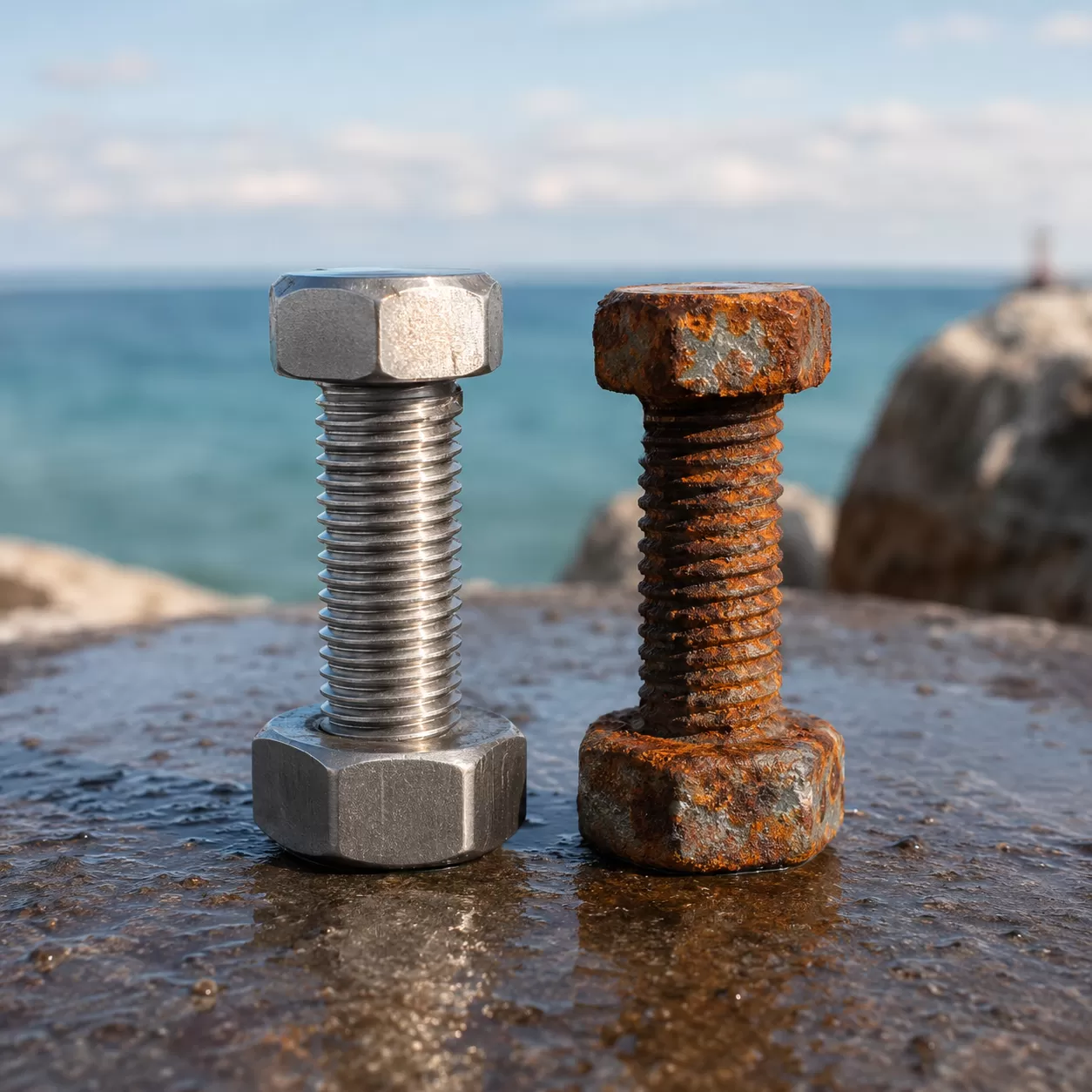
Environmental exposure can change the material decision even when a prototype passes static load testing. Moisture, salt, temperature, cleaning chemistry, and galvanic contact all matter.
Oxidation and Chemical Exposure
Titanium naturally forms a stable oxide layer and performs extremely well in many marine, chloride, biomedical, and chemical environments. It is not universally immune to every corrosive condition, but it is one of the strongest choices when corrosion risk is high.
Aluminum also forms an oxide layer, but raw aluminum can pit in saltwater, harsh chemicals, and galvanic couples. It is often protected with anodizing, conversion coating, powder coating, paint, or other surface treatment.
Prototype Protection Options
- Anodizing: Improves corrosion resistance and surface hardness for aluminum.
- Chromate conversion coating: Adds corrosion protection while preserving electrical conductivity better than many coatings.
- Powder coating: Creates a physical barrier for moisture and chemical exposure.
- Mechanical finishing: Improves appearance and prepares surfaces for coating or inspection. See HXCNC’s mechanical surface finishing.
Prototype Cost and Budget Reality

The cost gap between aluminum and titanium includes raw material, cutting speed, tool wear, fixture rigidity, coolant, cycle time, scrap risk, and inspection.
6061-T6 is widely available and economical for early prototypes.
Grade 5 needs lower speeds, rigid setups, and careful coolant.
Titanium traps heat near the cutting edge and increases tool demand.
Raw Material Pricing
Grade 5 titanium typically costs several times more than 6061-T6 aluminum, although actual pricing changes with stock form, certification, quantity, and market conditions. Aluminum is usually the default for budget-conscious form, fit, and moderate-load functional testing.
Total CNC Machining Cost
Aluminum supports high material-removal rates and predictable finishes. Titanium requires more conservative cutting parameters, sharp carbide tooling, rigid workholding, and careful heat control. HXCNC evaluates both material routes through precision CNC machining services to reduce unnecessary setup and cycle time.
ROI for High-Performance Prototypes
Titanium can justify its price when the prototype must survive extreme stress, high temperature, aggressive environments, or medical evaluation. If the goal is visual review, ergonomic testing, enclosure validation, or moderate mechanical testing, aluminum often delivers a faster and more economical proof of concept.
Machinability and Manufacturing Feasibility
Material machinability directly affects timeline, tolerance risk, and part cost.
CNC Machining Aluminum
Aluminum 6061-T6 is one of the most efficient prototype materials. It machines quickly, produces good surface finish, and supports complex geometries at reasonable cost. See HXCNC’s aluminum alloy CNC machining capabilities.
- Speed: High material-removal rates shorten lead time.
- Precision: Stable setups can hold tight prototype tolerances.
- Finish: Machined surfaces are often clean and ready for anodizing or coating.
CNC Machining Titanium
Ti-6Al-4V is more demanding. Its low thermal conductivity, high strength, and work-hardening tendency require controlled cutting conditions. HXCNC supports these requirements through titanium alloy CNC machining.
- Tool wear: Requires high-quality tooling and conservative cutting strategy.
- Heat control: Coolant delivery and chip evacuation are critical.
- Rigidity: Workholding and machine stiffness help prevent chatter.
Alternative Prototype Routes
- Metal additive manufacturing: Useful for complex titanium shapes that are difficult to mill.
- Investment casting: Useful if the prototype path will later move into casting volumes.
- Sheet metal fabrication: Cost-effective for brackets, covers, and enclosures.
- 5-axis machining: Useful for complex aerospace, impeller, and organic geometry. See HXCNC’s 5-axis CNC machining service.
Industry-Specific Decision Matrix
Choosing between titanium and aluminum for custom functional prototypes depends heavily on the industry and test objective.
Aerospace and Defense
Titanium is common for high-stress and higher-temperature components. Aluminum remains standard for brackets, housings, fixtures, UAV structures, and secondary structures where low mass and cost matter. Related capability: aerospace and UAV high-precision parts.
Automotive Engineering
Aluminum dominates cost-sensitive lightweight prototypes such as chassis brackets, housings, and EV enclosures. Titanium is reserved for racing, exhaust, heat-exposed, or high-performance prototypes. Related application: automotive and EV components.
Medical Devices
Titanium is widely used for implants and surgical applications because of its biocompatibility and corrosion resistance. Aluminum is more common for equipment frames, housings, and non-contact tooling. Related application: medical high-cleanliness precision parts.
Consumer Electronics
Aluminum is preferred for laptop shells, frames, heat spreaders, and anodized premium housings. Titanium appears in ruggedized or ultra-premium products where scratch resistance, strength, and market positioning justify cost. Related application: electronics and communication components.
Comparison Matrix: Titanium vs. Aluminum
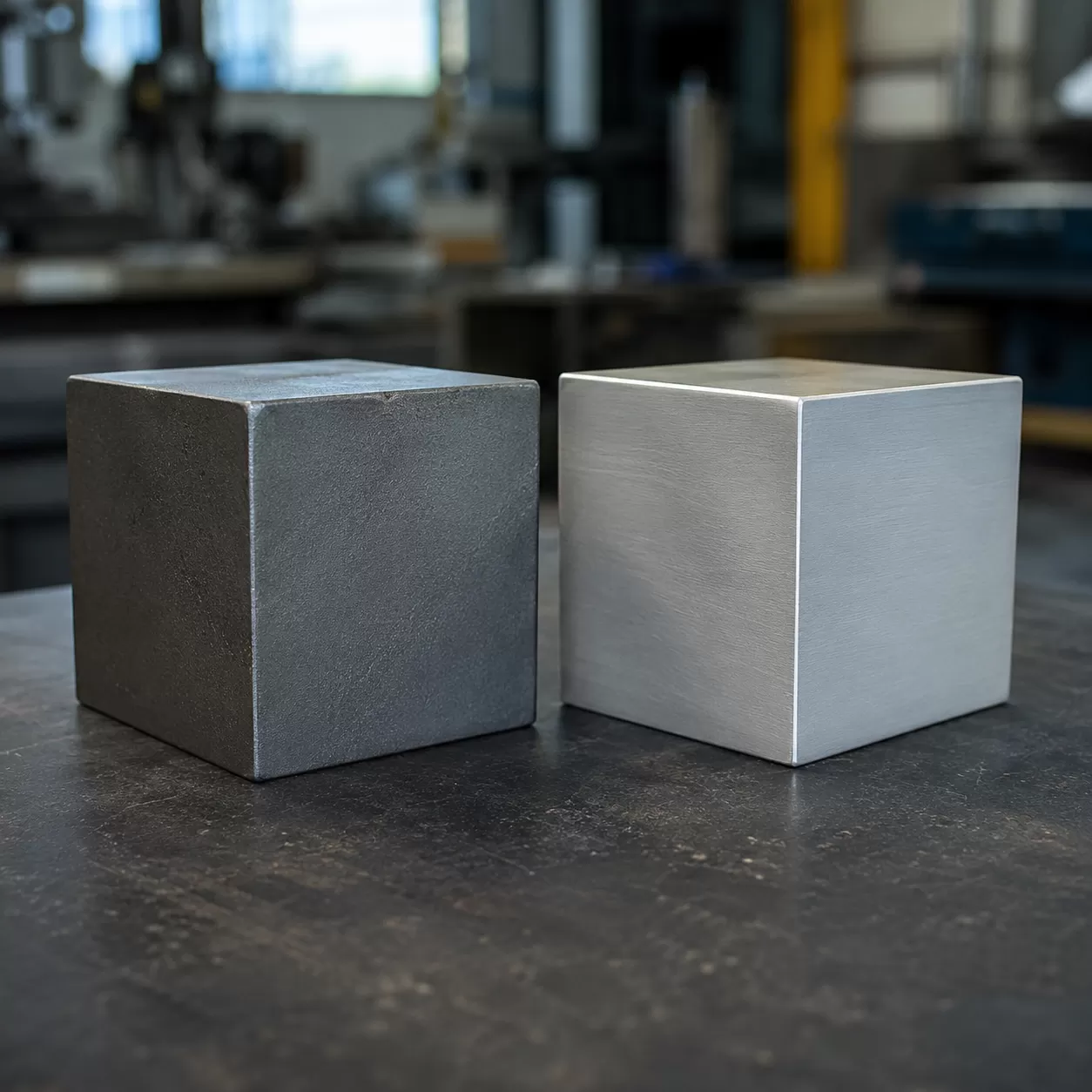
| Material Property | Aluminum 6061-T6 | Titanium Grade 5 (Ti-6Al-4V) |
|---|---|---|
| Density | 2.70 g/cm³ | 4.43 g/cm³ |
| Yield strength | About 276 MPa | About 880 MPa |
| Specific strength | Good | Excellent |
| Thermal conductivity | High, around 167 W/m·K | Low, around 6.7 W/m·K |
| Corrosion resistance | Good; excellent with appropriate finish | Outstanding in many harsh environments |
| Machinability | Excellent | Difficult |
| Relative prototype cost | Low to moderate | High |
For complex rotary or fluid parts, such as a closed impeller, the decision should account for both geometry and material behavior. Titanium may solve strength and temperature problems, while aluminum may solve cost, weight, and heat-transfer problems.
Fast Selection Checklist
- Choose aluminum for lowest weight by volume, lower cost, fast machining, heat dissipation, anodized appearance, and rapid iteration.
- Choose titanium for high stress, compact walls, high service temperature, excellent corrosion resistance, biocompatibility, and premium durability.
- Prototype both when the design is close to its strength, thermal, or cost limit and test data will decide the production route.
Frequently Asked Questions
Which metal has a better strength-to-weight ratio?
Grade 5 titanium usually has the stronger specific strength compared with 6061-T6 aluminum. Aluminum is lighter by volume, but titanium can carry much higher stress in a compact section.
When should I choose aluminum 6061-T6 over titanium?
Choose aluminum when cost, lead time, absolute weight, thermal conductivity, and easy surface finishing matter more than maximum strength or high-temperature performance.
Is titanium or aluminum easier to CNC machine?
Aluminum is much easier to machine. Titanium needs slower speeds, rigid workholding, careful coolant, and experienced process control to protect tools and maintain precision CNC milling tolerances.
Can both materials be used in aerospace prototypes?
Yes. Titanium is commonly used for high-stress and heat-exposed components. Aluminum is used for brackets, housings, secondary structures, UAV components, and rapid design iterations.