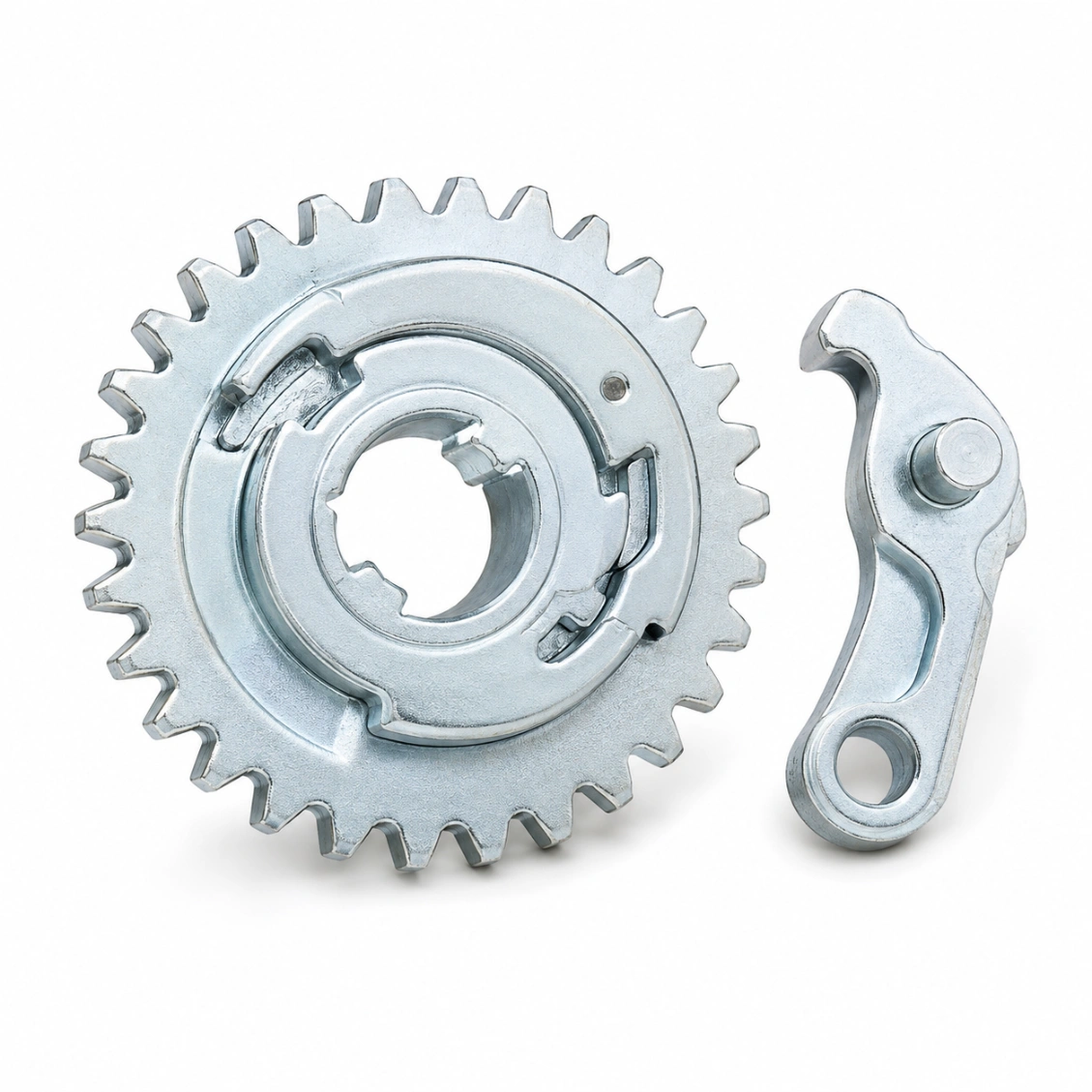
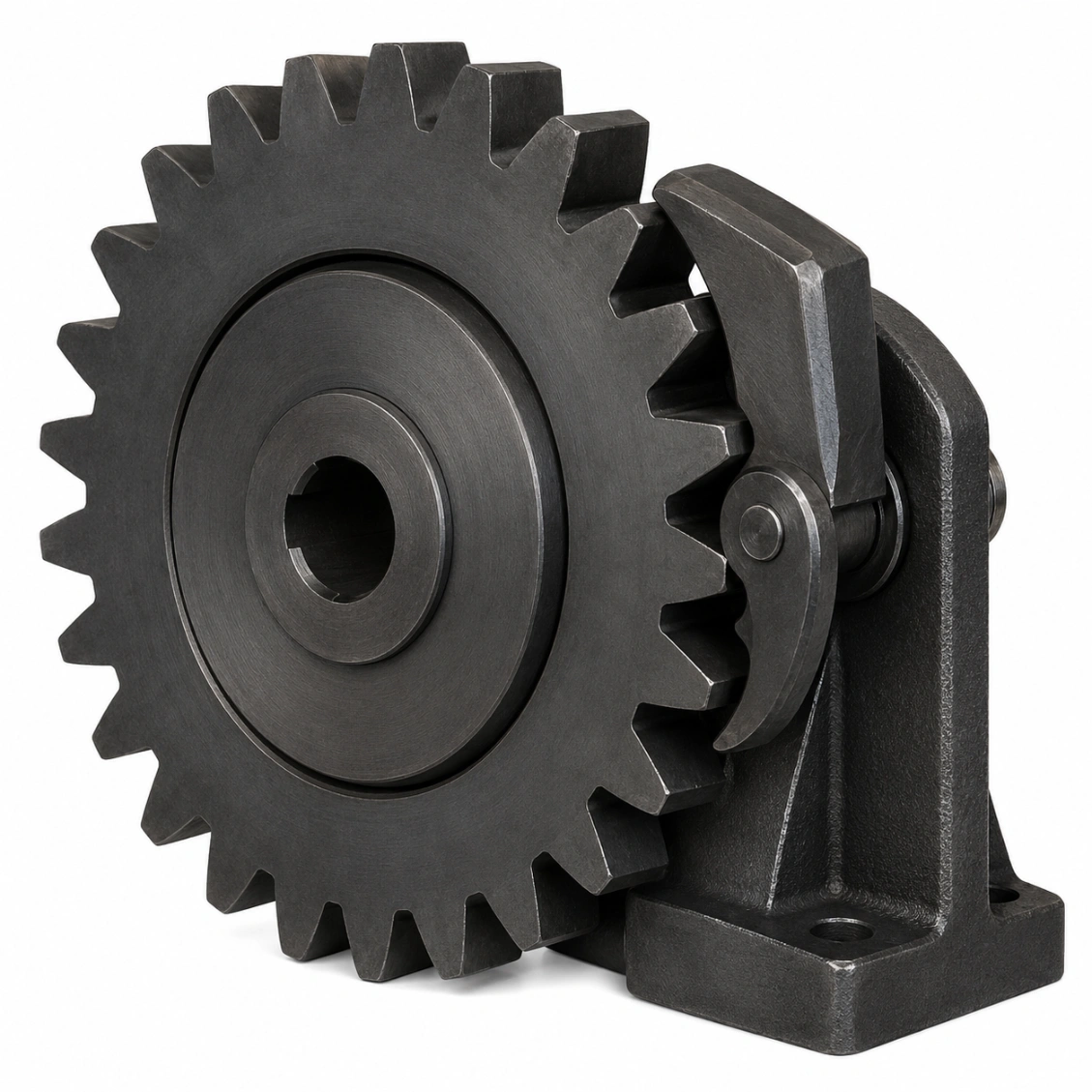
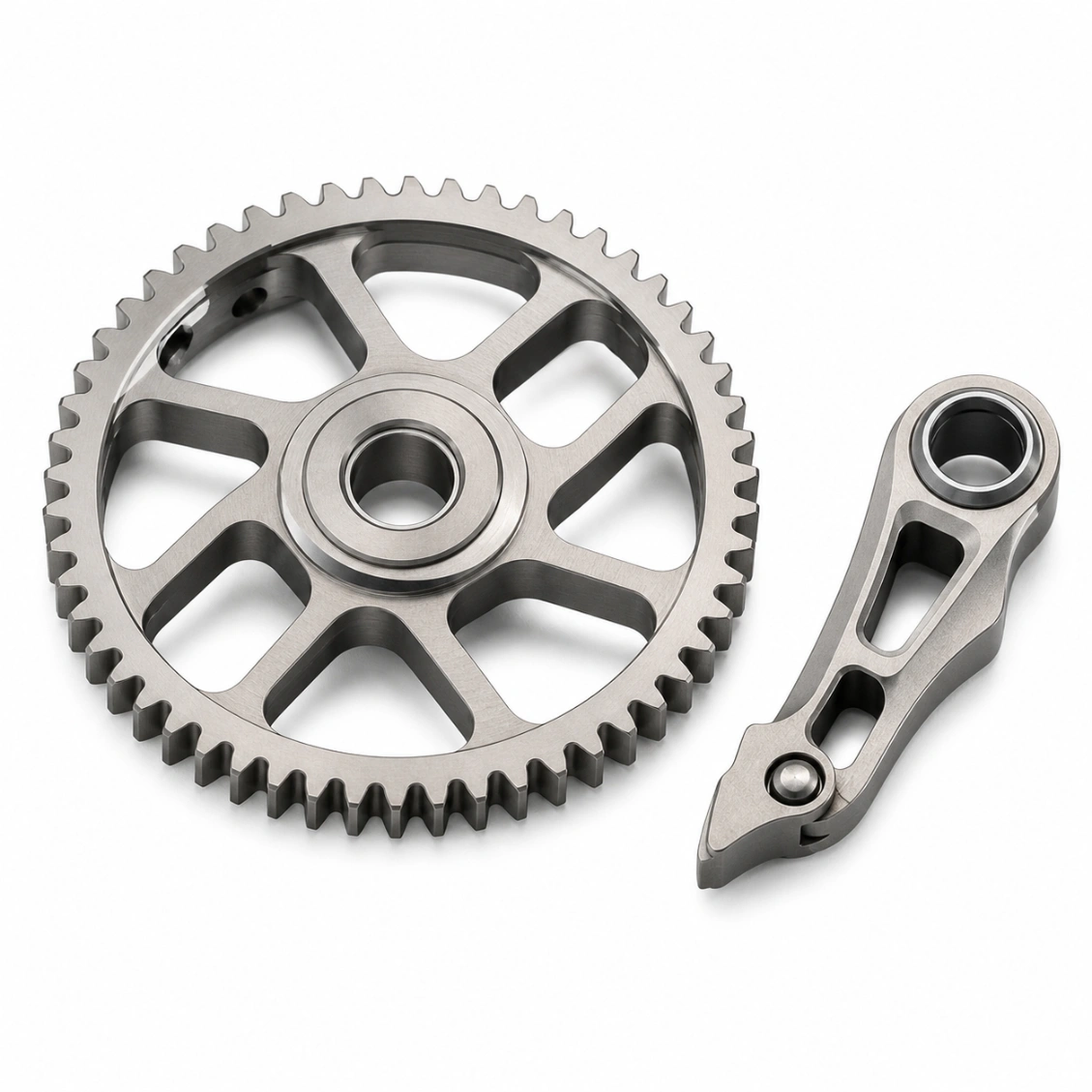
High-accuracy ratchet wheels, pawls, and complete assemblies for indexing, overrunning, and backstop
applications. Any pitch, any tooth count, any geometry — prototype to mass production, every part fully
CMM-inspected and 100% engagement-tested.
Four processes — from standard broached ratchet wheels to full sub-assembly integration with springs, pins,
and housings.
⚙️
Ratchet Wheel Milling
CNC tooth form
🔬
Broșare și formare
High-volume internal
🏭
Pawl CNC Turning
Pivot geometry
🔧
Complete Assembly
Spring + pin + housing
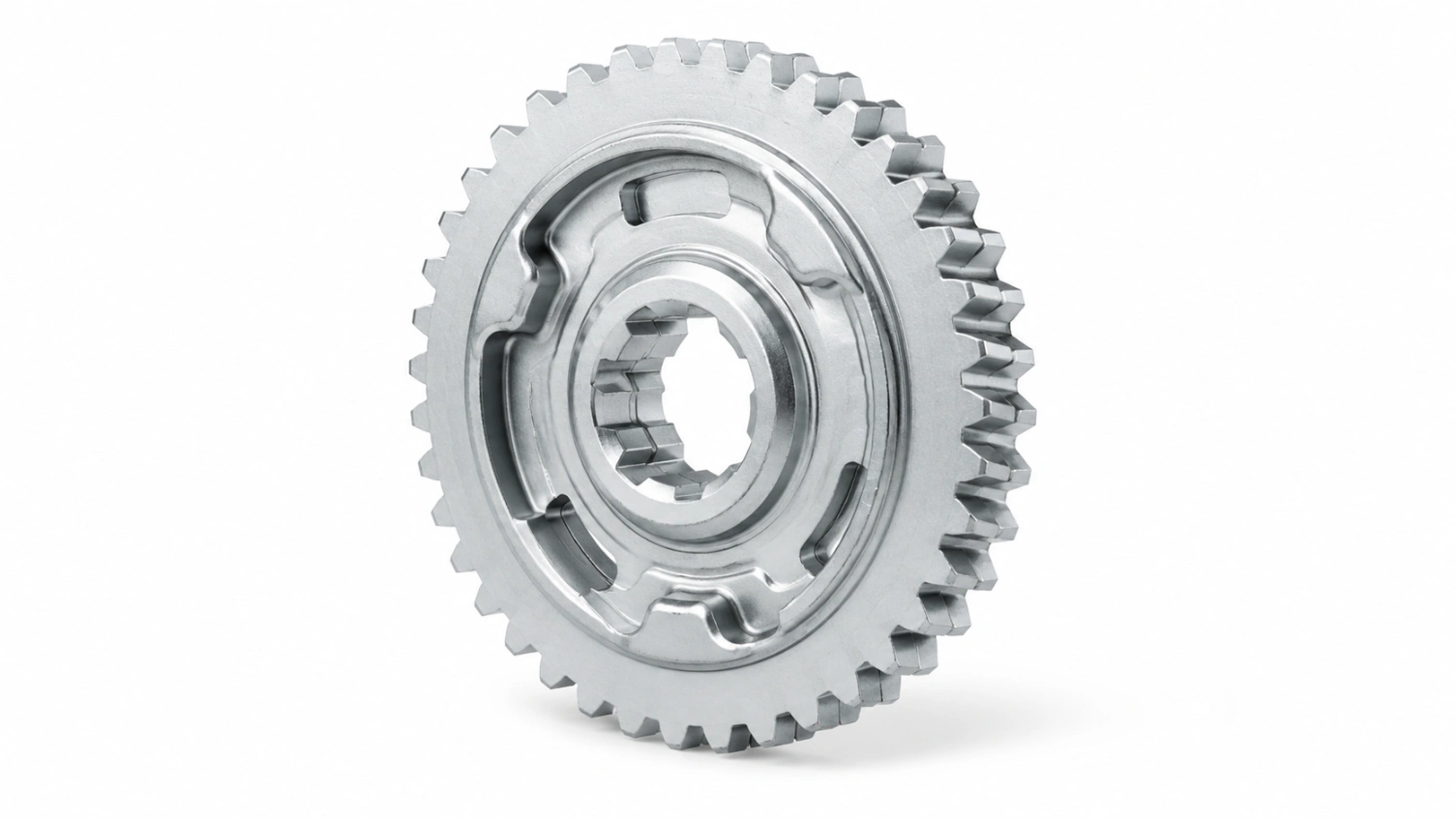
Ratchet Wheel CNC Milling
5-axis CNC milling generates any ratchet tooth profile — asymmetric saw-tooth, square, or custom — on
external or internal ratchet wheels. Ideal for custom pitches, large diameters, and prototypes.
Integrated bore, keyway, and mounting features machined in one setup.
OD range
8 – 800 mm
Tooth count
4 – 300
Pitch range
0.5 – 50 mm
Tooth form tol.
±0.010 mm
Tip
External · Internal · Face oricare
MOQ
1 buc
Timp de livrare
5 – 12 zile
Materiale
Toate metalele + plastice de inginerie
Broaching & Gear Shaping
Broaching delivers consistent internal ratchet profiles at high volume with excellent surface finish.
Gear shaping is used for internal ratchets and face ratchets where broaching is not feasible. Both
processes suit medium to large production runs with repeatable tooth geometry.
Internal ID range
12 – 300 mm
Tooth count
8 – 200
Tooth form tol.
±0,012 mm
Finisaj suprafață Ra
0.8 – 1.6 µm
Cantitate tipică
100 – 50,000 pcs
Timp de livrare
7 – 16 days
Materiale
Steel, Al, Brass, Cast Iron
Post-process
Heat treat · Plating · Grind
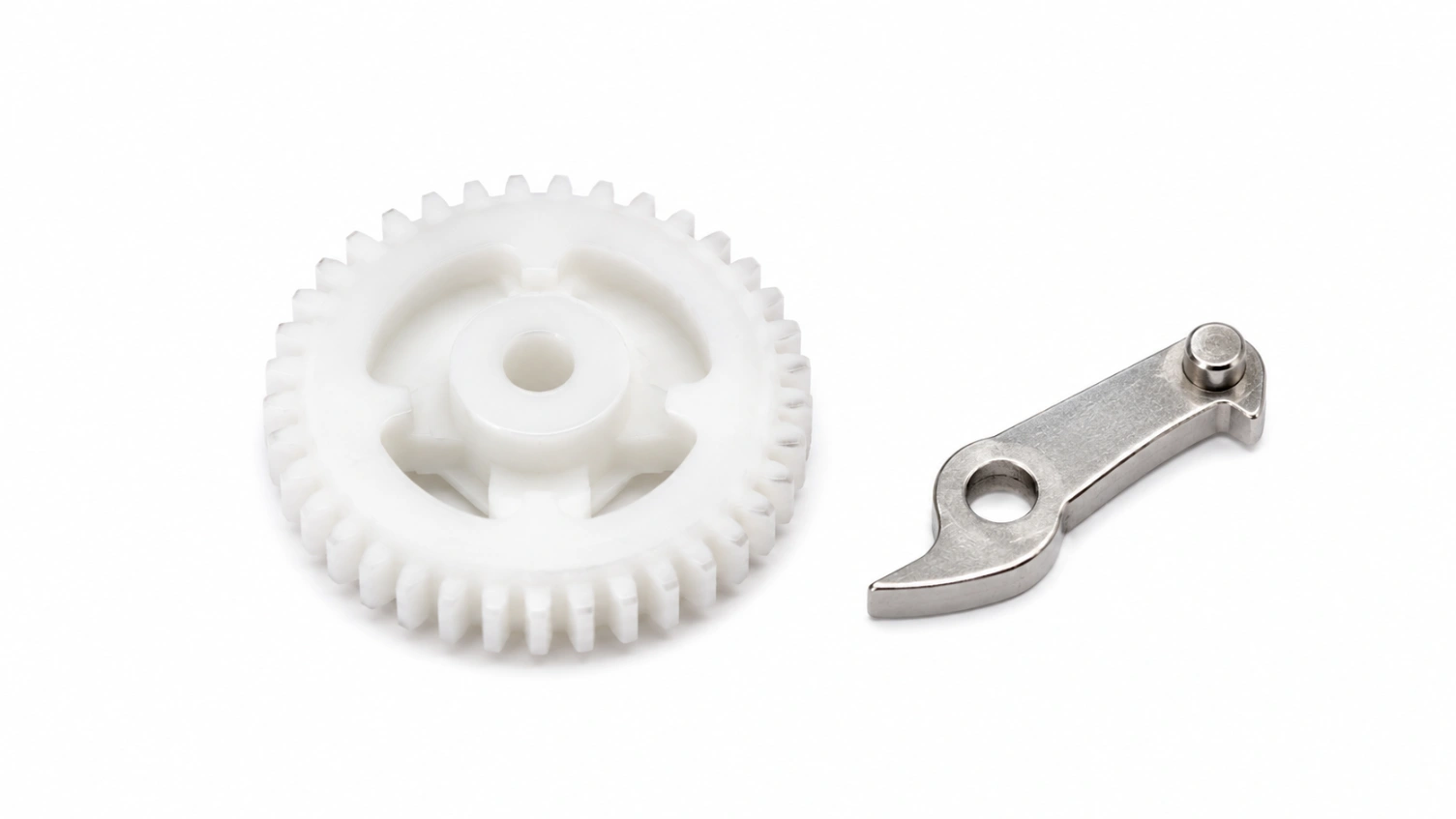
Pawl CNC Turning & Milling
Pawls are machined complete — pivot bore, engagement nose, spring recess, and any stop faces — in a
single 5-axis setup for maximum concentricity. Custom pawl geometry, including dual-pawl and
spring-loaded integral designs, are fully supported.
Pivot bore dia.
2 – 50 mm
Overall length
5 – 250 mm
Nose form tol.
±0.010 mm
Spring pocket
Yes — any geometry
Dual-pawl design
Yes — supported
MOQ
1 buc
Timp de livrare
5 – 10 zile
Materiale
Steel, Stainless, Al, POM, PEEK
Complete Sub-Assembly
HXC supplies fully assembled and tested pawl-and-ratchet units — ratchet wheel, pawl, pivot pin, return
spring, and housing or carrier bracket — ready to drop into your product. Each assembly is
engagement-tested before shipment.
Domeniu
Wheel + pawl + spring + pin
Housing options
Aluminium · Steel · Plastic
Spring type
Torsion · Compression · Leaf
Engagement test
Yes — 100% cycled
Cycle test qty
Up to 1,000 cycles QC sample
Timp de livrare
10 – 18 zile
MOQ
1 set
Drawing format
Assembly DXF / STEP accepted
Materiale
Peste 50 de materiale certificate
Full mill certificates and spectral analysis on every batch. Ratchet wheel and pawl materials selected
together for optimal engagement life.
Metale
Plastice de inginerie
Oțel inoxidabil SUS316L
Passivated for marine, food-processing, and medical environments. Excellent corrosion resistance.
MarineCalitate alimentară
Oțel aliat 42CrMo4
Through-hardened to HRC 48–55. Industry standard for high-load ratchet wheels in lifting and industrial drives.
Greutate mareDurificatLifting
Al 6061-T6
Lightweight, anodizable. Aerospace indexing mechanisms and robotics applications.
UșorAerospațial
Alama C36000
Free-machining, low-noise. Fine-pitch ratchets for instruments, clocks, and optical equipment.
Every pawl and ratchet assembly passes a 4-stage inspection protocol — including 100% functional engagement
testing — before leaving our facility.
Certificări și Echipamente
✓
ISO 9001:2015
Sistem de Management al Calității — toate procesele certificate
📐
DIN / Customer Standards
Tooth form, pitch, and runout to drawing tolerance; IATF 16949 PPAP on request
🔭
Zeiss CMM + Optical CMM
3D coordinate measurement and optical profile scanning for tooth form verification
📄
Certificare completă a materialului
Mill cert + spectral analysis on every batch; third-party certs available on request
Protocol de inspecție în 4 etape
1
Verificare material intrare
Spectral analyzer confirms alloy grade for ratchet wheel and pawl blanks before any machining.
2
Inspecție pentru primul articol
Full CMM measurement of the first ratchet wheel — tooth form, pitch, OD, bore, and runout confirmed before batch production.
3
In-Process Tooth Form Check
Optical profile scanning at defined intervals during production verifies tooth angle, root radius, and pitch consistency.
4
100% Functional Engagement Test
Every assembled set is cycled through its engagement direction to confirm positive pawl lock and free back-travel before shipment.
Recenzii
De încredere pentru ingineri din întreaga lume
★★★★★
"800 winch ratchet sets — hardened, black-oxide, 100% engagement-tested. Every single set passed our incoming inspection first time. CE documentation was complete and saved us weeks. Exactly what a supplier should be."
DH
Dirk H.
Product Engineer · Germany
★★★★★
"10,000 seat-belt retractor ratchet wheels on a tight automotive schedule. HXC hit every dimension, submitted PPAP on time, and had zero NCRs through our entire IATF audit. They are now our preferred supplier for precision stampings and ratchets."
MO
Maria O.
Supplier Quality Engineer · Spain
★★★★★
"Silent POM ratchet assemblies for our infusion pump — noise below 38 dB was a hard requirement. HXC nailed the geometry on the first prototype, provided FDA material certs, and scaled to production in 10 days. Outstanding."
KW
Kevin W.
Mechanical Design Engineer · USA
Întrebări frecvente
Întrebări frecvente
Everything engineers and buyers ask about pawl and ratchet assemblies — answered by our manufacturing team.
A pawl and ratchet is a mechanical assembly that permits rotation in one direction while preventing rotation in the other. The ratchet wheel is a toothed disc with asymmetric — usually saw-tooth — teeth. The pawl is a pivoting lever or pin whose nose engages between ratchet teeth. When the wheel turns in the permitted direction, the pawl nose rides over the sloping tooth faces. When the wheel attempts to turn in the blocked direction, the pawl nose locks into the steep tooth face and prevents motion. Together they are one of the oldest and most reliable one-way mechanical elements.
Unghiul de ratchet is the toothed wheel (or rack or ring). It is the driven or held element with the asymmetric teeth that determine the angular resolution and load capacity of the assembly. The pawl is the engaging element — the pivoting arm, lever, or pin that interfaces with the ratchet teeth to either allow or prevent motion. They always work together; neither functions without the other. In common usage "ratchet" often refers to the whole assembly, but in precision engineering the two parts are specified and manufactured separately.
The main types are: external ratchet — teeth on the outer circumference; the most common type in winches, hand tools, and drives; internal ratchet — teeth on the inner bore; used in freewheel hubs and compact mechanisms; face (end) ratchet — teeth on the end face of a disc; used where axial rather than radial engagement is needed; linear (rack) ratchet — a toothed bar with a pawl for linear one-way motion; and roller ratchet (sprag clutch) — uses rollers or sprags rather than a discrete pawl, giving silent engagement and any angular resolution. HXC manufactures all of these types.
An indexing ratchet is designed to advance a mechanism by a precise, repeatable angular step — one tooth per actuation stroke. Each tooth represents a fixed angular increment: a 36-tooth ratchet indexes 10° per step, a 72-tooth ratchet indexes 5°. Indexing ratchets are used in rotary indexing tables, feed mechanisms, counting mechanisms, escapements, and any application where a shaft must be advanced by exact increments. Angular resolution is determined solely by tooth count — the more teeth, the finer the step. Fine-pitch indexing ratchets with up to 300 teeth are used in precision instruments.
A backstop ratchet is a ratchet-and-pawl assembly where the pawl is fixed to the housing (not moving), and its sole function is to prevent reverse rotation of a loaded shaft. Unlike an indexing ratchet, it does not advance the shaft — it simply holds position. Backstop ratchets are used on incline conveyors (preventing belt run-back on power loss), winches and hoists (holding suspended loads), and valve actuators (preventing back-drive from line pressure). They are designed for high static holding loads and are typically specified with a safety factor of 3–5× the operating torque.
An overrunning ratchet allows the driven shaft to run faster than the driving shaft without transmitting reverse torque — the classic freewheel or one-way clutch function. The bicycle rear hub is the most familiar example: pedalling drives the wheel, but the wheel can coast without back-driving the pedals. In industrial applications, overrunning ratchets are used in backstop clutches, engine starters, conveyor overrunning drives, and dual-motor arrangements where one motor must override another without locking both. Fine-tooth overrunning ratchets give finer engagement and smoother coasting than coarse-tooth designs.
The most common profile is the asymmetric saw-tooth: a near-radial (or slightly undercut) locking face and a gradual sloping drive face. The locking-face angle is typically 0–15° from radial — steeper faces give more positive lock and resist pawl jump-out under shock loads; shallower faces require less pawl spring force for engagement. For high-load or safety-critical applications, a slight negative rake (undercut) on the locking face gives a self-clamping action. For bi-directional selectable ratchets, symmetric or near-symmetric teeth are used. Square teeth are used for face ratchets. HXC can machine any profile to your drawing.
Holding torque capacity is primarily determined by: tooth bending strength (material, module/pitch, and face width); number of pawls in simultaneous engagement (multiple pawls multiply load capacity); and tooth face geometry (undercut vs. radial locking face). The simplified formula for a single pawl is: T = F × r, where F is the tooth face force and r is the pitch radius. Tooth face force F ≤ σ_allowable × b × m², where b is face width and m is module. For safety-critical lifting applications, apply a safety factor of ≥ 3 to the calculated capacity. HXC engineers can review your load case and recommend module, tooth count, and material for your required torque.
Ratchet skip (pawl jump-out) occurs when the pawl rides over the locking face instead of engaging. The main causes are: insufficient pawl spring force — the spring must hold the pawl nose against the tooth root at all operating speeds; too-shallow locking face angle — angles below 5° from radial are prone to skip under shock loads; excessive operating speed — at high RPM centrifugal force can pull the pawl away from the wheel; worn or rounded tooth faces — work-hardened or worn locking faces reduce engagement; and misalignment — the pawl pivot axis must be parallel to the ratchet wheel axis. Adding a second pawl offset by half a tooth pitch increases load capacity and eliminates one-tooth skip.
Unlike gear backlash, ratchet "backlash" is the free angular travel before the pawl engages the next tooth — equal to one full tooth pitch. A 36-tooth ratchet wheel has 10° of free travel before the pawl locks; a 72-tooth wheel has 5°. This is inherent to the design and is why fine-tooth ratchets are used where minimal lost motion is important. To approach zero backlash in a ratchet-style mechanism, designers use dual offset pawls (halving the free angle), multiple engagement points, or switch to a sprag clutch or roller ratchet which has truly zero engagement backlash. For precision indexing, this free angle is the primary resolution limit.
A dual-pawl ratchet has two pawls angularly offset by half a tooth pitch (180° / tooth count). The benefits are: doubled load capacity — both pawls share the holding load equally; halved free-angle backlash — while one pawl is between teeth, the other is already at the tooth root; and redundancy — if one pawl spring fails, the other holds. Dual-pawl designs are standard in safety-critical lifting applications (CE Machinery Directive), high-cycle automotive components, and any ratchet where reduced lost motion matters. HXC can machine and assemble dual-pawl units to your drawing.
Three spring types are common: torsion spring — a coil spring that wraps around the pawl pivot pin, the most compact and reliable choice for most applications; compression spring in a blind pocket — pushes the pawl nose radially into the wheel, easy to service and replace; and leaf spring — a flat spring integrated into the housing, used in thin-profile mechanisms like bicycle freewheels and instrument ratchets. Key design criteria: the spring force must overcome the centrifugal force on the pawl at maximum operating speed plus provide reliable engagement force at the tooth root. Stainless steel springs are required for marine, food-grade, and medical applications.
In lifting equipment, ratchets serve as load-holding backstops. When a hand winch, come-along, or manual hoist is operated, the ratchet wheel is attached to the drum or drive shaft. When the operator pauses or releases the handle, the pawl engages the ratchet teeth and prevents the load from running back. This allows lifting in incremental steps without holding the handle under load. For CE-marked lifting equipment, the ratchet assembly must be rated for a minimum safety factor of 4:1 on static holding load and must pass a proof-load test. HXC can supply the relevant material certificates and dimensional reports required for CE marking.
For lifting and load-holding ratchets the priority is toughness and resistance to brittle fracture under impact loads, not just hardness. The standard choice is 42CrMo4 through-hardened to HRC 48–55 — it combines high yield strength with good notch toughness and is widely accepted in CE-marked lifting gear. For very high-cycle applications (automotive retractors), case-hardened 20CrMnTi gives a harder tooth surface with a ductile core. Avoid through-hardening to above HRC 58 in lifting ratchets — while the hardness is higher, the material becomes brittle and susceptible to sudden fracture under shock loading. HXC engineers will advise the correct hardness range for your load case.
A tie-down ratchet is a hand-operated linear ratchet mechanism used to tension a webbing strap around a load for transport. The ratchet axle winds in the webbing as the handle is pumped; the pawl prevents the strap from slackening when the handle is released. Tie-down ratchet bodies and axles are typically pressed steel or die-cast zinc for consumer grades, or machined steel for heavy-duty cargo applications. HXC manufactures the precision-machined components used in heavy cargo tie-down systems — ratchet axles, pawl carriers, and pivot pins to EN 12195-2 working load requirements — for clients supplying the transport and logistics sectors.
Yes. A reversible ratchet uses one of several mechanisms to allow the operator to select the permitted direction: a flip pawl that can be physically turned 180° to engage the opposite tooth face; a sliding pawl selector that moves between two pawls — one for each direction; or a dual-sided ratchet wheel with different tooth geometries on each face. The most familiar example is the reversible ratchet spanner. HXC machines all these variants including the selector mechanisms, detent balls, and flip levers. For bi-directional neutral locking (locked in both directions), two opposing pawls can be engaged simultaneously.
Provide as many of these as possible: ratchet wheel OD and bore, tooth count and pitch (or module), tooth profile (saw-tooth angle, undercut or not), face width, engagement direction (CW or CCW), material and hardness, pawl geometry (pivot bore dia., nose radius, spring type), assembly scope (wheel only / pawl only / complete assembly with spring and pin), finisaj suprafață, și quantity. A sketch, CAD file (STEP/DXF), or even a photo of an existing part is enough to start. For holding torque requirements, provide your maximum load torque and required safety factor — we will back-calculate the geometry.
Solicită o ofertă
Trimite-ți desenul. Obține o ofertă.
Fiecare solicitare include o revizuire DFM — fezabilitatea toleranței, confirmarea materialului și abordarea procesului înainte de începerea producției. MOQ 1 piesă.
24hr
Răspuns la ofertă
MOQ 1
Prototipuri OK
ISO
9001:2015
📐
Revizuire DFM pentru fiecare solicitare
Fezabilitatea toleranței, strategia de fixare și confirmarea materialului. Feedback specific și acționabil — nu respingeri generice.
🎯
Inspecția primului articol — Standard
Raport FAI pentru fiecare lot nou. Certificări de material și tratament de suprafață incluse cu fiecare livrare.
🔄
Același proces: prototipare până în producție
Planul de proces din prototipul dumneavoastră se aplică loturilor de producție. Fără re-qualificare atunci când scalați.
⚙
Frezare CNC 3 / 4 / 5-Axis + Strunjire
Piese structurale complexe, arbori, carcase și componente de transmisie. Metale și plastice de inginerie.
ISO 9001:2015Frezare 3/4/5-AxisFrezare în strung CNCInspecție CMMLivrare globală